Adherents call the Moon a hollow craft that rang like a bell; Apollo seismic and GRAIL records print a layered interior. The hypothesis was put in print in 1970 by Mikhail Vasin and Alexander Shcherbakov in the Soviet magazine Sputnik, and adherent pages still reprint it. They cite crater depths, density, gravity patches near the lunar seas, and the long seismic signal recorded when an Apollo 12 module struck the surface. NASA's preliminary report on that signal, a later study of Apollo moonquake records, and two GRAIL mission papers print what those instruments measured. The six doors below are set side by side, adherent pages first.
The 1970 Sputnik article
An Anomalien page dated 23 September 2021 reprints "Is the Moon the Creation of Alien Intelligence?", which it describes as a paper by Vasin and Shcherbakov in the Soviet journal Sputnik. The authors state their hypothesis: "The Moon is an artificial Earth satellite put into orbit around the Earth by some intelligent beings unknown to ourselves." They write that a launched sputnik would be made hollow, and they propose a double-layered shell, a dense armouring of about 20 miles under a looser covering of about three, around a core with a gap of about 30 miles between them. They say such a structure would give the Moon its specific gravity of 3.3 grams per cubic centimetre against Earth's 5.5. They argue that large craters are all about 1.2 to 2 miles deep because impacts stop at the armour, that chromium, titanium and zirconium in lunar rock suit a protective hull, and that gravity variations near the large seas mark repair machinery beneath. They close by saying the evidence is so far only circumstantial and that direct evidence must be awaited, "or refute it."
Sputnik article, as reprinted by Anomalien: https://anomalien.com/russian-scientists-in-the-70s-is-the-moon-the-creation-of-alien-intelligence/
An adherent page on the ringing
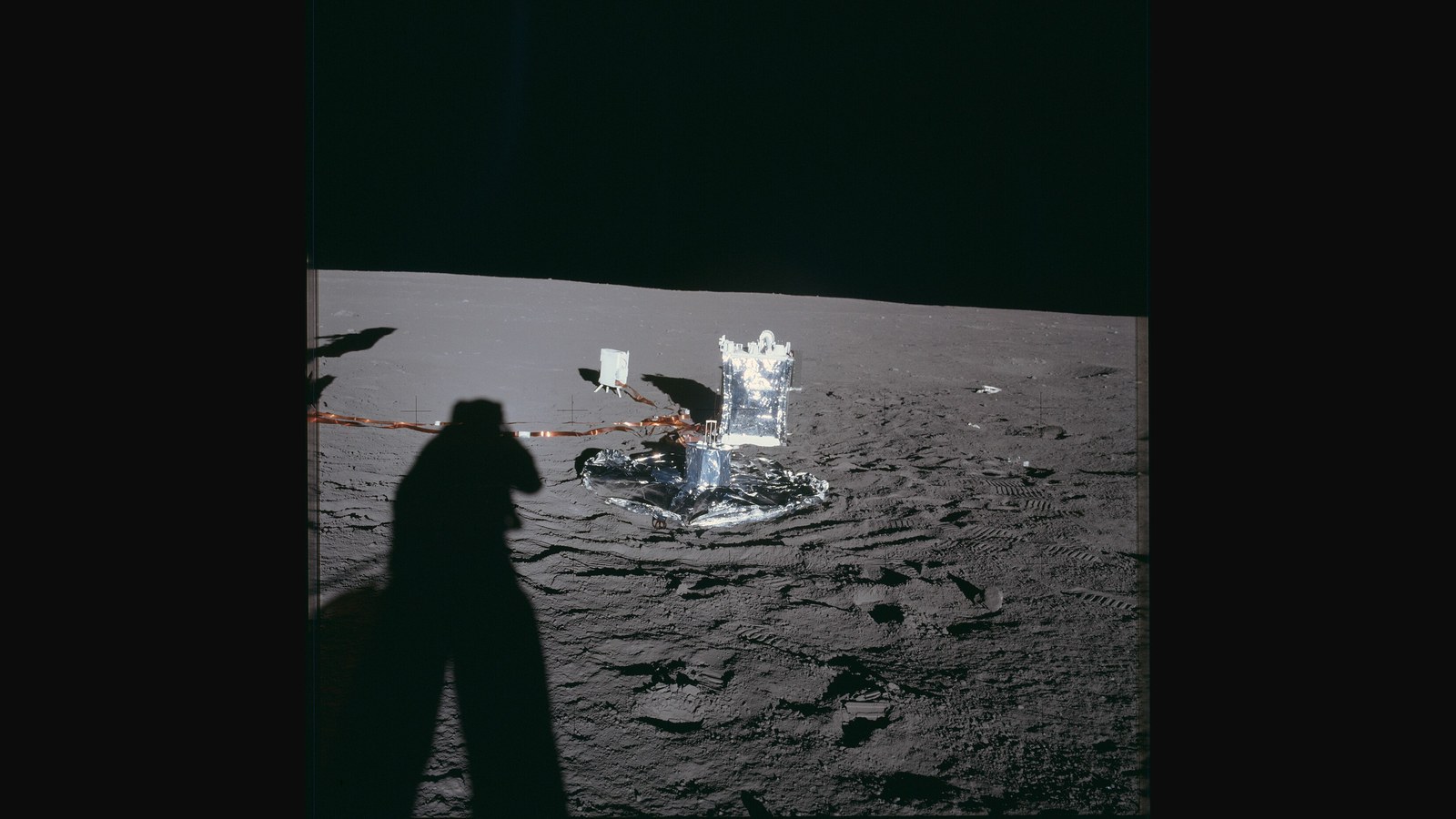
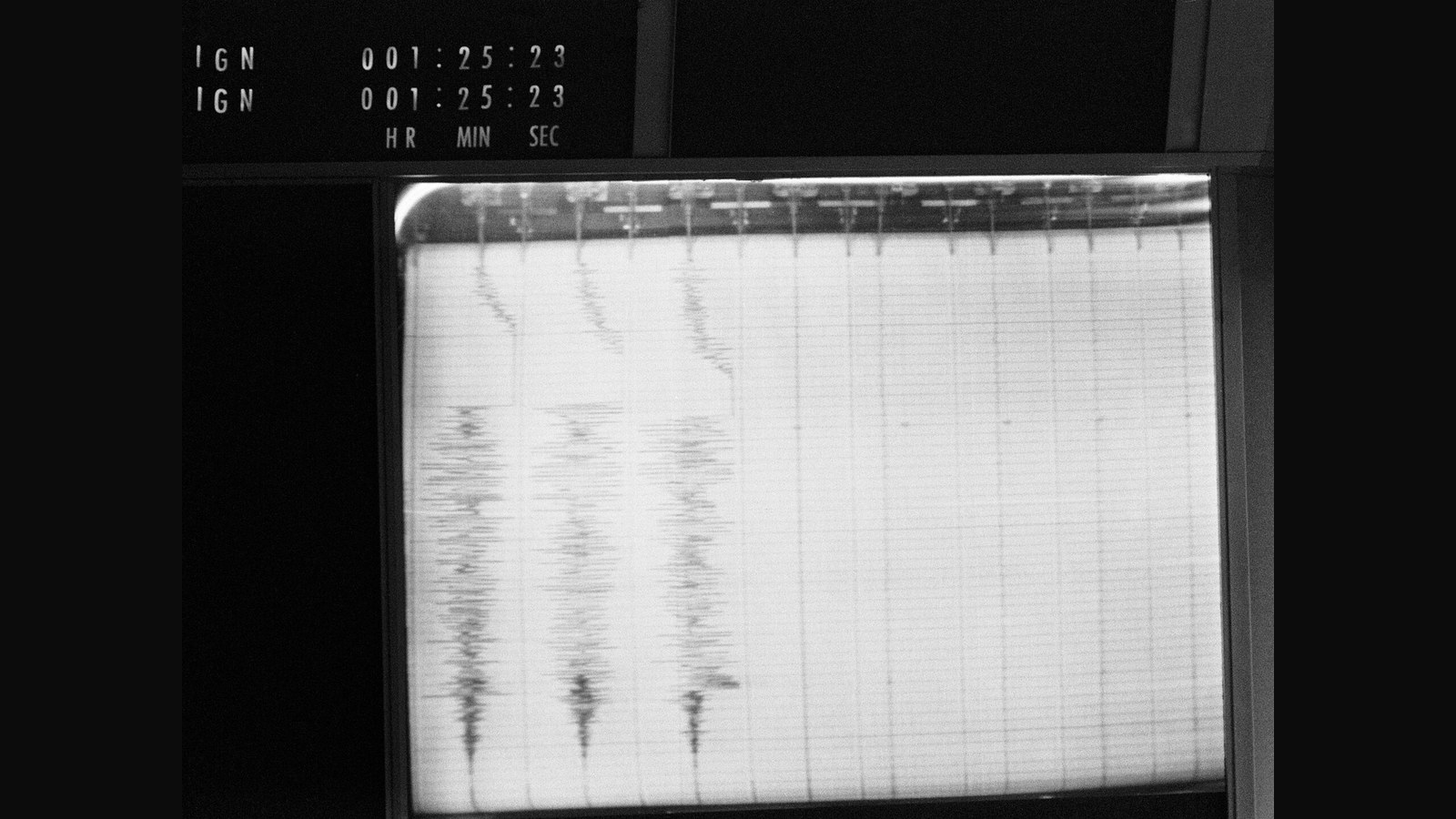
A second Anomalien article, dated 11 March 2021, says some of the claims come from the fact that when meteors strike the Moon "it rings like a bell." It says that on 20 November 1969 an Apollo crew released the lunar module, and its impact made their seismic equipment register a continuous reverberation for more than an hour. It says astronomy data indicate the Moon's inner regions are less dense than its outer ones, and that all craters have the same depth, which it says suggests a metallic barrier under the surface. It credits Vasin and Shcherbakov with the theory in July 1970.
Anomalien, 11 March 2021: https://anomalien.com/spaceship-moon-theory-is-the-moon-an-artificial-alien-satellite/
What the Apollo 12 seismometer recorded
The Apollo 12 Preliminary Science Report, NASA SP-235, says the passive seismic experiment was meant to detect vibrations and so determine the internal structure and physical state of the Moon. It says the lunar module ascent stage struck 75.9 kilometres from the instruments, that the signal built up over about seven minutes to 10 nanometres peak to peak, and that its total duration was approximately 55 minutes. Because of the likeness, it says other prolonged signals are thought to come from meteoroid impacts or shallow moonquakes, mostly within 100 kilometres. It says such prolonged signals may imply very low attenuation together with intense wave scattering, conditions mutually exclusive on Earth, and that a medium with high Q and high scattering is unlike anything within the Earth; cold blocks in welded contact might behave this way. It also offers a near-surface waveguide, with wave speed of about 100 metres per second in the regolith rising to about 6 kilometres per second at 15 to 20 kilometres depth, and says work was continuing on which mechanism matters more.
Apollo 12 Preliminary Science Report: https://ntrs.nasa.gov/api/citations/19700025955/downloads/19700025955.pdf
A core in the old records
A 2011 presentation by Renee C. Weber and colleagues, "Seismic detection of the layers of the lunar core," says four Apollo seismic stations, from Apollo 12, 14, 15 and 16, operated until 1977 and recorded impacts and shallow and deep moonquakes. Stacking records from deep moonquake clusters, it places a partial-melt boundary at 480 kilometres, a core-mantle boundary at 330 kilometres, and an inner-core boundary at 240 kilometres. It reads the outer core as consistent with liquid iron alloy and the core as about 40 percent solid. It also warns that the layer depths are not constrained, since each depth trades off against the velocity above it.
Weber and others, 2011: https://ntrs.nasa.gov/api/citations/20110007235/downloads/20110007235.pdf
The GRAIL gravity mission
A 2012 status abstract by Gregory A. Neumann and the GRAIL science team says the twin spacecraft launched on 10 September 2011, entered lunar orbit on 31 December 2011 and 1 January 2012, and mapped gravity from 55-kilometre polar orbits until 29 May 2012. It says the field improves on all earlier models by two orders of magnitude on the nearside and nearly three on the farside, and that it is being used to study the thickness, density and porosity of the crust, the impact basins, and the mantle and core.
GRAIL status abstract, 2012: https://ntrs.nasa.gov/api/citations/20120016928/downloads/20120016928.pdf
Interior properties from GRAIL
A 2013 abstract by James G. Williams and the GRAIL team, "Preliminary results on lunar interior properties from the GRAIL mission," reports a gravity field of degree 420 from the primary mission, with 13-kilometre resolution, and at least 660 with the extended mission. It gives the Moon's mean density as 3345.6 plus or minus 0.4 kilograms per cubic metre. It says lunar structure includes a thin crust, a deep mantle, a fluid core and a suspected solid inner core, and that GRAIL will search for evidence of a solid inner core.
Williams and others, 2013: https://ntrs.nasa.gov/api/citations/20130013614/downloads/20130013614.pdf
Beside the hypothesis
The Sputnik authors offered a hollow shell, uniform crater depths, and gravity patches as signs of a built craft, and called their evidence circumstantial. The adherent page adds the hour-long ringing. The Apollo 12 report records a signal of about 55 minutes and explains it by low attenuation and scattering, or by a near-surface waveguide, without naming a hollow interior. The 2011 study reads layered core boundaries from Apollo records, with stated limits. GRAIL's papers print a mean density near the 3.3 the authors cited, and a structure of crust, mantle and core. Each door prints its own measure.