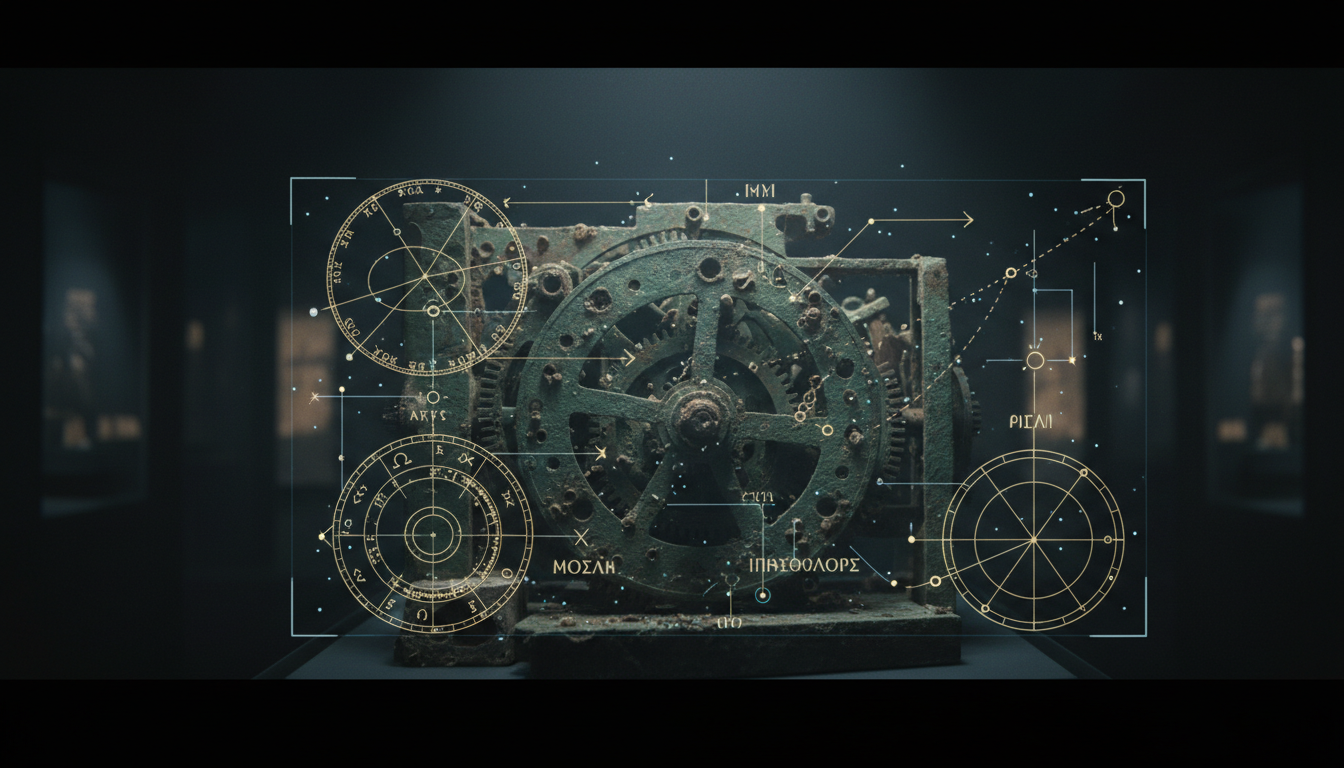
The Antikythera Eclipse Computer: The 2,000-Year-Old Machine That Predicted the Future
For over a century after its discovery in a shipwreck in 1901, mainstream history tried to downplay the Antikythera Mechanism. Standard textbooks routinely dismissed the heavily corroded bronze artifact as a basic, glorified mechanical calendar—a neat but primitive novelty crafted by ancient Greeks who surely lacked any true understanding of advanced computing or precision engineering.
The academic establishment held firm to the timeline that complex, multi-geared analog computers were a strictly modern invention, arriving safely during the Enlightenment and the Industrial Revolution.
Then, modern radiological science stepped in, and the paradigm completely shattered.
Unlocking the Microscopic Inscriptions
In the 2000s, an international team of scientists used cutting-edge, high-resolution X-ray Computed Tomography (CT) to look deep inside the fragmented, calcified lump of bronze. What they found stunned the world of physics. Hidden beneath the corrosion, etched directly onto the brass plates and the gear teeth themselves, were thousands of characters of tiny, microscopic Greek text.
When linguists and physicists translated these hidden inscriptions, they realized they weren't looking at basic assembly instructions. They were looking at an operating manual for a mind-bogglingly complex mathematical dial positioned on the back of the device.
The Saros Dial: Calculating the Cosmic Shadow
The text revealed that the machine operated on a highly sophisticated astronomical framework known as the Saros Cycle—a repeating geometric pattern spanning roughly 18 years, 11 days, and 8 hours, which dictates when the Sun, Earth, and Moon return to the exact same relative positions.
The Antikythera Mechanism wasn't just telling the user what day it was; it was actively running calculations to predict future solar and lunar eclipses with terrifying precision:
- The Direction of the Shadow: By turning the front crank, the gears turned a pointer on the back Saros dial. The inscriptions showed that the device calculated the exact trajectory and direction that an eclipse shadow would sweep across the Earth.
- The Precise Hour: The dial was divided into 223 months, each etched with specific glyphs (characteristics called Characteristics) that told the user the exact hour of the day or night the celestial alignment would occur.
- The Color of the Apocalypse: Most incredibly, the text proved the computer calculated physical characteristics of the eclipse, including the specific wind directions at the time and the exact color—whether a deep crimson "blood moon" or a dark obsidian solar ring—the celestial body would turn during the event.
[ Front Crank Turn ]     ---> [ 30+ Interlocking Bronze Gears ]
                                      |
                                      v
          [ Saros Dial Output: Predicts Next 18 Years of Eclipses ]
          • Matches exact hour  • Projects shadow angle  • Decodes eclipse color
A 1,500-Year Technological Dark Age
To pull off these calculations mechanically, the machine utilized a groundbreaking pin-and-slot variable speed gear mechanism. This allowed the pointer to mimic the Moon's irregular movement through the sky (what we now know as Kepler's Second Law of elliptical orbits), accelerating and slowing down exactly as the Moon does in real life.
The realization was a devastating blow to the standard historical timeline. The Antikythera Mechanism represents a level of predictive, precision engineering that humanity would completely lose to a dark age, not replicating its mechanical complexity again until Europe's late Industrial Revolution over 1,500 years later. It stands as definitive proof that ancient human technology didn't move in a slow, upward line—it achieved a staggering peak of computational genius that was entirely lost to history.
References
- The Core X-Ray CT Scan Breakthrough: Freeth, T., Bitsakis, Y., Moussas, X., et al. (2006). Decoding the ancient Greek astronomical calculator known as the Antikythera Mechanism. Nature, 444(7119), 587-591. Nature Journal Archive
- Decoding the Inscriptions and the Saros Dial: Freeth, T., Jones, A., Steele, J. M., & Bitsakis, Y. (2008). Calendars and predictions on the Antikythera Mechanism. Nature, 454(7204), 614-617. Nature Journal Archive
- The Pin-and-Slot Mechanical Physics Analysis: Edmunds, M. G. (2014). The Antikythera Mechanism and the mechanical universe. Philosophical Transactions of the Royal Society A, 372(2023). Royal Society Publishing
- Comprehensive Gear Reconstruction Models: Freeth, T., Higgon, D., Dacanalis, A., et al. (2021). A Model of the Cosmos in the ancient Greek Antikythera Mechanism. Scientific Reports, 11(1), 5821. Scientific Reports / Nature