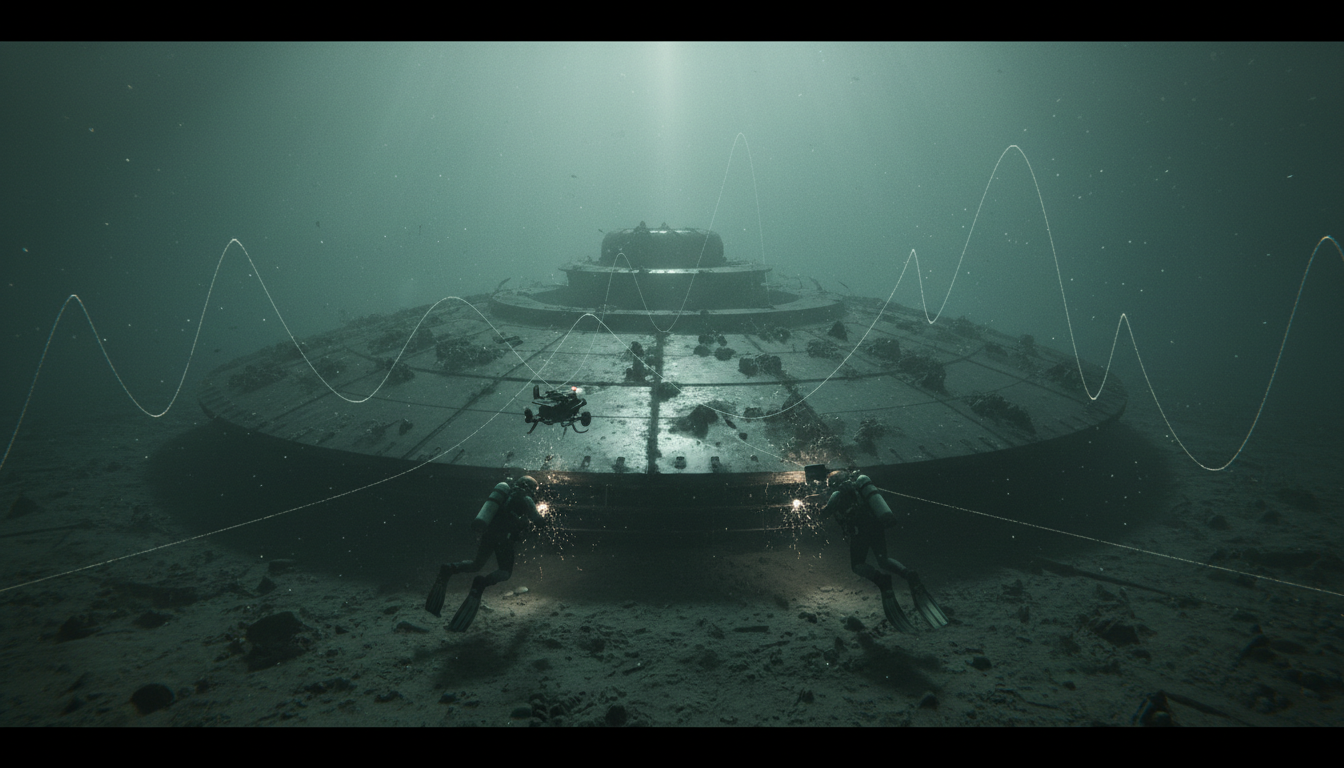
Marine explorers found a massive, 200-foot-wide disc-shaped object sitting at the bottom of the Baltic Sea that instantly cuts off all electronic equipment whenever divers get close to it.
DAILY BRIEFING — THIS L2 FILE IS UNSEALED FOR EVERYONE UNTIL MIDNIGHT UTC
EXHIBITS (1)
EXHIBIT A·IMAGE
DOCUMENT CONTENT
The Baltic Sea Anomaly: The Deep-Sea Shipwreck That Kills Electronics
For decades, Unidentified Submerged Object (USO) researchers and alternative historians have pointed toward the world's oceans as the ultimate repository for forgotten history. They have long claimed that the pitch-black, high-pressure seafloor hides ancient, crashed extraterrestrial craft or pre-diluvian structures completely untouched by surface eons.
Whenever deep-sea exploration teams would bring forward anomalous data, mainstream geologists routinely dismissed it. They maintained that the ocean floor is a chaotic, volcanic environment where shifting tectonic plates and cooling magma naturally mimic artificial layouts, rendering any "geometric finding" a basic case of geological pareidolia.
Then came the summer of 2011, when a team of professional Swedish marine salvagers set sail into the Baltic Sea—and ran directly into a technological blackout.
The Discovery at 300 Feet
Led by researchers Peter Lindberg and Dennis Åsberg, the veteran ocean salvage crew Ocean X was using advanced side-scan sonar to hunt for historic shipwrecks between Sweden and Finland. Instead of a wooden hull or a sunken steel vessel, their monitors painted a staggering, surreal geometric silhouette resting $300\text{ feet}$ ($90\text{ meters}$) below the surface.
The object, which became globally famous as the Baltic Sea Anomaly, measured roughly $200\text{ feet}$ ($60\text{ meters}$) in diameter and stood out from the surrounding seabed with distinct, non-natural traits:
The Millennium Falcon Silhouette: The structure was a massive, highly uniform mushroom-shaped disc featuring smooth, circular curves interrupted by rigid, perpendicular steps and precise right angles.
The Smooth Channels: Divers who later descended to the site reported seeing long, smooth trenches or channels etched into the surface of the dome, resembling integrated circuitry or intentional drainage paths.
The 1,000-Foot Runway: The massive disc did not sit isolated in the silt. It rested at the absolute terminus of a $1,000\text{-foot-long}$ ($300\text{-meter}$) flattened, scraped path across the seabed—resembling a catastrophic crash-landing runway or an intentionally cleared staging platform.
The 200-Meter Electromagnetic Dead Zone
The mystery transitioned from an archaeological curiosity to a terrifying physical anomaly the moment the Ocean X team attempted to drop a manned dive team and remote vehicles directly onto the structure.
As the salvage ship positioned itself directly over the coordinate point, the crew's satellite phones completely cut out. Within a $200\text{-meter}$ radius of the object, the ship’s electrical generators suffered sudden voltage drops, underwater video cameras went totally black, and the deep-sea sonar arrays died.
The team’s professional diver, Stefan Hogeborn, documented that the electronic blackout was strictly spatial. The exact moment the divers or remote submersibles swam past the $200\text{-meter}$ threshold away from the disc, all cameras blinked back to life, satellite links re-established, and batteries resumed their normal charges. The object was actively radiating a localized, heavy electromagnetic dampening field capable of neutralizing modern surface technology.
The Laboratory Verdict: Non-Natural Metallurgy
Desperate for answers, the divers managed to scrape physical fragments and rock samples directly from the surface of the circular dome and brought them to Stockholm University for formal laboratory analysis.
Mainstream skeptics expected the lab reports to show basic, localized Baltic basalt or glacial granite dumped by retreating ice sheets during the last Ice Age. Instead, the mineralogical analysis, overseen by Associate Professor of Geology Volker Brüchert, threw a massive wrench into the natural narrative.
The fragments were composed of highly concentrated limonite and goethite. In the world of industrial metallurgy, these are not ordinary, passive seafloor stones; they are dense, iron-oxide minerals that typically require heavy industrial processing or distinct, hyper-intense thermal foundry conditions to form with such pure, metallic rigidity.
The samples also contained highly unusual magmatic silicates—materials born from molten, high-temperature volcanic activity—in a region of the Baltic Sea that has been completely tectonically dead and devoid of active volcanism for millions of years.
The Lingering Deep-Sea Paradox
Today, the Baltic Sea Anomaly rests in a state of frustrating academic limbo. Mainstream geological consensus has settled on a conservative framework: they argue that the structure is a unique, albeit entirely natural, glacial deposit or an unmapped volcanic outcrop sculpted into weird shapes by shifting undercurrents, brushing off the electromagnetic anomalies as standard equipment failures caused by cold, deep-sea pressures.
Yet, for marine engineers, naval defense analysts, and USO researchers, the Ocean X paper trail remains an open wound in orthodox science. A natural rock formation cannot generate a perfect $1,000\text{-foot}$ scraping runway, it cannot form out of processed, out-of-place iron oxides, and it certainly cannot selectively shut down the satellite networks of ships floating on the surface of the sea.
The Baltic Sea holds its secrets tightly under a blanket of dark water, standing as a chilling reminder that the deep trenches of our own planet may hold technologies that make our modern achievements look primitive by comparison.
References
Initial Discovery Press Archive: Ocean X Team. (2011). Official Ship Logs and Sonar Scan Registry: Baltic Sea Coordinate Sector.Ocean X Team Official Vault
Mineralogical and Geochemical Laboratory Analysis: Brüchert, V. (2012). X-Ray Diffraction and Elemental Profiles of Samples Recovered from the Baltic Sea Anomaly. Department of Geological Sciences, Stockholm University. Stockholm University Institutional Repository
The Principles of Side-Scan Sonar Artifacts: Fish, J. P., & Carr, H. A. (1990). Sound Reflection: Advanced Side-Scan Sonar Operation and Interpretation. American Underwater Search and Survey. (Detailing how sonar can distort underwater structures).
The Baltic Sea Glacial Geology Baseline: Björck, S. (1995). A review of the history of the Baltic Sea of the Last Glacial/Interglacial transition. Quaternary International, 27, 19-40. ScienceDirect Link