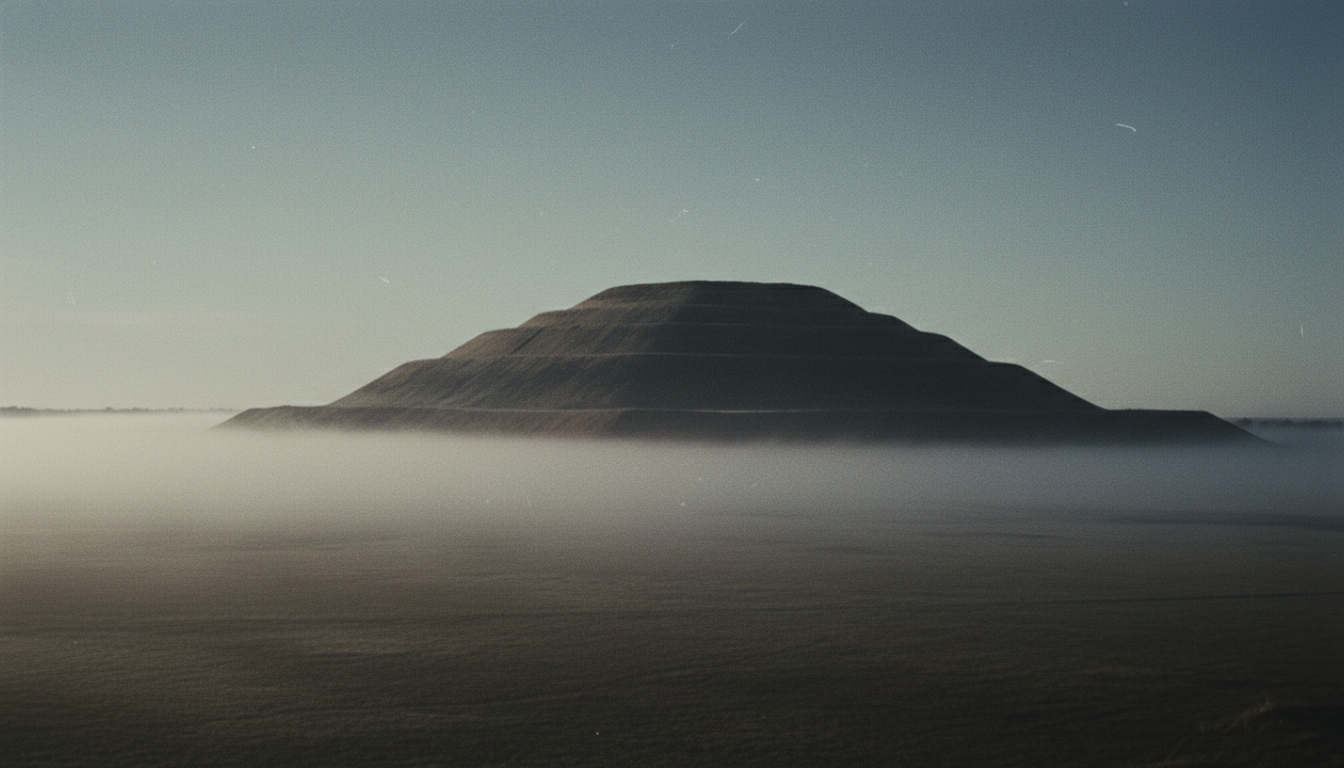
East of St. Louis, on the Illinois floodplain, the earthen pyramids and plazas of Cahokia mark the densest pre-Columbian urban landscape north of Mexico. At its Mississippian peak around 1050–1200 CE, the city organized mounds, a vast plaza, residential zones, and a palisade across thousands of acres. UNESCO inscribed Cahokia Mounds State Historic Site in 1982. The National Park Service and Illinois historic-site stewards frame Monks Mound and its neighbors as Indigenous urban archaeology. Nineteenth-century “lost race” mound-builder myths once denied that authorship. This Archive file is documented. The shelf tension is myth versus excavation—not a tourism brochure.
The Mississippian City
Public interpretation and WH language converge on scale. Roughly 120 mounds once stood in the wider landscape; Illinois protects a core of about 2,200 acres with dozens still visible. Population estimates for the peak century are routinely compared, in site and NPS prose, with contemporary European cities. Causality for rise and decline remains research-active—climate, maize politics, flooding, social stress—but the urban fact is not optional folklore. Platform, ridgetop, and conical mounds structured ceremony, residence, and hierarchy.
Cahokia Mounds official site: https://cahokiamounds.org/.
Monks Mound and the Plaza Program
Monks Mound is the signature earthwork: a multi-terrace platform covering hectares and rising about thirty meters, built in stages. It faces a grand plaza that organized spectacle and gathering. Woodhenge post circles and palisade lines enter the same reconstructed city grammar. None of that requires lost white civilizations, giants, or alien survey crews. It requires labor, engineering in soil, and Mississippian political religion—Indigenous authorship written in dirt.
NPS World Heritage article: https://www.nps.gov/articles/000/cahokia-mounds-state-historic-site-world-heritage-site.htm.
NPS Places — Interpretive Center: https://www.nps.gov/places/cahokia-mounds-state-historic-site.htm.
Official Posture: UNESCO, NHL, Illinois Stewardship
UNESCO List 198 and its documents hub are the international paperwork doors: nomination values, conservation reporting, committee language. National Historic Landmark status (1965) and Illinois Department of Natural Resources Historic Sites management are the domestic chain. The Interpretive Center—subject to renovation cycles—translates excavation into public narrative. Stewardship means controlled trails, mound protection, and research permits, not a free dig field.
UNESCO Cahokia List 198: https://whc.unesco.org/en/list/198/.
UNESCO documents hub: https://whc.unesco.org/en/list/198/documents/.
Illinois DNR Historic Sites experience portal: https://dnrhistoric.illinois.gov/experience.html.
Lost-Race Myths Versus Dig Records
Nineteenth-century American mound literature often invented a vanished superior race to explain earthworks, pushing living Indigenous nations out of authorship. That myth system was a custody fight over national origin stories as much as a bad chronology. Twentieth-century professional archaeology—ceramic sequences, radiocarbon, settlement survey—rebuilt Cahokia as Mississippian. Documented filing refuses to reopen lost-race authorship as an equal hypothesis. It does record that the myth shaped early collecting, looting, and public memory, which is why WH language still has to say Indigenous out loud.
Viral paleocontact captions sometimes bolt aliens onto Monks Mound the way they bolt them onto other pyramidal silhouettes. Those captions do not appear in the UNESCO listing text. Stick to Mississippian urbanism, staged mound construction, and state/federal heritage paperwork.
Why Documented Still Has Teeth
Settled on the packets: a major Mississippian urban center at Cahokia; Monks Mound and plaza landscape; UNESCO inscription 1982; NHL and Illinois historic-site stewardship; Indigenous authorship as the archaeological baseline. Overclaim to refuse: lost-race builders, nonhuman architects, and any implication that excavation has finished the entire floodplain map.
The Archive tension is narrative control of deep North American urbanism. Officials present a World Heritage Indigenous city. Older folklore and newer mystery media present a problem that “cannot” be Native. The file holds the WH dossier against that theft of authorship.
Archive Siblings
Newark Earthworks and Hopewell ceremonial landscapes are the Ohio UNESCO neighbor for Indigenous monumental earthwork politics. Other Mississippian mound centers belong in the same urban grammar without collapsing into one tourist “mound mystery” brand. Keep Cahokia on the Mississippian and WH spine.
Earthwork Against Erasure
Monks Mound’s silhouette is easy to mystify because it is huge and soil-quiet. Excavation units, palisade trenches, and ceramic chronologies are harder to meme. Documented filing privileges the harder record. Lost-race prose was never neutral error; it was a story that made Indigenous cities into ruins of someone else. Cahokia’s modern institutional language—UNESCO, NPS, Illinois Historic Sites—exists partly to end that theft in public heritage speech.
Dig Tourism Versus Shelf Tension
Visitor trails up Monks Mound and plaza boardwalks are real public goods. They are not the Archive’s so-what. The shelf question is authorship and myth: who gets to claim the largest Indigenous city north of Mexico, and which nineteenth-century storylines still try to steal that claim. UNESCO paperwork and NPS interpretive articles answer with Mississippian archaeology. Mystery media answer with riddles. Documented filing stays with the first answer while naming the second as reception that shaped American collecting culture.
What the Paper Trail Settles
Settled: Mississippian metropolis; Monks Mound staged construction; WH and NHL status; Illinois-protected core; continuing archaeology and interpretation. Still research-active: precise population curves, decline models, neighborhood variation across the bottomland. Those open questions are ordinary urban archaeology, not invitations to reinstate lost-race myths.
The tension that remains is myth versus stewardship. Officials present an Indigenous World Heritage city managed as a state historic site. Older and viral captions present a riddle that needs non-Native authors. Cahokia is that fight—read with the UNESCO and NPS doors open, and with lost-race slogans left labeled as claim.