Some of the most widely shared images in ancient astronaut writing are paintings: a Saharan rock figure, rock art in the Alps and Utah, a Serbian Orthodox fresco, a Florentine tondo, and a Dutch canvas. Every one of these works exists and can be seen today. What is argued is what the painters meant. If adherents are right, artists across ten thousand years kept recording visitors from the sky. If the art-historical readings hold, the same shapes belong to masks, gods, spirits, and the religious conventions of their own times. This page sets out both readings, work by work, in the sources that state them.
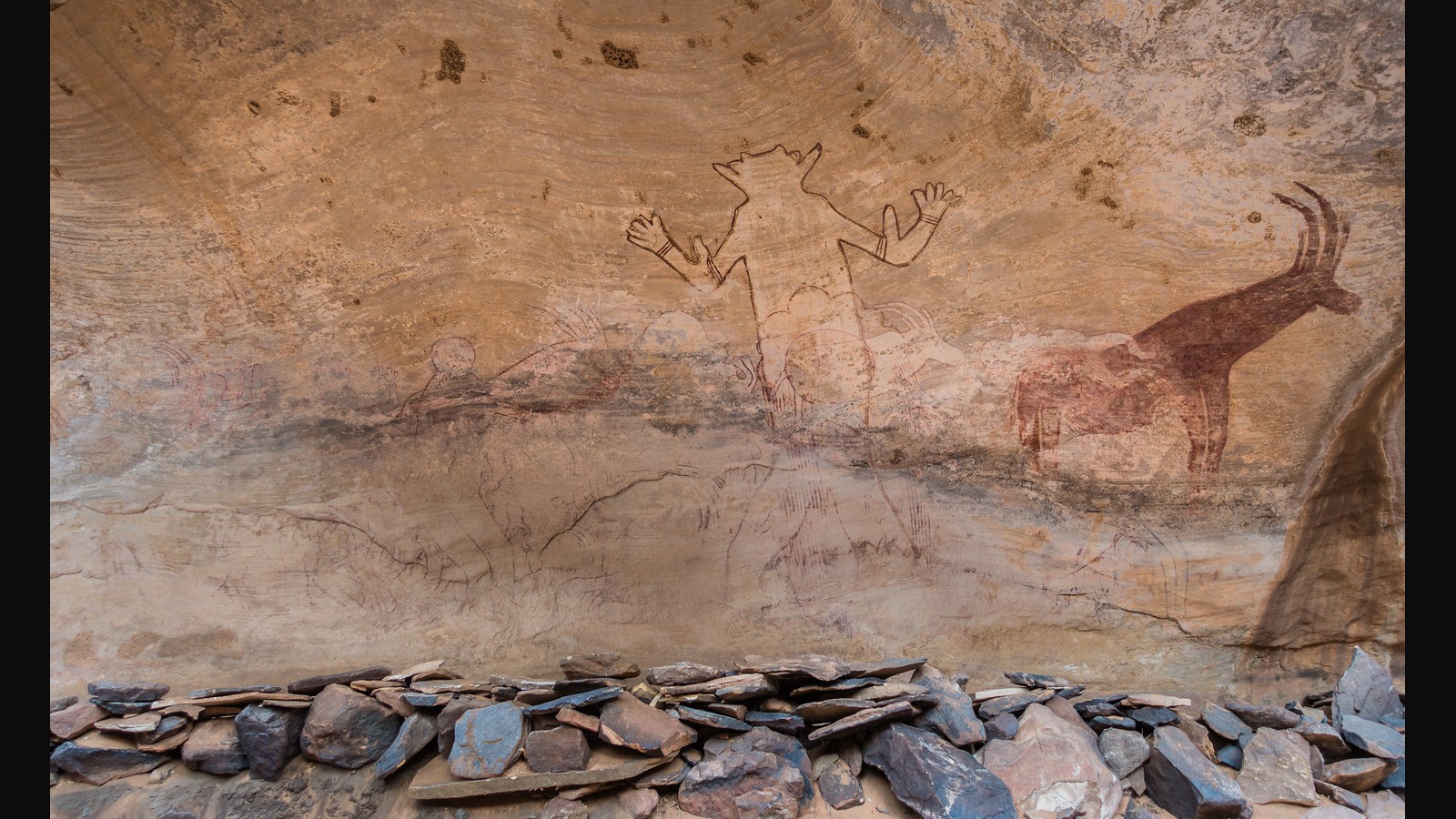
The great "Martian" god of Jabbaren
UNESCO describes Tassili n'Ajjer, in south east Algeria, as having "one of the most important groupings of prehistoric cave art in the world," with more than fifteen thousand drawings and engravings. UNESCO says the paintings of the Round Heads Period "evoke possible magic-religious practices some 10,000 years old."
Henri Lhote went to the Tassili in 1956 "with a team of copyists for a 16-month expedition." In The Search for the Tassili Frescoes (1959), he describes a round-headed figure at Jabbaren, nearly eighteen feet high, as "very like the pictures we sometimes see of 'Martians'," and a plate caption names it "The Great 'Martian' God of Jabbaren." Erich von Däniken, in Chariots of the Gods?, writes of "the great god Mars, so Lhote christened him," and says the figure seemed "depicted in a space or diving suit."
The expedition's own record is disputed. In 2006 the University of Bristol announced Jeremy Keenan's film The Lesser Gods, which it said "shows that several of the discoveries were actually fraudulent." The art historian Nathalie Hager writes that French members of the team made "copies" of Egyptian-looking figures and passed them off as faithful reproductions. Lhote himself likened a masked figure at Aouanrhet to masks still used "in initiation ceremonies" in West Africa.
Sources: University of Bristol, 23 October 2006: https://www.bristol.ac.uk/news/2006/5132.html ; UNESCO, Tassili n'Ajjer: https://whc.unesco.org/en/list/179/ ; Lhote, The Search for the Tassili Frescoes (Hutchinson, 1959) ; von Däniken, Chariots of the Gods? (Bantam, 1971) ; Smarthistory: https://smarthistory.org/running-horned-woman-tassili-najjer-algeria/
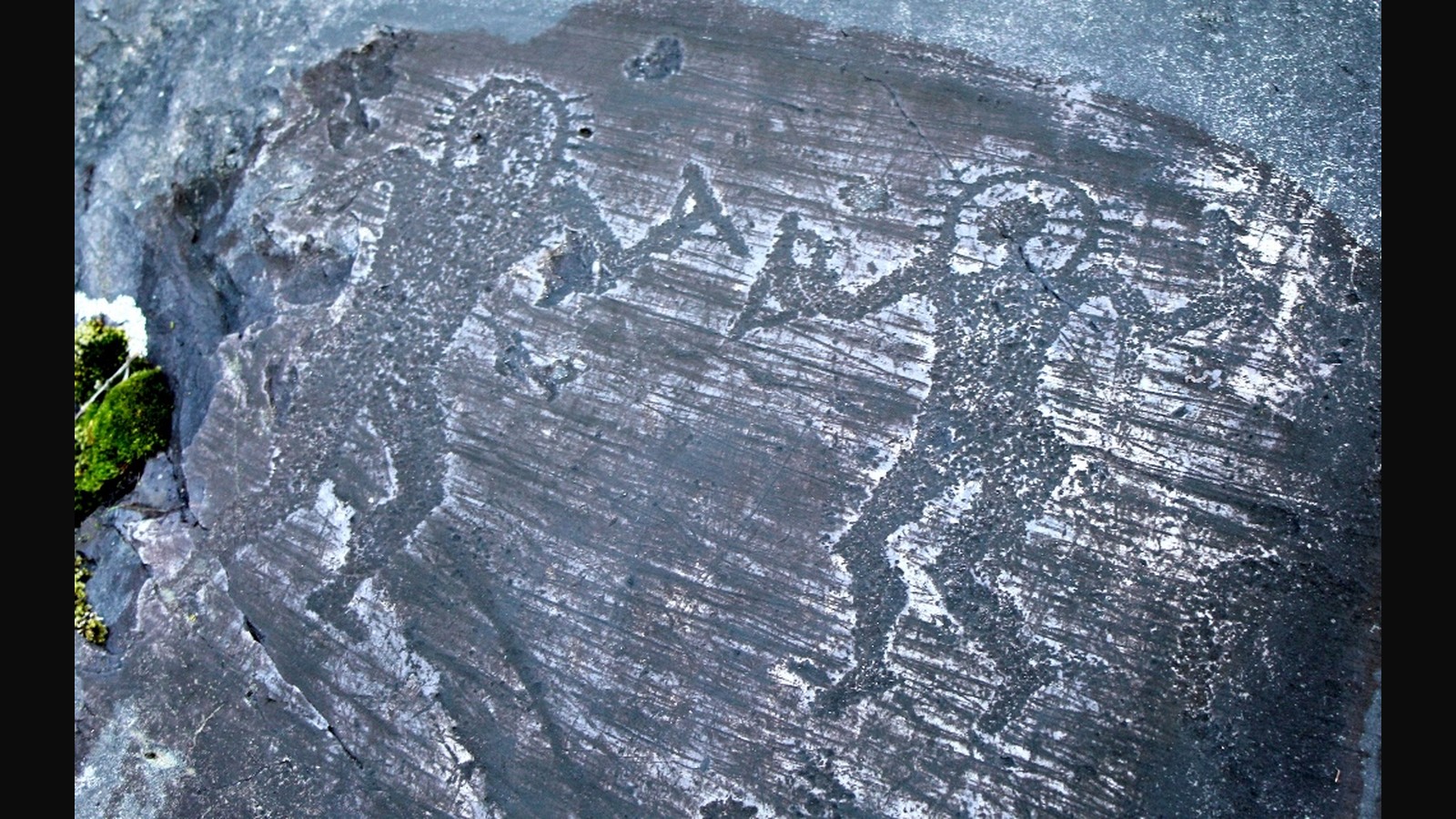
The Valcamonica "astronauts"
In the Italian Alps, UNESCO's Rock Drawings in Valcamonica, inscribed in 1979, hold "more than 140,000 symbols and figures carved in the rock over a period of 8,000 years." Two carved figures with rayed heads at Zurla, near Nadro, are called the astronauts by adherents. Von Däniken wrote that "figures in bulky suits occur again in Val Camonica (Brescia, Italy), and, annoyingly enough, they also have horns on their heads."
Adherents following von Däniken's 1968 book Chariots of the Gods? have also read the Wandjina of the Kimberley as visitors. The Worrorra, Ngarinyin and Wunambal Traditional Owners regard Wandjina as sacred ancestral beings and object to the alien reading.
Sources: UNESCO, Rock Drawings in Valcamonica: https://whc.unesco.org/en/list/94/ ; von Däniken, Chariots of the Gods? (Bantam, 1971) ; ABC News, 5 December 2016: https://www.abc.net.au/news/2016-12-05/aboriginal-people-move-to-reclaim-sacred-wandjina-drawings/8049978
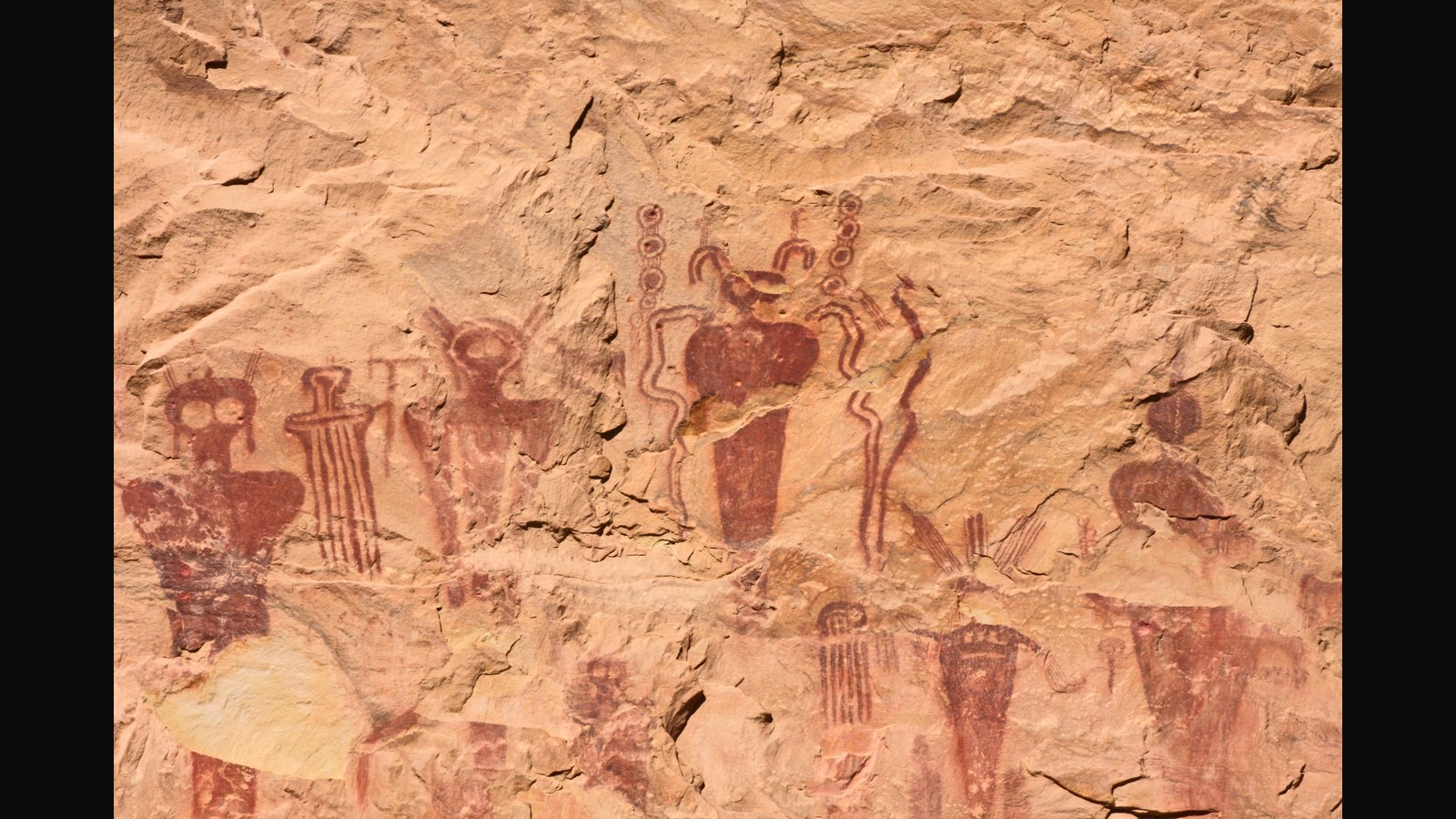
Sego Canyon's Barrier Canyon figures
The Bureau of Land Management says Sego Canyon, Utah, contains "three culturally distinct styles of rock art: Fremont, Ute and Barrier-style." The National Park Service dates the style, at its best known site in Horseshoe Canyon, to the Late Archaic period, "from 2000 BCE to 500 CE." An NPS Canyonlands reader, The Archeology of Horseshoe Canyon, says their "ghost-like" appearance led the rock art specialist Polly Schaafsma "to suggest that this colorful style represents shamanistic art." A 2014 Utah State University study dated one panel there to about A.D. 1 to 1100. None of these dates is specific to Sego.
A 2014 Ancient Origins article says "Advocates of the ancient astronaut theory suggest that the strange figures of the Barrier Canyon style rock art depict extra-terrestrials that once visited Earth," pointing to "the large, hollow looking eyes and the triangular shaped heads."
Sources: NPS, The Archeology of Horseshoe Canyon: https://nhmu.utah.edu/sites/default/files/trail-resource/HorseshoeBook.pdf ; NPS, Horseshoe Canyon: https://www.nps.gov/places/horseshoe-canyon.htm ; BLM: https://www.blm.gov/visit/sego-canyon-rock-art-interpretive-site ; Utah State University, 28 August 2014: https://www.usu.edu/today/story/usu-scientists-shed-new-light-on-age-of-barrier-canyon-style-rock-art ; Ancient Origins, 23 April 2014 (adherents' view): https://www.ancient-origins.net/ancient-places-americas/haunting-rock-art-sego-canyon-extra-terrestrials-or-spiritual-visions-001584
The Crucifixion at Visoki Dečani
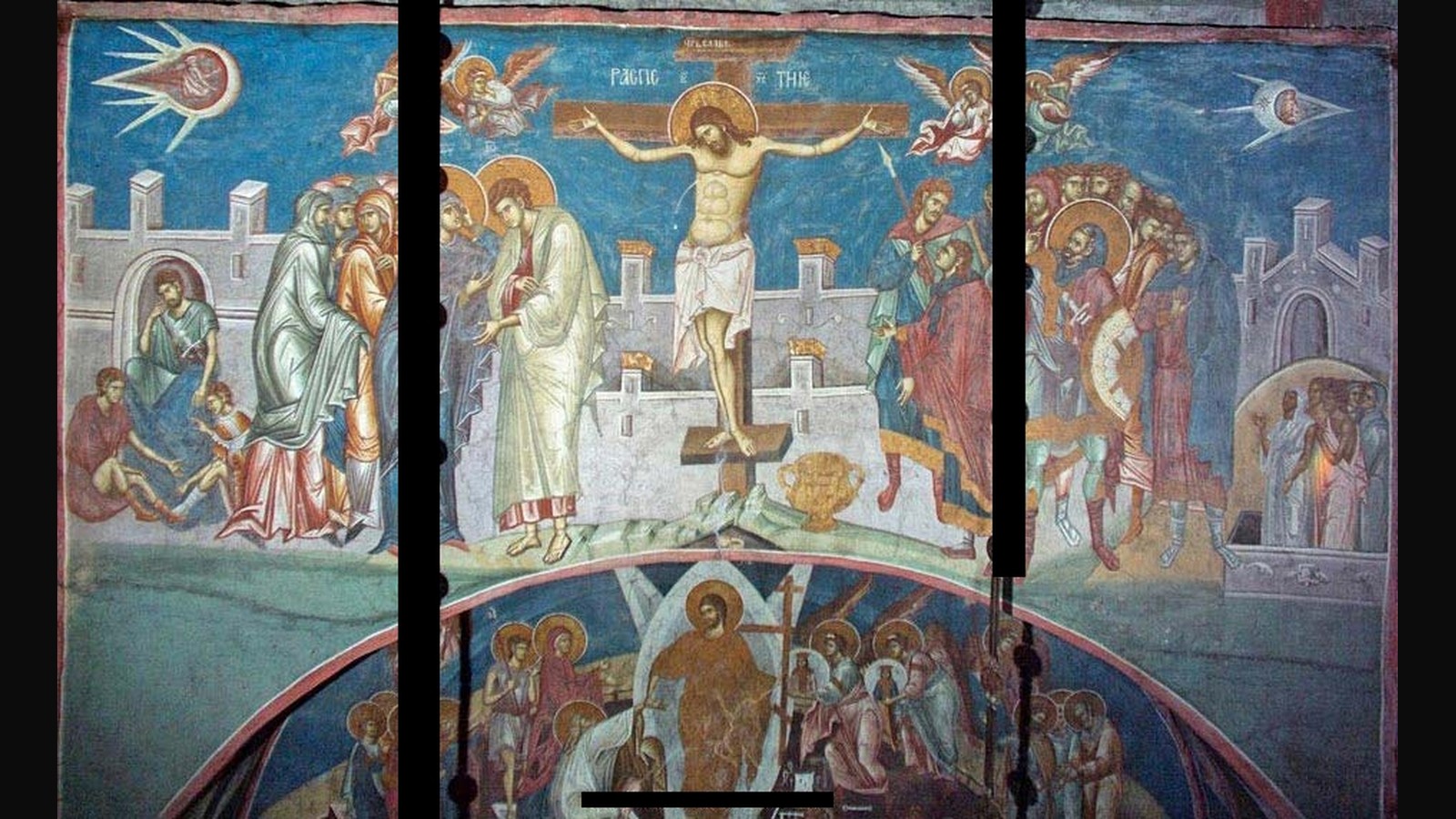
UNESCO says the Dečani Monastery in Kosovo "was built in the mid-14th century for the Serbian king Stefan Dečanski," and lists it among the Medieval Monuments in Kosovo for their "distinct style of wall painting." Its Crucifixion shows two shapes, each carrying a small figure, on either side of the cross. The art historian Diego Cuoghi traces the UFO reading to articles in the 1960s in the French magazine Spoutnik, after the fresco was "discovered" in 1964 by Alexandar Paunovitch. The art-historical reading is that they are the Sun and the Moon, shown as human witnesses to the Crucifixion. Cuoghi quotes James Hall's Dictionary of Subjects and Symbols in Art: "The sun and moon, one on each side of the cross, are a regular feature of Medieval crucifixions."
Sources: Cuoghi, Art and UFOs, Part 2: https://www.sprezzatura.it/Arte/Arte_UFO_2_eng.htm ; UNESCO, Medieval Monuments in Kosovo: https://whc.unesco.org/en/list/724/
The Madonna with Saint Giovannino
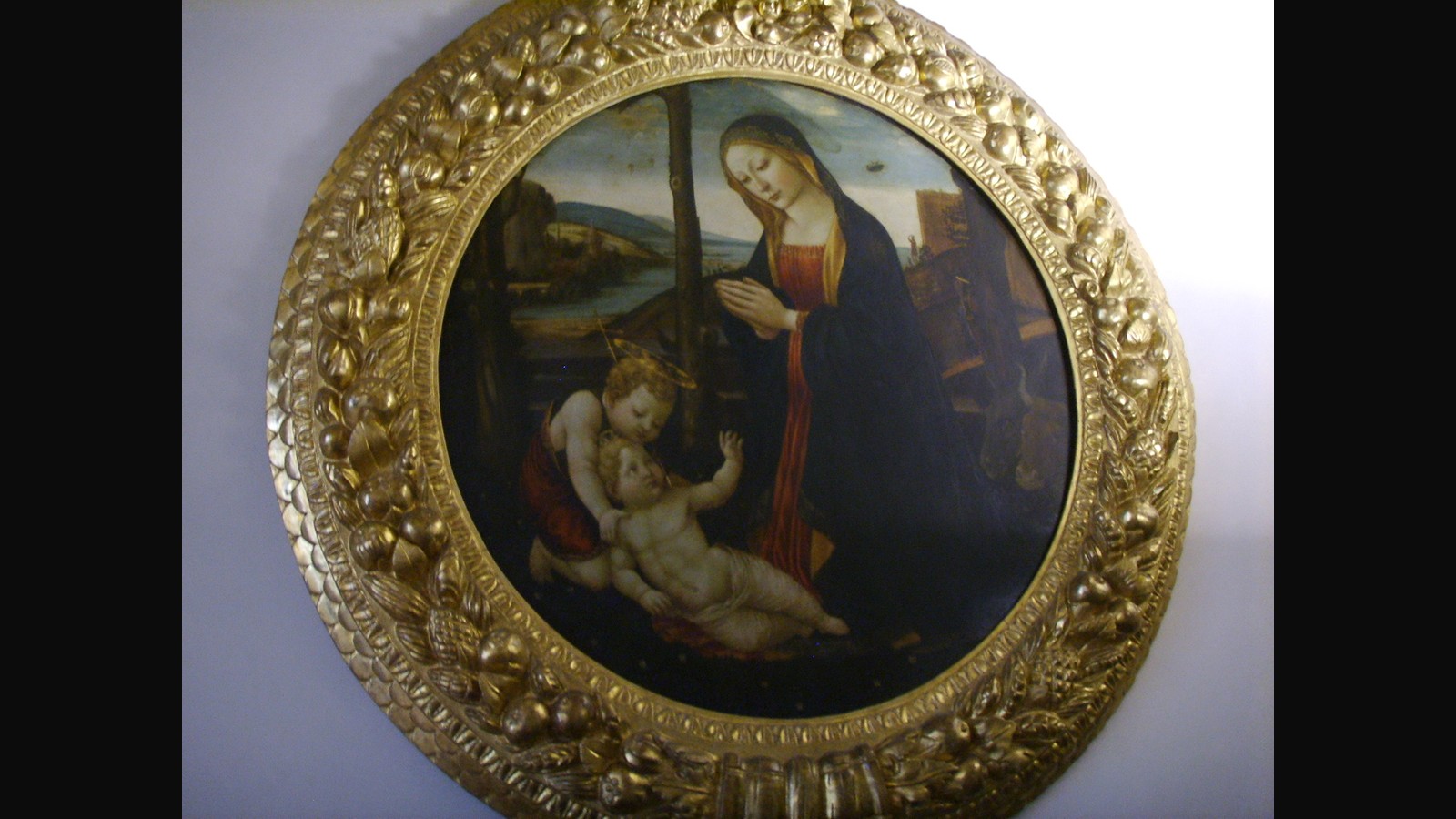
The Palazzo Vecchio in Florence holds a fifteenth century tondo of the Madonna and Child with the infant Saint John. The museum label names Jacopo del Sellaio, and the catalog entry favors Sebastiano Mainardi. Behind the Madonna, a man shades his eyes and a dog looks up at a shape in the sky. In Notiziario UFO in 1996, Daniele Bedini described "an airborne object leaden in color and inclined to port, sporting a 'dome' or 'turret'." Cuoghi reads the scene as the announcement to the shepherds from the Gospel of Luke. He traces the glowing cloud to the Protogospel of James, where "a luminous cloud over-shadowed the cave."
Source: Cuoghi, Art and UFOs, Part 5: https://www.sprezzatura.it/Arte/Arte_UFO_5_eng.htm
Aert de Gelder's Baptism of Christ
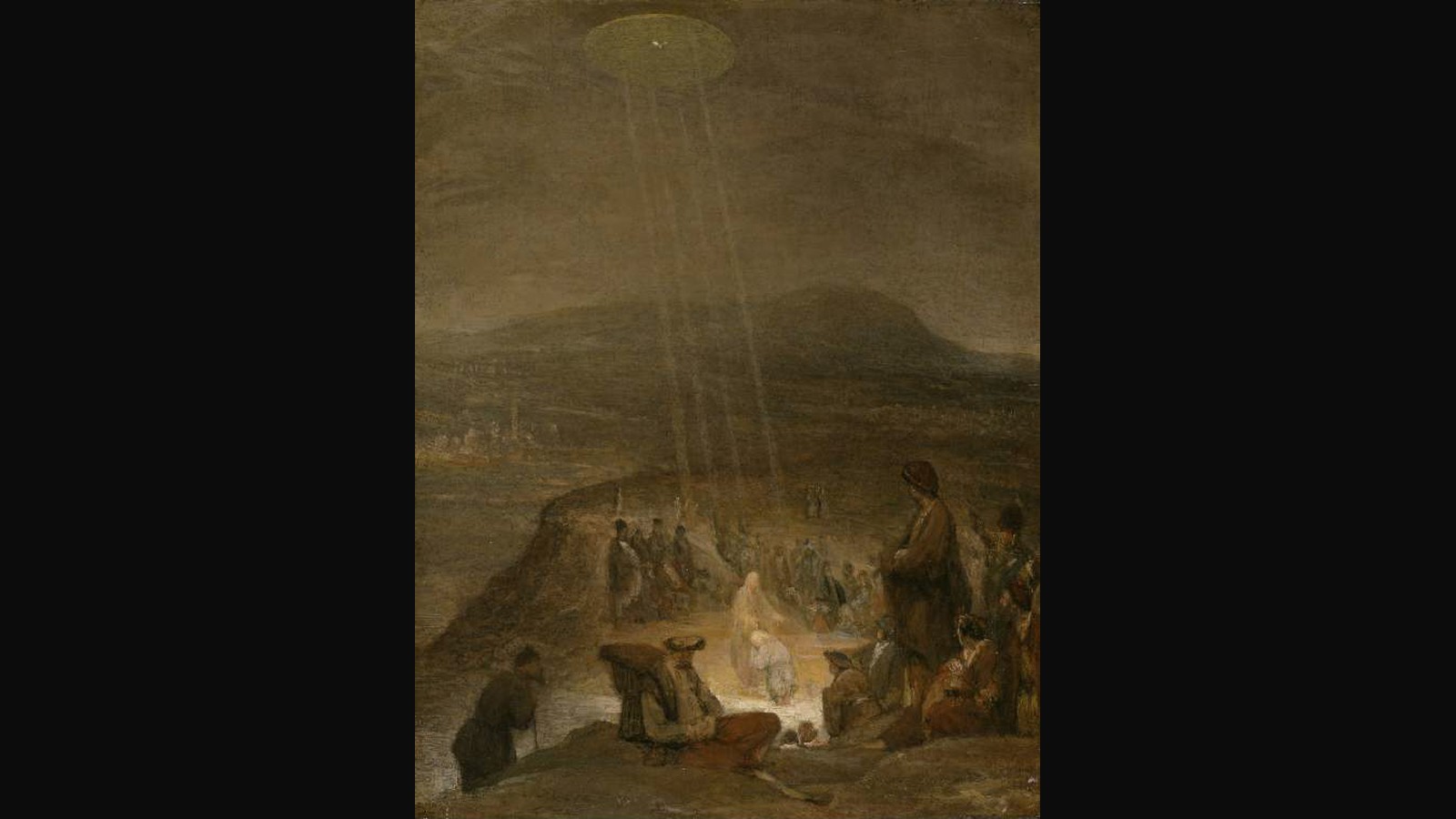
Aert de Gelder's Baptism of Christ, an oil on canvas of about 1710, now in Cambridge, shows Christ and John the Baptist lit by rays from a disc high above. The Italian site Edicolaweb, as quoted by Cuoghi, describes "what appears as a disc" sending "four rays of light" onto the ground around the Baptist and Christ (translated from Italian). All four Gospels describe the Spirit descending like a dove at the baptism. Cuoghi notes that a small dove sits at the center of de Gelder's circle of light, and quotes the Fitzwilliam Museum catalogue: "The two figures are brilliantly lit by rays from the Dove high above, against general darkness."
Sources: Cuoghi, Arte e UFO, Parte 3: https://www.sprezzatura.it/Arte/Arte_UFO_3.htm ; Art UK: https://artuk.org/discover/artworks/baptism-of-christ-5363
What stays contested
The works and their places are documented; the reading is not. Art historians read sun and moon personifications, a shepherds' annunciation, and a dove in glory. Archaeologists read masks, spirit figures, and ritual. Adherents answer that painters on three continents kept showing helmets, discs, and floating beings because they kept seeing them.