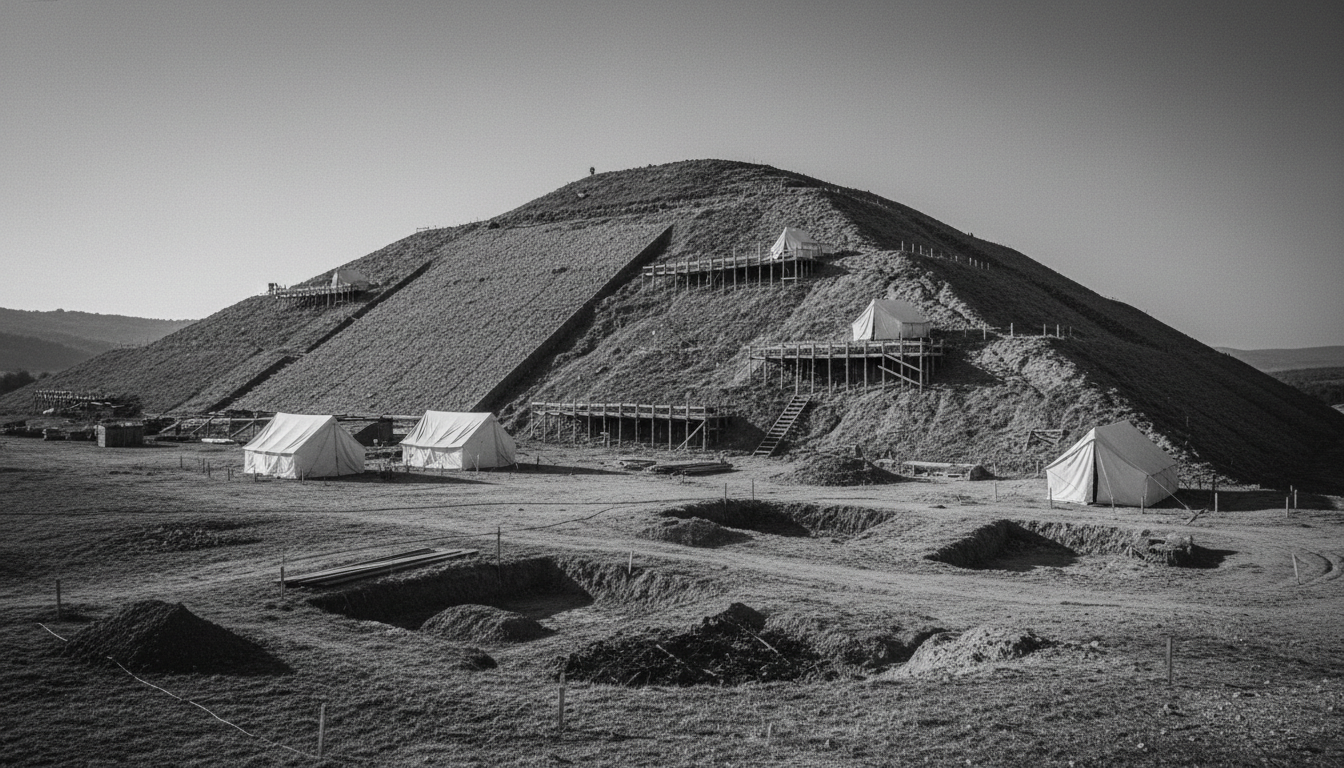

In 2005–2006, Semir Osmanagić announced that hills above Visoko, Bosnia and Herzegovina—above all Visočica—were not ordinary geology but the largest pyramids on Earth. Media followed. Diggers cut stepped profiles into soil and rock. Tour buses arrived. European archaeologists and field geologists answered with a different vocabulary: flatirons, Miocene sandstone and conglomerate, tectonic joints, and a medieval fortress already on the books as national heritage. This Archive file stays contested. It maps the claim ecology against the geological and heritage record without inventing FOIA cables or baptizing a lost European pyramid age.
Naming Hills as Pyramids
Osmanagić’s Foundation framed Visočica as the Pyramid of the Sun, neighboring Plješevica as the Pyramid of the Moon, and spoke of tunnels, pavements, and concrete-like blocks. The visual grammar was Egyptian by analogy: slope, terrace, axis. Local tourism economies noticed. Contested filing records that announcement and excavation theater as public history. It does not treat a press conference as a stratigraphic report.
What the digs exposed, in specialist readings, were fractured sedimentary plates and reshaped hillsides. Workers and visitors could see right angles. Right angles in sandstone are not, by themselves, masonry certificates.
What Field Geology Keeps Saying
Boston University geologist Robert M. Schoch, after visiting Visoko, published a blunt field essay: no pyramids. Visočica and Plješevica, in his account, are layered sandstone, clay, mudstone, siltstone, and conglomerate from ancient lake and river systems, later tilted by tectonics. Soft beds deform; harder beds break into blocks whose size tracks bed thickness. Ripple marks and burrows appear in the same rocks sold as pavements. That is the expected signature of natural sedimentary geology under stress—not a missing dynastic quarry ledger.
Robert Schoch — Bosnian Pyramids: https://www.robertschoch.com/bosnia.html.
John Bohannon’s 2006 Science feature, “Mad About Pyramids,” carried the fight into a major research journal’s news pages: geological skepticism, archaeological alarm, and the spectacle of a hillside being cut to look more pyramidal.
Science — Bohannon: https://www.science.org/doi/10.1126/science.313.5794.1718.
European Archaeology’s Open Letter
In December 2006, senior European archaeological officials—including the then president of the European Association of Archaeologists—signed an open protest to Bosnian authorities. The letter called the Visoko pyramid scheme a cruel hoax on an unsuspecting public, a waste of scarce resources, and a diversion from protecting genuine, endangered heritage. Contested filing keeps that institutional voice on the shelf beside Foundation tourism language. It is not a secret memo. It is a signed declaration.
EAA protest declaration (PDF mirror): https://www.robertschoch.com/articles/schoch_eaa_statement.pdf.
The Real Archaeology Already on Visočica
Visočica is not an empty hill waiting for a first story. The medieval Old Town of Visoki sits on the same massif. Bosnia and Herzegovina’s Commission to Preserve National Monuments holds the national-monument machinery for such sites. The City of Visoko publishes protection framing for national treasures including Stari grad Visoki. The local Zavičajni muzej presents the fortress archaeology to residents and visitors. Pyramid-park earthmoving that damages medieval or Roman deposits is not a side issue in those doors. It is the heritage conflict under the media caption.
Commission to Preserve National Monuments: https://kons.gov.ba/.
Grad Visoko — heritage protection: https://www.visoko.gov.ba/zastita-nacionalnog-blaga/.
Zavičajni muzej — Stari grad Visoki: https://www.zavicajnimuzej.com/stari-grad-visoki/.
Why Contested Remains Honest
Settled enough for documentary purposes: Osmanagić launched a pyramid project at Visoko; hills were reshaped and marketed as pyramids; Schoch and other geologists describe natural sedimentary flatiron geology; European archaeological leadership publicly denounced the scheme; Visoki medieval remains are a protected heritage subject on the same hill. Not settled as historical fact on this page: that Visoko hides a prehistoric pyramid civilization larger than Egypt’s.
Foundation believers will keep pointing to tunnels, geopolymer claims, and energy narratives. Specialists will keep pointing to bedding, joints, and damaged real archaeology. The Archive records both citation habits. It does not convert either into a verdict sermon, and it does not invent government FOIA where the public record is already loud.
Blocks, Tunnels, and the Camera
Promotional photography favors clean steps and dark passages. Contested filing separates three things that viral captions glue together: natural jointed blocks, modern excavation cuts that invent a stepped silhouette, and tunnel systems whose age and function remain Foundation-asserted until published in venues that convince field geologists. A corridor can be real as a hole in the ground and still fail as proof of a Neolithic pyramid architect. The Archive keeps that distinction visible.
Science reportage from 2006 already noted how quickly hillside modification could manufacture the look of terraces. Later visitors inherit those cuts. Photographs of “pavement” after clearing are not the same exhibit as an untouched outcrop with ripple marks still in place. Schoch’s essay keeps returning to those sedimentary features precisely because they survive as geology even when captions rename them architecture.
Tourism Versus Stratigraphy
Visitor platforms reward wonder. Jointed conglomerate rewards patience. Contested status is honest about that mismatch. Readers who want only suppressed European Atlantis will not be moved by a Miocene lake bed. Readers who want only mockery will miss why Visoko’s fortress museum and municipal heritage pages matter. The file holds claim, geology, and national-monument paperwork on one page.
What the Paper Trail Settles
Settled: a high-visibility pyramid claim; geological counter-readings in specialist and Science channels; an EAA-linked open letter; ongoing tension with genuine Visoko heritage protection. Still open as cultural history: why the claim traveled so far, how local politics funded or resisted digging, and how tourism will market the hills next season. Those questions are not the same as proving a pyramid empire.
The tension that remains is Foundation spectacle versus geological and heritage paperwork. Officials and field scientists argue about sandstone and medieval walls. Promoters argue about the largest pyramids on Earth. Visoko is that argument—read with Schoch, Science, and kons.gov.ba open, and with dynastic Bosnia left labeled as claim.