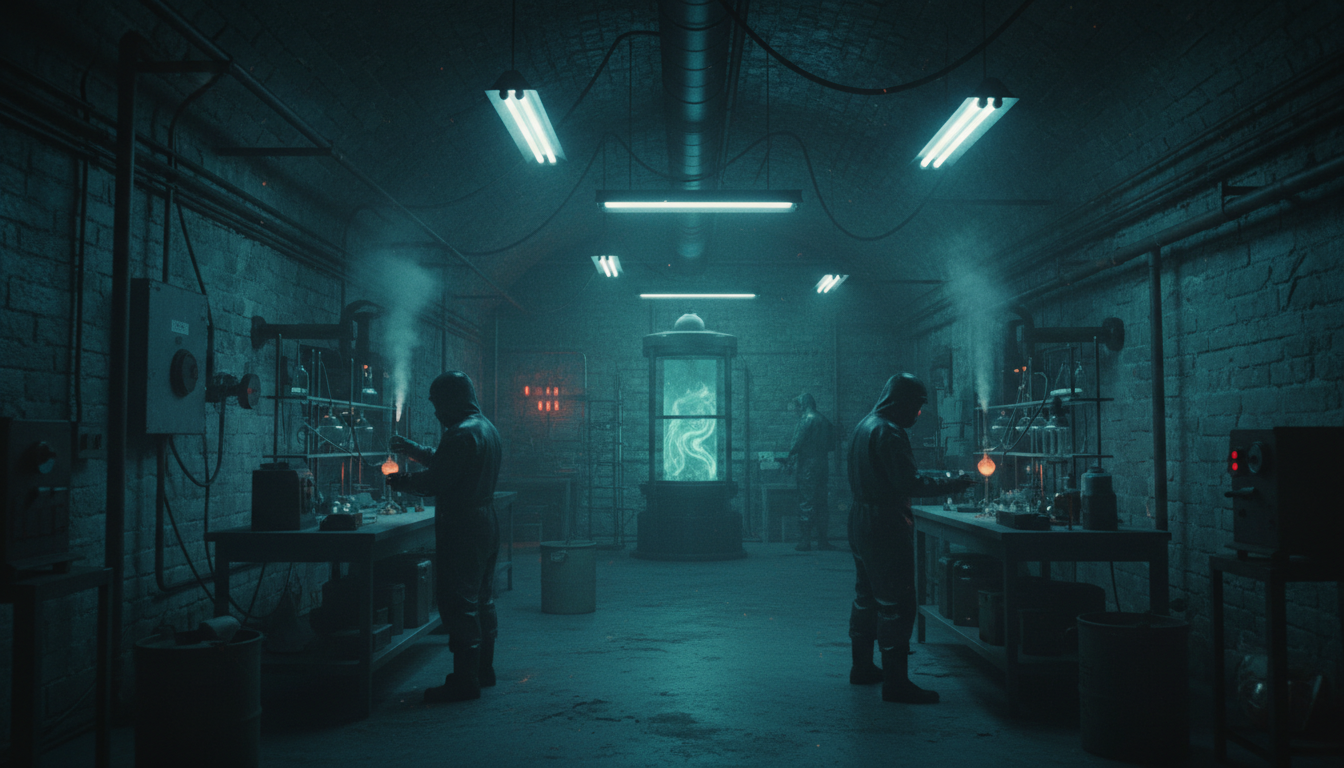
Edward Haslam ties Mary Sherman's 1964 murder to a secret monkey-virus lab; police files and pathologists differ. Haslam's book says Sherman, a New Orleans bone pathologist, was hurt in an accident at a hidden laboratory and that her death was staged to conceal it. A 117-page police report shows detectives chasing leads that went nowhere, and two of three pathologists who reviewed the photographs said an ordinary fire could explain her burns. Behind the book sits a real event: polio vaccine given in the United States between 1955 and 1963 was partly contaminated with the monkey virus SV40.
The book and its claim
TrineDay, the publisher, describes Dr. Mary's Monkey by Edward T. Haslam, with a foreword by Jim Marrs, as an account that begins with the 1964 murder of a nationally known cancer researcher. It says the book follows police records, FBI files, cancer statistics and medical journals, and presents evidence of "a web of medical secret-keeping" that began with the handling of evidence in the JFK assassination and extended to contaminated polio vaccine, the arrival of the AIDS virus, and biological weapon research using infected monkeys. The full subtitle links the murder, a secret laboratory in New Orleans and cancer-causing monkey viruses to Lee Harvey Oswald and emerging global epidemics.
TrineDay, Dr. Mary's Monkey: https://trineday.myshopify.com/products/dr-marys-monkey
Haslam in his own words, 2007
Gambit Weekly reported in July 2007 that Haslam, whose father taught orthopedic surgery at Tulane, learned as a boy from his parents that Sherman's right arm was missing. Haslam says a linear particle accelerator at the US Public Health Service hospital was used to irradiate monkey viruses, either toward a vaccine for cancers that might follow the contaminated polio vaccine or toward a cancer-causing virus that could be used against Fidel Castro. He says Sherman worked on that project under Alton Ochsner, alongside David Ferrie and Oswald, and that her arm and rib cage were burned in a lab accident before a stab wound to the heart killed her. He cites a slim heart wound unlike the other wounds, blood around the heart but not the liver, and morphine in her blood. In the book he also cites National Cancer Institute figures showing sharp rises in soft-tissue cancers between 1973 and 1988. The paper said Judyth Vary Baker, who says she worked in the lab with Sherman and Oswald, backs his account, and that the case is still officially open.
Gambit Weekly, "Missing Links," 2007: https://www.theadvocate.com/gambit/new_orleans/news/missing-links/article_f401622c-9d09-52d1-82ab-ddc5fcd825c6.html
The police file and the pathologists
NOLA.com and The Times-Picayune obtained the police report and 70 pages of case files in 2014. They say Sherman was found at about 4 a.m. on July 21, 1964, in her apartment on St. Charles Avenue, severely burned on her right side, her right arm and right torso gone, and stabbed through the heart. Apart from the bed there was little fire damage, and her purse and jewelry were still there. Over five years detectives questioned at least 104 people; the report shows no clear suspect and police pursuing a theory that the killing was a crime of passion. Haslam told the paper, "She did not die in her apartment." Dr. Gregory Davis and Dr. Scott Denton said a normal fire could have caused the burns; Davis pointed to an accelerant and the mattress, and Denton said she was stabbed, then partly burned after death. Dr. Judy Melinek said the poor photos and missing records made a firm judgment hard, and that a body burned elsewhere and moved might explain the pattern.
NOLA.com, "In the death of Doctor Mary Sherman," 2014: https://www.nola.com/news/crime_police/in-the-death-of-doctor-mary-sherman-strange-myths-pale-next-to-stranger-facts/article_7022729c-95bf-5fc7-b9ab-8000e1336f6a.html
A colleague's review
Writing in The Ochsner Journal in 2007, Frank A. Riddick Jr., chief executive officer emeritus of Ochsner Clinic Foundation, reviewed Haslam's 1997 book and Dr. Mary's Monkey. He summed up the theory as a CIA effort, through Ochsner, to make a cancer-causing virus for use against Castro, with work consolidated at the Public Health Service hospital, where an accident killed Sherman and released a virus later seen as HIV. Riddick wrote that Sherman "was not a virologist at all, nor a basic scientist in cancer research," and that in his opinion Haslam's speculations about her lacked validity. His review dates the murder to April 1964; the police file dates it July 21.
Riddick, "Ochsner in Literature—nonfiction," 2007: https://pmc.ncbi.nlm.nih.gov/articles/PMC3096393/
What the Institute of Medicine found, 2002
On October 22, 2002, the National Academies announced an Institute of Medicine report finding the evidence insufficient to prove or disprove that SV40-contaminated polio vaccine given from 1955 to 1963 caused cancer. It said 10 to 30 percent of that vaccine was contaminated, potentially exposing 10 million to 30 million Americans, and that vaccine has been free of SV40 since 1963. Most population studies found no increased cancer rates, the committee said, but they had substantial statistical and design limits. The incidence of some suspected cancers has risen, it said, but better detection and other causes could account for that. SV40 DNA has been found in human tumors, yet not in all of them and sometimes in normal tissue, and its presence "does not by itself demonstrate a causal link."
National Academies, IOM report on SV40 and polio vaccine, 2002: https://www.nationalacademies.org/news/more-data-needed-to-determine-if-contaminated-polio-vaccine-from-1955-1963-causes-cancer-in-adults-today
Researchers who see SV40 as a human pathogen
Regis A. Vilchez and Janet S. Butel of Baylor College of Medicine wrote in Clinical Microbiology Reviews in 2004 that SV40 causes brain and bone cancers, mesothelioma and lymphomas in laboratory animals, and that a meta-analysis of data from 1,793 cancer patients showed a significant excess of SV40 in the same human cancers. They called SV40 an emerging pathogen and quoted the Institute of Medicine that the biological evidence is "of moderate strength" that SV40 could lead to cancer in humans.
Vilchez and Butel, "Emergent Human Pathogen Simian Virus 40 and Its Role in Cancer," 2004: https://pmc.ncbi.nlm.nih.gov/articles/PMC452549/
Where the record stands
Adherents cite the contaminated vaccine, SV40 in tumors, and Sherman's burns. The record confirms the contamination and an open debate over cancer, while the murder file names no lab and no suspect.