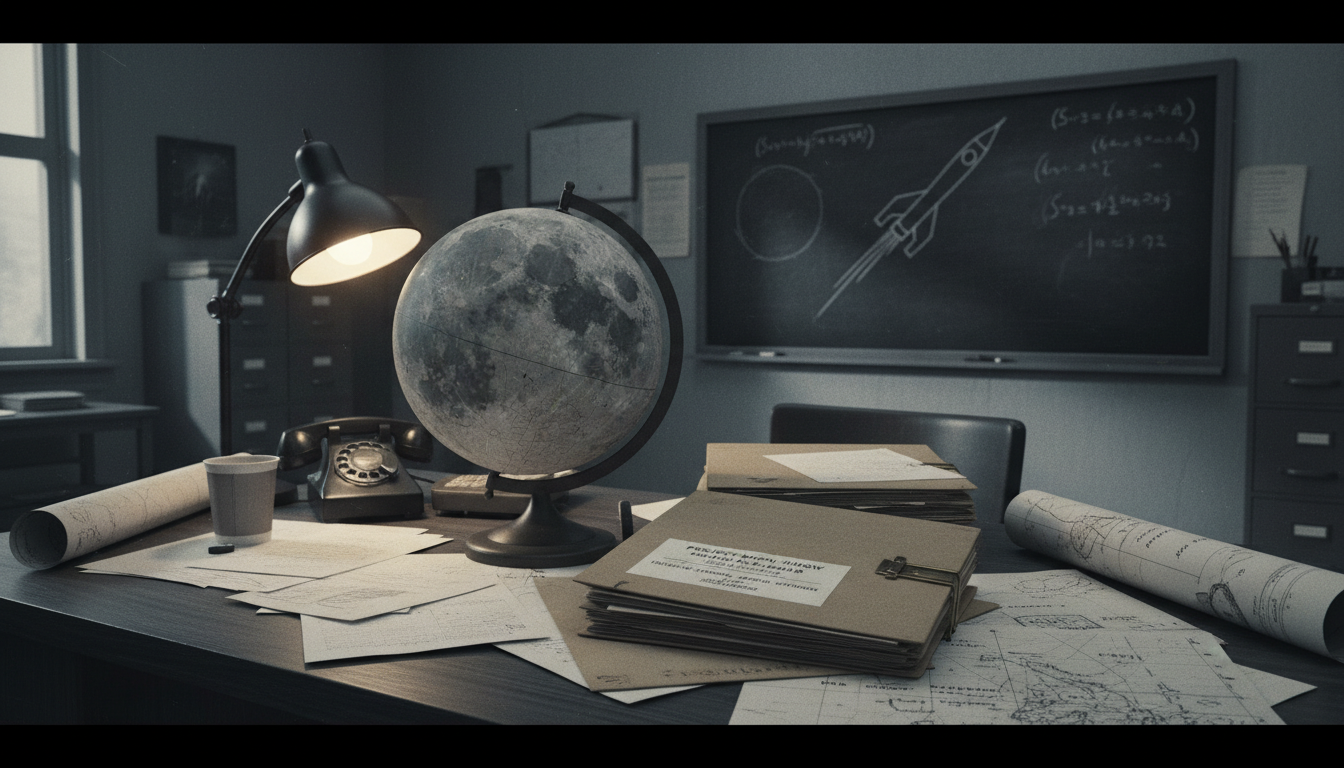
The Air Force secretly studied a nuclear blast on the Moon, and the plan stayed hidden until its leader spoke in 2000. Project A119 was real. In 1958, months after Sputnik, the US Air Force paid a Chicago research foundation to work out whether an atomic explosion on or near the Moon could be seen from Earth and what it would teach scientists. The study was classified, its progress reports were stamped secret, and for four decades the public knew nothing. It came out not through a government release but because Leonard Reiffel, the physicist who ran it, wrote a letter to a science journal defending the record of a famous colleague, Carl Sagan.
The post-Sputnik moon race
The National Security Archive's briefing book on secret lunar plans sets the scene. Before the Moon landing was assigned to NASA, both the Army and the Air Force lobbied to establish outposts there. Its editor, Jeffrey Richelson, groups the declassified record into three themes: early military plans, including the possibility of nuclear tests in space; the use of the Moon to bounce signals for military and intelligence purposes; and US intelligence estimates of Soviet lunar missions. Among the posted records is a study on "the detonation of a nuclear device on or in the vicinity of the moon."
National Security Archive, "Soldiers, Spies and the Moon: Secret U.S. and Soviet Plans from the 1950s and 1960s" (20 July 2014): https://nsarchive2.gwu.edu/NSAEBB/NSAEBB479/
The Army's lunar base
The Air Force study did not stand alone. The Army's two-volume Project Horizon study, released in the same briefing book, argued for a manned military outpost on the Moon. It proposed using a lunar base for surveillance of the Earth and of space, for communications relay, and for operations on the lunar surface, and it worked through the rockets, launches, and construction such a base would need. Read beside A119, it shows how seriously the services treated the Moon as military ground in 1959.
US Army, Project Horizon, Volume I (1959), National Security Archive document 1a: https://nsarchive2.gwu.edu/NSAEBB/NSAEBB479/docs/EBB-Moon01_sm.pdf
The report itself
The one volume that survives in the public record is "A Study of Lunar Research Flights," Volume I, issued by the Armour Research Foundation of the Illinois Institute of Technology on 19 June 1959 for the Air Force Special Weapons Center, under document number AD 425380. Its author list is led by L. Reiffel, and C. E. Sagan appears among the contributors. The abstract says nuclear detonations in the vicinity of the Moon are considered "along with scientific information which might be obtained from such explosions." It lists the military side as investigation of the space environment, detection of nuclear device testing, and "capability of weapons in space." The introduction is blunt: the detonation of a nuclear weapon on or near the Moon "has often been suggested," and the motivation "is clearly threefold: scientific, military and political." Chapters cover lunar optics, seismic observations, surface and magnetic fields, plasma effects, and organic matter on the Moon.
Armour Research Foundation, "A Study of Lunar Research Flights," Vol. I (19 June 1959), AD 425380, via GovInfo: https://www.govinfo.gov/content/pkg/GOVPUB-D301-PURL-gpo32511/pdf/GOVPUB-D301-PURL-gpo32511.pdf
How it surfaced
Silence ended in May 2000. Reiffel, then in his seventies, wrote to Nature in response to a review of Keay Davidson's biography of Carl Sagan. He confirmed that in May 1958 the Air Force asked his group to add a small, fast-track project on the visibility and effects of a hypothetical nuclear explosion on the Moon, that the work was secret, and that he assigned Sagan to model the expanding cloud of gas and dust. Nine monthly progress reports, all classified secret and including all of Sagan's work, went to the Air Force Special Weapons Center from May 1958 to January 1959. Reiffel wrote that in his opinion Sagan "breached security in March 1959" when he described the classified lunar detonation work in an application for a Miller fellowship.
Leonard Reiffel, letter to Nature (May 2000), Wayback copy: https://web.archive.org/web/20250104002106/https://www.nature.com/articles/35011148.pdf
The interviews
The British Observer ran an interview with Reiffel on 14 May 2000. He said senior Air Force officers approached him in 1958 and asked him to fast-track the project, which was titled "A Study of Lunar Research Flights." He said the main aim of the proposed detonation was clearly a public relations exercise and a show of one-upmanship over the Soviet Union, and that the scientific cost of contaminating the Moon was not a priority for the Air Force. Sagan, who died in 1996, had been hired to model how the cloud of dust from the blast would expand, since that cloud decided whether the flash could be seen. The paper noted that details emerged after the Sagan biography was published in the US the year before.
The Guardian/Observer, "US planned one big nuclear blast for mankind" (14 May 2000): https://www.theguardian.com/science/2000/may/14/spaceexploration.theobserver
Two days later the New York Times reported that the US had weighed detonating a nuclear bomb on the Moon "as a show of military and technical strength" in the post-Sputnik years. Reiffel told the paper that the research ran from 1958 under the Air Force special weapons center in Albuquerque, involved up to ten people including Sagan, and that the device considered was about the size of the bomb that leveled Hiroshima. A hydrogen bomb, he said, was ruled out because the heavier weapon was harder to fly 235,000 miles. His team reported on blast effects and how the flash would look on the sunlit or shadowed face of the Moon.
The New York Times, "U.S. Planned Nuclear Blast on the Moon, Physicist Says" (16 May 2000): https://archive.nytimes.com/www.nytimes.com/library/national/science/051600sci-us-nuke.html
What was hidden, and why
What was hidden was a plan to explode an atomic weapon on the Moon, studied by the Air Force and a contractor and never shown to the public. It was hidden the ordinary Cold War way: classification, secret progress reports, and silence after the project stopped in early 1959. The reasons the record gives are the ones the report itself names, scientific, military, and political, with Reiffel adding that the main aim was public relations and one-upmanship. The bomb never flew. The paper trail outlived the secret only because a participant decided to talk.