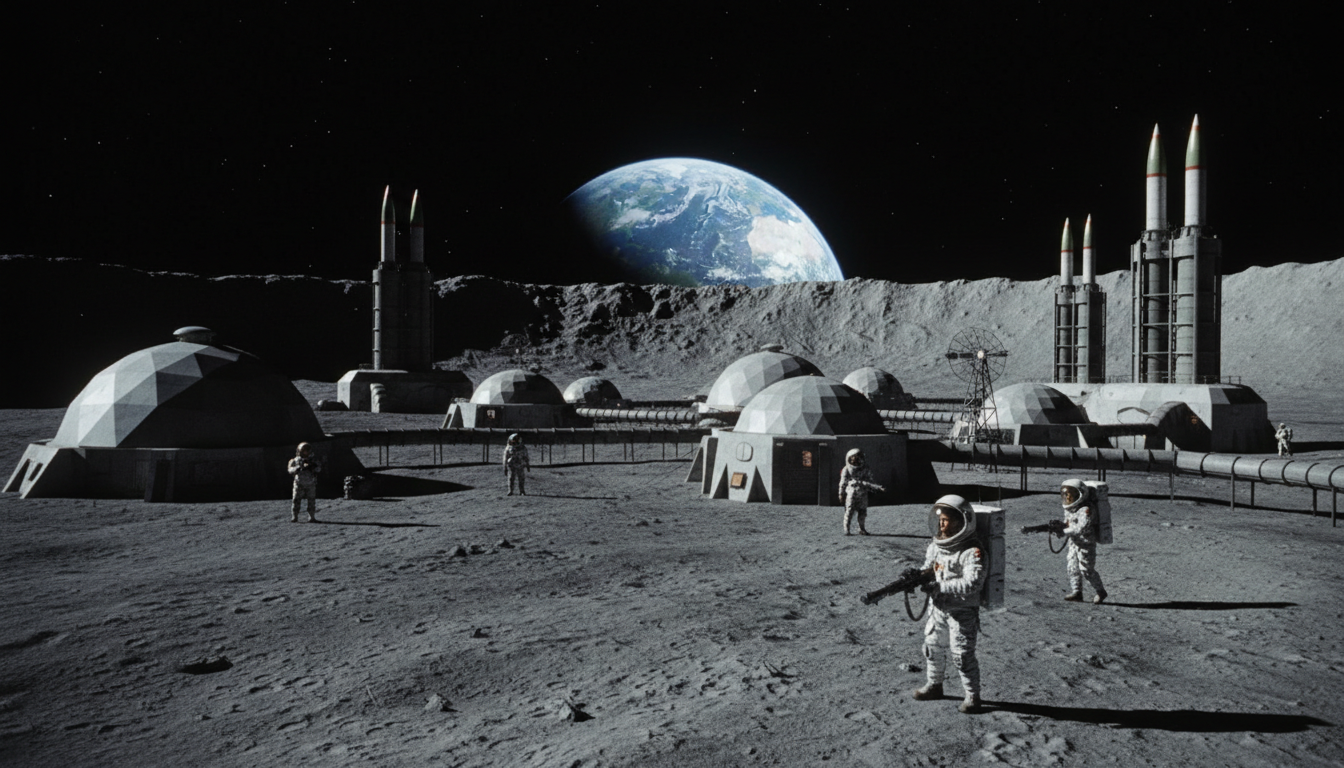
A Fort on the Moon, on Army Letterhead
Long before flags and golf carts on Mare Tranquillitatis, U.S. Army planners drafted a multi-volume study for a permanent military lunar outpost. Conspiracy culture often invents secret moon bases from whole cloth. Project Horizon did not need invention: the feasibility report exists, was classified, and is now public.
The 1959 Army Lunar Study
In March 1959, Lt. Gen. Arthur G. Trudeau, Army Chief of Research and Development, directed Ordnance to determine requirements for a manned lunar station by the mid-1960s. The Army Ballistic Missile Agency (ABMA)—with Wernher von Braun's organization in the loop and Heinz-Hermann Koelle leading technical work—produced Project Horizon: A U.S. Army Study for the Establishment of a Lunar Military Outpost, dated June 1959 (Phase I / Volume summaries around 8–9 June).
The study argued that military, political, and scientific considerations made early U.S. lunar occupation imperative. Stated missions included protecting potential U.S. interests on the Moon; developing Moon-based Earth/space surveillance and communications relay; supporting exploration; and enabling military operations on the lunar surface "if required." Design concepts covered buried cylindrical habitats, nuclear power, logistics, crew rotations, and defense of the outpost. Schedules in the study literature sketched cargo and crew milestones in the mid-1960s with multi-billion-dollar cost envelopes typical of Manhattan-Project-scale rhetoric.
Horizon did not become a funded construction program. As NASA consolidated the civilian space mission, Army lunar-base ambitions were sidelined. Correspondence in 1960 shows the Horizon package forwarded through the Secretary of the Army and Defense to NASA "for such use as may be desired." Smithsonian National Air and Space Museum finding aids hold the volumes; Army history offices and the National Security Archive have published or hosted related PDFs. The documents were later downgraded from higher classifications.
Nuclear delivery from the Moon appears in popular retellings more starkly than in careful readings of the engineering volumes, which emphasize outpost, surveillance, and presence. Archive accuracy prefers the study's own mission language over later embellishment—while still noting that "military operations if required" and Cold War denial-of-Soviet-claims language are on the page.
Permanent Outpost Specs
Documented: the Army produced a serious, detailed 1959 feasibility study for a manned military lunar outpost and circulated it at senior levels. Contested or exaggerated: that Horizon was an active construction program secretly completed; that Apollo was only cover for a finished base; or that every nuclear anecdote attributed to Horizon is verbatim from the report. The study is ambitious militarized space planning; it is not proof of a hidden inhabited base today.
Forum maximalism pairs Horizon with later Apollo anomalies. Historians of the space race treat it as a losing bureaucratic bid: ABMA wanted the Moon mission framed as Army territory before NASA's charter closed that door.
Study Versus Base Folklore
Critics of militarized space cite Horizon as evidence that lunar prestige was never purely scientific in U.S. planning culture. Defenders note every major power explored dual-use space concepts and that Horizon remained paper. Engineers reading the volumes often remark on how much was speculative logistics dressed as certainty.
Status: authentic declassified feasibility study; never built. Horizon belongs in the Archive beside other paper empires of the early space age—real enough to cite, unfinished enough to keep mythmakers busy.