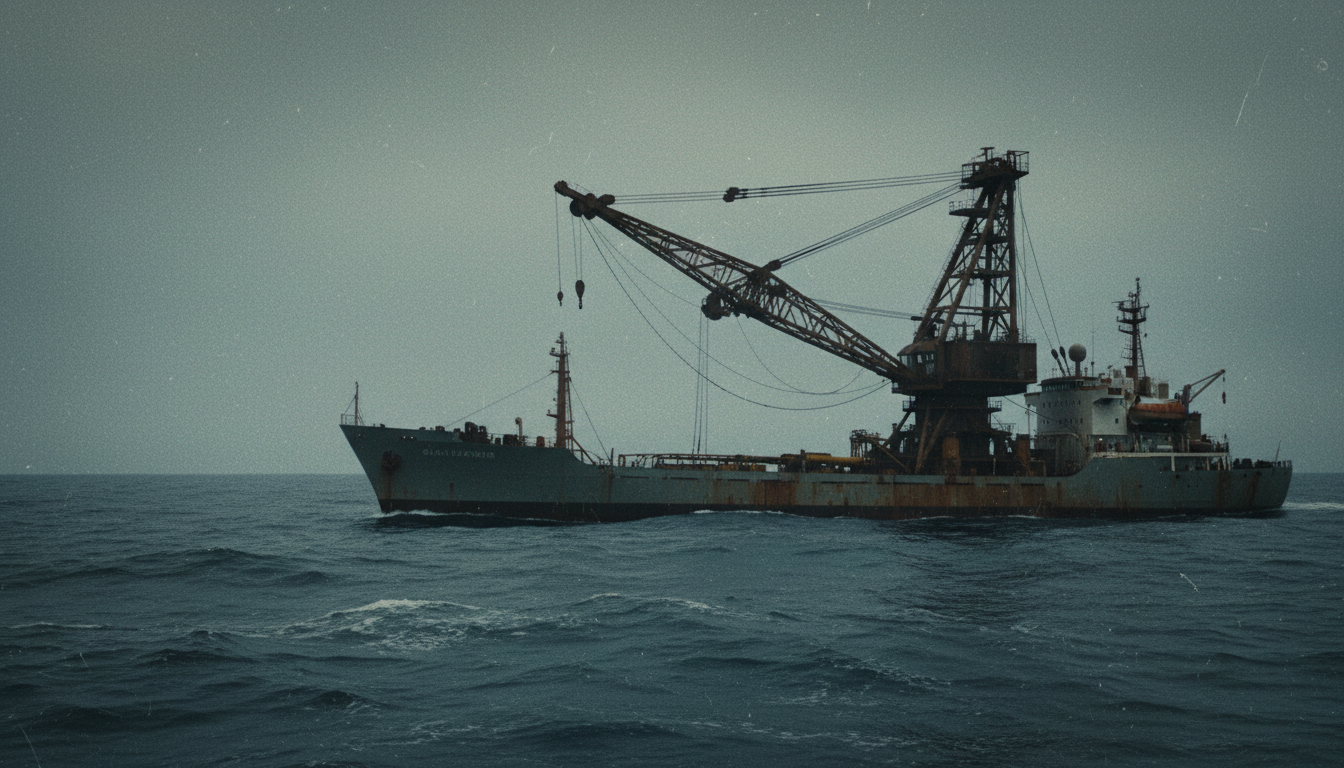
Project Azorian
In 1974 a ship that looked like a deep-ocean mining platform hovered over a grave site in the Pacific. Beneath it, mechanical claws reached for a Soviet Golf-class submarine that had sunk in 1968. The mining story was theater. The customer was the Central Intelligence Agency. The program name was Azorian.
K-129 and the Cover
Soviet submarine K-129 went down northwest of Hawaii with nuclear weapons and cryptographic material aboard—exactly the kind of prize Cold War intelligence services dream about and rarely can touch. U.S. assessments located the wreck in very deep water. Conventional salvage looked impossible. Azorian made the impossible a budget line.
Howard Hughes's public mystique became the cover. The Glomar Explorer was presented as a commercial manganese-nodule mining vessel. Contractors built a capture vehicle nicknamed the "claw." Only a narrow circle knew the real tasking.
What Rose—and What Did Not
The lift was only partly successful. Sections of the submarine were recovered; other portions broke away. Exact inventories of bodies, missiles, and code gear remain sensitive in places and contested in secondary literature, but the Agency's later public histories concede the recovery attempt and partial success. This is no longer a "did it happen" dispute.
Press exposure in 1975—after Los Angeles and national reporting pierced the mining cover—forced the government into a novel FOIA posture. The "Glomar response," refusing to confirm or deny, took its name from this ship and entered case law as a secrecy tool.
Engineering as Espionage
Azorian sits beside acoustic undersea collection and other deep-ocean intelligence efforts as proof that Cold War espionage was sometimes a heavy-industry project, not only a dead drop in a park. Billions in today's dollars, exotic metallurgy, and a cover story robust enough to fool most of the maritime press—until it wasn't.
Fringe extensions (claims of intact alien craft in the same claw, or unbroken cryptographic miracles) are not what CIA historical essays or National Security Archive briefings support. The submarine recovery is the spine.
From Denial to Exhibit
Decades later, CIA.gov publishes Azorian storytelling for a general audience. That arc—from Glomar stonewall to public history—matters for Archive method. Some "conspiracy" topics graduate into acknowledged operations once classification scores change. Azorian graduated. Readers should still separate the documented claw-and-submarine program from every underwater legend that borrowed the Glomar silhouette.
Secrecy Law Named for a Ship
The Glomar response migrated from submarine salvage into a general FOIA tactic: neither confirm nor deny. That legal afterlife is part of Azorian's historical footprint. Journalists who cracked the mining cover in 1975 did not merely spoil a party; they coined a secrecy doctrine's nickname.
Hughes as cutout also teaches corporate mystique as operational camouflage. A billionaire brand can be more persuasive than a bland Navy hull number. Acoustic collection programs elsewhere show the same undersea chessboard without the Hollywood mining ship.
Azorian's public CIA storytelling today is almost cheerful engineering nostalgia. Read it beside the 1970s stonewall to see how classification winters thaw.