The Gift That Listened
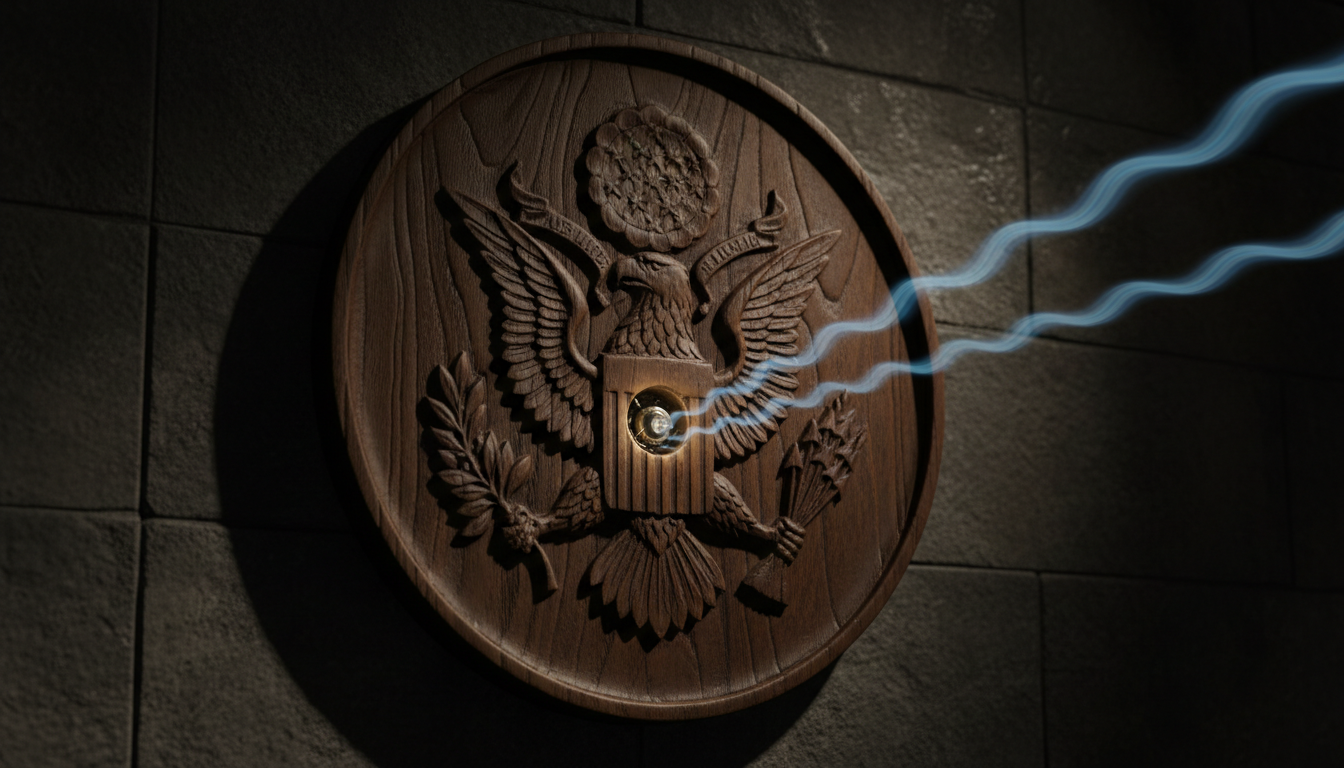
Cold War folklore loved "impossible" bugs: devices with no batteries, no wires, and no active transmitter a sweeper could find humming in a wall. In 1952, U.S. technicians examining Spaso House—the Moscow residence of the American ambassador—confirmed that the folklore had an object. Inside a carved wooden Great Seal of the United States, presented in 1945 by Soviet Young Pioneers to Ambassador W. Averell Harriman, sat a passive resonant cavity microphone later nicknamed The Thing.
The Great Seal Bug
The device, designed by inventor Léon Theremin during his constrained Soviet period, required no internal power source. A thin membrane formed one wall of a cavity tuned so that an external radio beam of the right frequency would illuminate it; voice vibrations modulated the reradiated signal, which could be received by operators nearby. Until that illuminating beam was present, the bug was effectively inert—hence the failure of conventional countersurveillance assumptions built around active transmitters and batteries.
The seal hung in the ambassador's residential study for roughly seven years before discovery in 1952, after which U.S. intelligence reverse-engineered and publicized the principle. Declassified FBI technical files, Crypto Museum reconstructions, and National Cryptologic Museum exhibit materials document the artifact as a landmark in passive RF eavesdropping. During the 1960 diplomatic crises, U.S. officials publicly displayed the technique as evidence of Soviet espionage practices. Popular histories sometimes compress timelines; the core sequence—1945 gift, long dwell time, 1952 find, Theremin attribution—is stable across museum and technical secondary sources.
"Acoustic cyber-espionage" as a modern label is anachronistic branding for a mid-century RF/acoustic hybrid, but it captures why the case still matters to security engineers: the attack surface was the illuminating radar plus a mechanically simple implant, not a battery you could hunt with a sniffer alone. Later embassy microwave and "Havana syndrome" debates are separate controversies; The Thing remains the clean pedagogical ancestor of battery-free illuminated sensors.
Passive Resonance Claims
Documented: a passive cavity bug in the Great Seal monitored ambassadorial space for years. Embellished: that every embassy gift since is equally weaponized, or that Theremin's musical career was merely an intelligence cover. The Thing is spectacular enough without sequel inflation. It also undercuts smug narratives that only one Cold War side ran exotic technical ops; Soviet tradecraft here was elegant and patient.
What Sweeps and Archives Confirm
Some technical writers note later active bugs were often more practical; The Thing's glamour exceeds its long-term operational lineage. Historians of surveillance treat it as the canonical teaching object for passive implants and illuminating beams.
Status: confirmed espionage device and technique. Open-and-shut technical history that conspiracy culture correctly flagged as too weird to be fake before museums hung the replica.
In Archive terms, The Thing is the rare bug story where the folklore understated the elegance: a wooden seal, a resonant cavity, and an illuminating beam were enough to empty an embassy study for seven years.
Primary anchors remain FBI technical files on the Great Seal bug, Crypto Museum reconstructions of Theremin's cavity resonator, and National Cryptologic Museum exhibit materials.