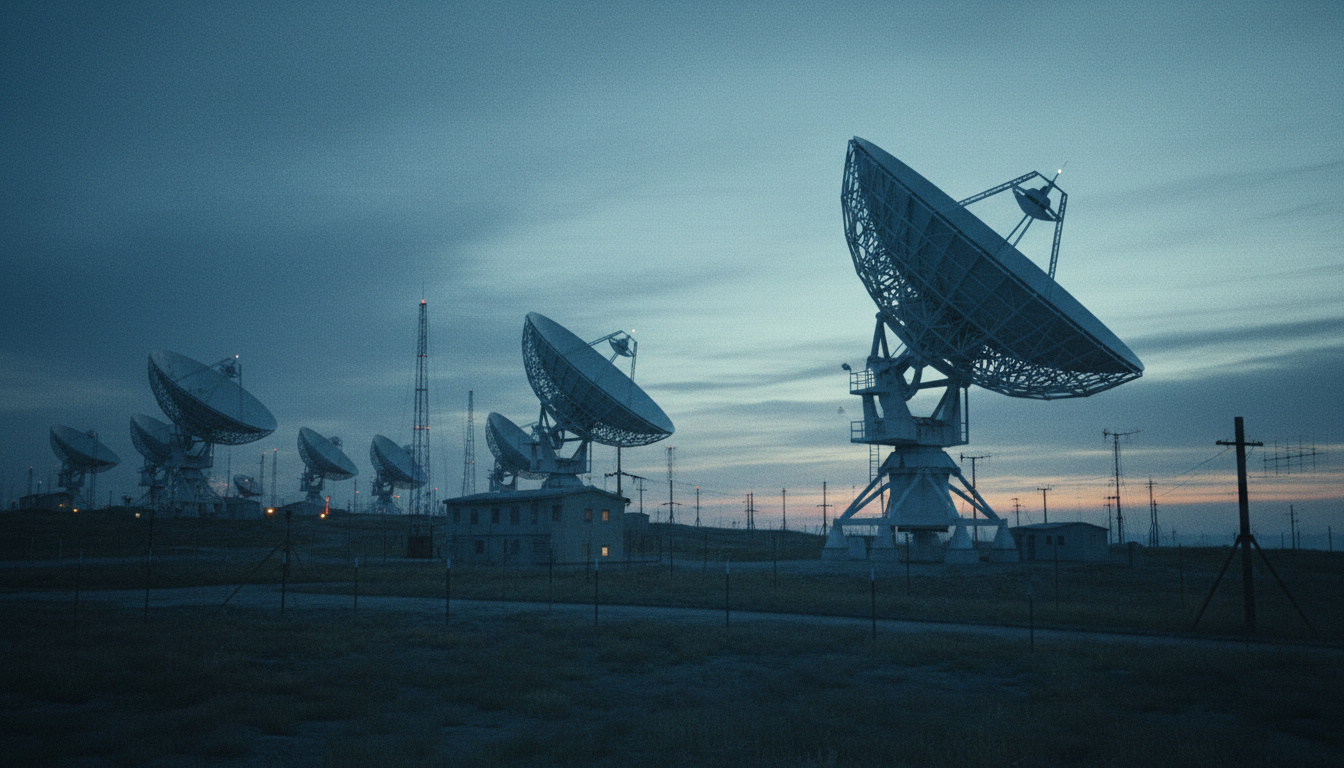
ECHELON
In 2000 the European Parliament stood up a temporary committee with an awkward mandate: determine whether a global interception system nicknamed ECHELON existed, and whether it threatened Europeans' privacy and commercial secrets. The rapporteur's work did not treat the name as science fiction. It treated UKUSA signals intelligence as a political fact requiring legal response.
UKUSA Wiring
The underlying alliance is older than the brand. Wartime and early Cold War agreements bound U.S., British, Canadian, Australian, and New Zealand SIGINT services into what later journalism called Five Eyes. Stations, cables, and satellite dishes fed dictionaries of targeted selectors—phone numbers, addresses, keywords—into shared processing.
ECHELON, in public usage, became shorthand for that dictionary-driven vacuum cleaner, especially the satellite intercept piece. Officials often refused the name while defending the alliance. Parliamentarians and investigative reporters kept using it because victims of industrial-espionage allegations needed a noun.
The Strasbourg Paper Trail
The Parliament's 2001 report is the documentary hinge for European readers. It argued the system was real, that private communications could be swept, and that member states needed stronger privacy shields and industrial counter-intelligence awareness. British and American public comment ranged from dismissal to careful non-denial.
This is not the same paper trail as the 2013 Snowden archive. Snowden mapped corporate portals (PRISM), querying tools, and legal wrappers under FISA and PAA. ECHELON debates were about microwave links, ground stations, and alliance burden-sharing a decade earlier. Continuity of alliance logic is clear. Identity of every cryptonym is not.
Industrial Espionage Fights
European political energy spiked when firms alleged U.S. or allied interception had been used for commercial advantage—claims Washington typically rejected as confusing legitimate military/terror targeting with trade spying. The parliamentary inquiry took the commercial-risk scenario seriously enough to recommend policy changes regardless of any single company's case file.
For Archive purposes, separate three layers: (1) Five Eyes SIGINT cooperation—documented; (2) large-scale satellite/cable interception capabilities—accepted by the EP inquiry; (3) every conspiracy claim about total planetary recording—overclaim.
After Snowden
Post-2013 coverage sometimes treats ECHELON as obsolete vocabulary. That erases the European investigation that forced democratic debate before cloud APIs existed. PRISM entries elsewhere in the Archive cover the Silicon Valley collection face. Acoustic and cable-tapping stories cover other technical faces. ECHELON remains the name under which Europe first tried to litigate the alliance vacuum cleaner in public.
What the record supports: a real UKUSA interception architecture, serious enough for an EP special committee, overlapping later leak-era systems without being identical to them. What it does not support: treating the word ECHELON as proof of omniscience or of every later surveillance rumor.
Stations, Dictionaries, and Politics
ECHELON talk often skips the boring machinery: dish farms, undersea cable access, and keyword lists that prioritize targets. Collection is ranked. Analysts drown without prioritization. "They record everything" is a slogan that erases how SIGINT organizations actually budget attention.
European anger mixed privacy theory with trade fear. U.S. answers mixed alliance solidarity with commercial-denial talking points. Neither side produced a full public wiring diagram. The EP report remains the democratic system's attempt to force a diagram anyway.
After Snowden, corporate compliance portals stole the spotlight. ECHELON belongs in the pre-cloud chapter of the same alliance novel.