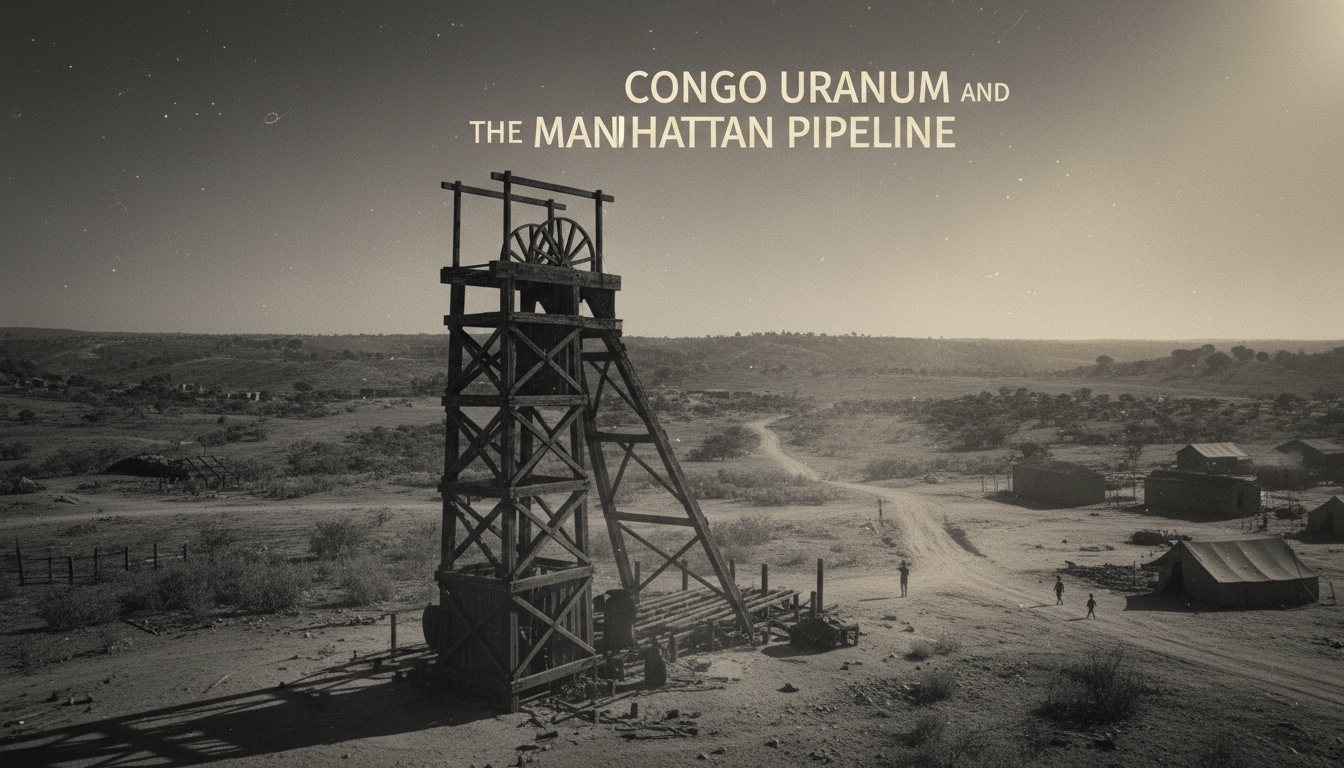
Before Los Alamos needed implosion lenses, the Manhattan Engineer District needed uranium. The richest known pitchblende on Earth sat at Shinkolobwe in Katanga, Belgian Congo, under Union Minière du Haut-Katanga. Edgar Sengier, the company’s director, had already moved about 1,200 tons of ore into a Staten Island warehouse in 1940—ahead of German occupation politics and ahead of most American officials’ interest. In September 1942, Lt. Col. Kenneth D. Nichols bought that stockpile and locked in Congolese supply. DOE’s Manhattan Project history states the blunt procurement fact: Shinkolobwe ore provided roughly two-thirds of the Project’s uranium.
The Deposit and the Stockpile
Shinkolobwe was not a marginal vanadium byproduct play. DOE notes pitchblende averaging more than two percent uranium—orders of magnitude richer than Colorado Plateau carnotite and richer than Canada’s Eldorado feed. Union Minière had mined for radium wealth in the 1920s, then idled the open pit in the late 1930s with large above-ground stocks after radium markets softened. Sengier, warned in London about German interest, shipped half the stored ore—those ~1,200 tons—to New York and kept barrels stamped for Belgian Congo uranium sitting near the Bayonne Bridge while he worked from Manhattan offices blocks from what became Project headquarters.
DOE OpenNet — Uranium Mines: https://www.osti.gov/opennet/manhattan-project-history/Places/Other/uranium-mines.html
NPS — Staten Island, New York: https://www.nps.gov/articles/000/staten-island-new-york.htm
Atomic Heritage Foundation — Edgar Sengier: https://ahf.nuclearmuseum.org/ahf/profile/edgar-sengier/
Official Posture: Buy Quietly, Ship Securely
Early U.S. approaches to Sengier stumbled over cobalt and bureaucracy. After Pearl Harbor and Nichols’s intervention, the posture hardened: purchase the Staten Island ore, contract additional African stocks, and reopen Shinkolobwe despite flooding and power needs. Allied diplomacy with the Belgian government-in-exile and British shareholders produced 1944 agreements to restart production and secure output for military use. Shipping shifted between Lobito and Matadi for security; OSS watched smuggling risks toward Germany. The public heard almost none of this. MED secrecy treated feed materials like weapon design—necessary, and not for newspapers.
DOE OpenNet — Manhattan Project 2010 history PDF: https://www.osti.gov/opennet/manhattan-project-history/publications/Manhattan_Project_2010.pdf
What the Paperwork Shows
NPS and DOE together fix the pipeline: Sengier’s foresight shipment; Nichols’s 1942 buy; Congolese ore as the majority Manhattan feed; Canadian and Colorado sources as complements at lower grade. A sibling paper trail sits in Alsos: Germany had confiscated large Belgian uranium stocks in 1940; Lansdale’s Stassfurt recovery in 1945 pulled roughly eleven hundred tons back into Allied control. The same colonial mineral system that fed Hanford and Oak Ridge had also fed German holdings—until Alsos emptied the mine dump into American and British custody.
AHF — Alsos Mission (Stassfurt ore recovery): https://ahf.nuclearmuseum.org/ahf/history/alsos-mission/
NARA — RG 326 MED/AEC context: https://www.archives.gov/research/guide-fed-records/groups/326.html
Shipping security was its own subplot. Early barrels moved through Lobito; later practice favored Matadi and tighter route discipline after losses at sea taught expensive lessons. Airfields at Elisabethville and Leopoldville expanded to support the logistics machine. None of that appears in popular bomb narratives. All of it appears in procurement historiography that treats oxide tons like any other strategic commodity—except the commodity could end a war.
Why the Story Stayed Quiet
Compartmentation hid tonnages and contracts. Postwar Medal for Merit recognition for Sengier acknowledged service without opening procurement ledgers to the public. Later Congo independence, Katanga secession, and nuclear-smuggling worries after Shinkolobwe’s concrete sealing are real afterlives—date-label them; do not collapse 1960 into 1942. This page’s documented core is wartime Allied acquisition of high-grade Congolese uranium under MED secrecy, not a full political history of the Congo.
Myth Discipline
Documented: Shinkolobwe richness; Sengier Staten Island stockpile; Nichols purchase; ~two-thirds DOE fraction; Allied reopen contracts; German-held Belgian ore as Alsos counterpart. Overclaim to refuse: pulp “stolen bomb” heist captions, “zero bomb without Congo” absolutes beyond DOE’s approximate majority language, and erasing Canadian/U.S. domestic feed entirely. Colonial extraction and Congolese labor conditions belong in labeled historiography; they do not replace the procurement documents.
Date discipline: radium boom 1920s; mine idle late 1930s; Sengier shipment 1940; Nichols deal 1942; reopen agreements 1944; major wartime deliveries; Sengier honored 1946; Alsos Stassfurt 1945.
Grade is the quiet protagonist. Colorado carnotite at roughly a quarter-percent uranium and Eldorado ore at about half to one percent could feed the Project; Shinkolobwe’s multi-percent pitchblende changed the logistics math. Nichols did not chase Congo ore for exotic geography. He chased oxide content that made enrichment and production schedules believable under wartime clocks. Sengier’s barrels on Staten Island were already inside U.S. jurisdiction when the District finally learned to ask. That geographic accident—warehouse near Manhattan, director in Manhattan, Project office in Manhattan—is contingency, not destiny, but it is contingency on the NPS and DOE pages.
Combined with Canadian airlifted concentrates and Plateau ore, the Allied feed system was a portfolio. Congo was the heavy weight. Erase it from the story and the majority fraction disappears; erase Eldorado and Colorado and the portfolio still functioned at higher cost and delay. Prefer that DOE arithmetic to mythic single-cause slogans.
Sengier received the Medal for Merit in 1946—public thanks for a supply chain the public had not been allowed to see. The medal does not settle Congolese political afterlives. It does mark Washington’s acknowledgment that Union Minière’s ore was strategic infrastructure. Read it as a receipt, not a moral blank check.
What the Paper Trail Settles
Settled on the documents: Manhattan’s uranium majority came from Congolese high-grade ore arranged through Union Minière and Sengier’s New York stockpile; Nichols closed the buy under MED secrecy; German-seized Belgian stocks were a parallel risk Alsos later rolled up. Officials needed feed material. The paper trail shows where the richest barrels already waited—and how quietly they entered the pipeline.