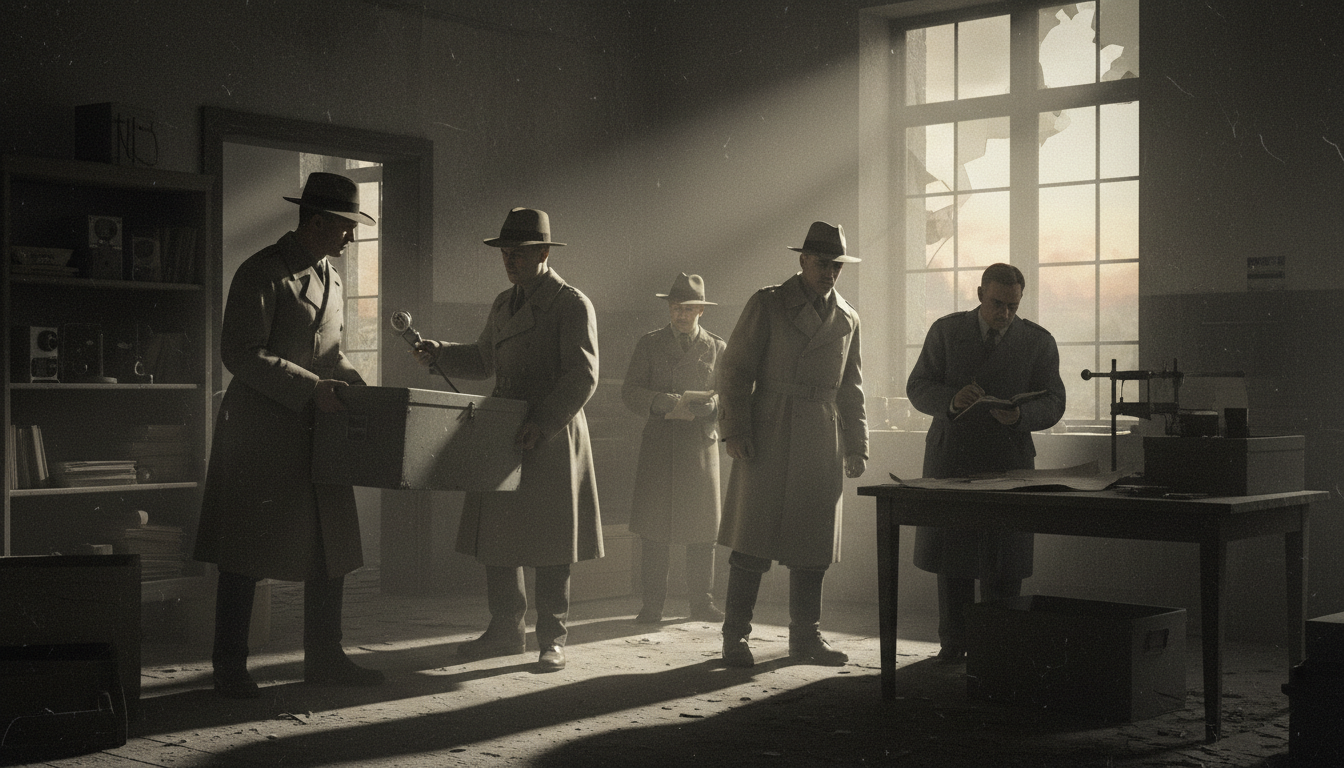
By late 1943 the Manhattan Engineer District had a bomb program and a knowledge problem. Refugee physicists warned that Germany—where fission was first observed in 1938—might hold a lead. Ordinary military intelligence could not be briefed in full without burning the project’s secrecy. General Leslie Groves’s answer was a separate scientific intelligence mission under MED auspices: Alsos. The public later remembered a Nazi-bomb race. The paperwork remembered something colder—measure the German program, seize its people and materials, and keep both out of Soviet hands.
The Fear and the Workaround
Uranium fission in Berlin rearranged Allied threat pictures. Heisenberg, Hahn, von Weizsäcker, and others sat in Allied dossiers as possible bomb-makers with German industry behind them. Groves could not open the Manhattan vault to standard G-2 analysts. In the fall of 1943, General George Marshall’s memo authorized a small scientific-military team selected with Groves and Vannevar Bush’s approval—seed for similar work as Allied armies advanced. The code name Alsos is Greek for “grove.” Groves hated the joke and kept it rather than rename and draw attention.
DOE OpenNet — Atomic Rivals and the ALSOS Mission: https://www.osti.gov/opennet/manhattan-project-history/Events/1942-1945/rivals.htm
Atomic Heritage Foundation — Alsos Mission: https://ahf.nuclearmuseum.org/ahf/history/alsos-mission/
Official Posture: Find Out, Then Deny
Alsos was not a publicity operation. It was assessment and denial. Lt. Col. Boris T. Pash commanded the military side; Dr. Samuel Goudsmit became scientific chief. Phases ran Italy, then France, then Germany, with a London liaison office building target lists of German physicists and labs. Interviews with Italian scientists in late 1943 produced little atomic product but set the pattern: move with the armies, interrogate, seize documents, and stay quiet about what the United States already knew how to build. By war’s end the detachment counted more than a hundred personnel—officers, enlisted, scientists, and counterintelligence agents—still operating as a District mission rather than a newspaper story.
U.S. Army historical framing of the Marshall memo and early seizures: https://www.army.mil/article/132740/alsos_mission_seizes_french_government_arsenal_september_1944
What the Paperwork Shows
France, summer–fall 1944: Alsos entered with advancing units; Frédéric Joliot-Curie’s College of France laboratory became a hinge interview. Joliot’s belief that German progress was limited mattered less than the German names and visits his interrogators logged—Schumann, Diebner, Bothe, Bagge, and others who mapped the uranium research network. Headquarters in Paris fed smaller teams forward. References to Hechingen and the Black Forest research cluster hardened into target folders even while the Battle of the Bulge stalled the ground advance.
Germany, 1945: two clocks ran—capture before the Wehrmacht’s collapse scattered the network, and capture before Soviet occupation zones swallowed facilities. Groves pushed the Oranienburg Auergesellschaft works into an Eighth Air Force strike when American ground seizure looked impossible. Operation Harborage cut across planned French occupation boundaries long enough for Pash’s teams to take Hechingen laboratories and scientists including Otto Hahn, Carl Friedrich von Weizsäcker, and Max von Laue. Heisenberg was taken later in the Bavarian Alps. Near Stassfurt, John Lansdale’s party recovered roughly eleven hundred tons of uranium ore—Belgian stocks the Germans had moved east. Groves told Marshall the haul removed the realistic chance of a German atomic weapon in that war.
DOE OpenNet Manhattan Project history PDF: https://www.osti.gov/opennet/manhattan-project-history/publications/Manhattan_Project_2010.pdf
Farm Hall: The Audited Conversation
Operation Epsilon detained ten German nuclear scientists at Farm Hall, England, from July 1945 into early 1946. The house was wired. When Hiroshima news broke, the transcripts captured shock, calculation, and argument about how far the German uranium-pile work had actually gone. Those recordings stayed closed for decades; UK catalogue access now points researchers at the transcript series. The mission itself was formally disbanded in October 1945, after the European war’s nuclear inventory problem had been turned into American and British custody problems.
The National Archives (UK) — Operation EPSILON / Farm Hall: https://discovery.nationalarchives.gov.uk/details/r/C4414534
Why the Story Stayed Managed
MED compartmentation meant Alsos results fed Groves and a tiny circle, not newspaper science pages. Late-war Soviet-denial objectives sat inside occupation diplomacy that could not be explained in public. Farm Hall’s value was precisely that the subjects did not know they were on tape. Postwar historiography then split: moral-obstruction readings of Heisenberg versus technical-shortfall readings of pile and isotope work. Both debates belong in labeled historiography. Neither erases the operational fact pattern Alsos put on paper—scientists seized, ore recovered, no German production-scale bomb plant found in the American assessment.
NARA — AEC/MED administrative context (RG 326): https://www.archives.gov/research/guide-fed-records/groups/326.html
Myth Discipline
Documented: Alsos as MED scientific intelligence; Pash/Goudsmit structure; Italy–France–Germany phases; Harborage and Stassfurt; Farm Hall detention and later-opened transcripts; Allied judgment that Germany had not fielded an atomic bomb. Overclaim to refuse: viral “Hitler nearly had the bomb” slogans, unsourced late-war German nuclear test folklore, and collapsing Farm Hall’s contested moral dialogue into a single cartoon of sabotage or genius. Read Alsos beside the Congo uranium pipeline and the MED secrecy regime—same District, same Groves problem of knowing without telling.
Date discipline matters. Alsos was authorized in late 1943; the Italian probe ran that December; France followed the 1944 breakout; Germany and Harborage filled the spring of 1945; Farm Hall ran from July 1945 into January 1946. The mission’s October 1945 disbandment closed the wartime chapter even as the AEC inheritance of MED records opened a longer classification fight over what those seizures meant.
What the Paper Trail Settles
Settled on the documents: a Groves-directed mission measured German nuclear work and seized its people and materials; the wartime American assessment was that Germany lacked a production bomb program; Farm Hall preserved the scientists’ own reactions under surveillance. Officials said the Allies had to know. The paper trail says they built a private intelligence arm to find out—and to keep what they found from Moscow.