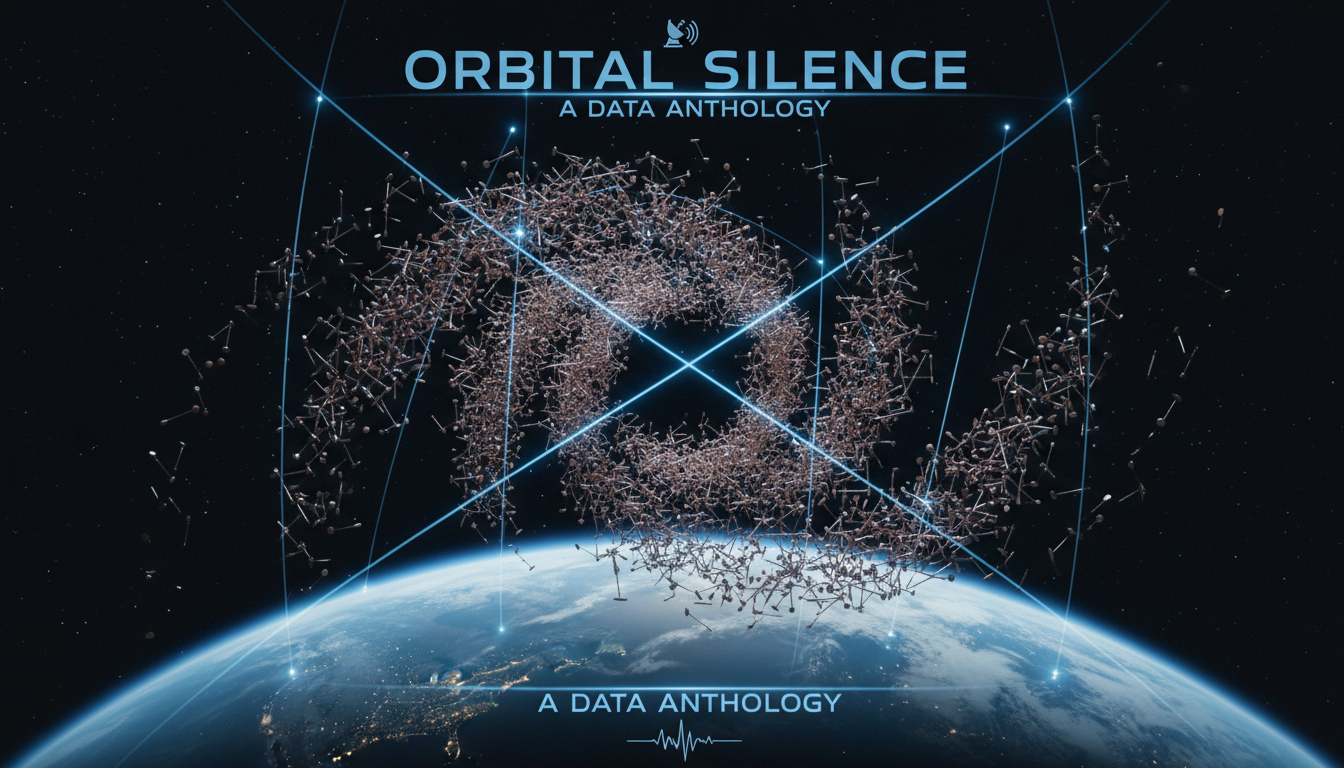
In the early 1960s, long-range military communications still depended on cables that could be cut and an ionosphere that solar storms—or nuclear detonations—could wreck. MIT Lincoln Laboratory’s answer sounded like science fiction until it flew: scatter hundreds of millions of hair-thin copper dipoles into a belt roughly 2,200 miles up and bounce X-band signals off the artificial cloud. Project West Ford (also called Needles) was a DoD communications experiment, not a weather myth. One launch failed. The next built a working belt. Astronomers protested. Decades later, NASA’s Orbital Debris Program Office still catalogues clumps that never dispersed.
The Communications Problem First
Undersea cables were finite and vulnerable. Ionospheric reflection worked until the Sun—or a high-altitude nuclear burst—ruined the path. DoD wanted a survivable backup that did not depend on a live satellite transponder an adversary could jam or kill. A passive belt of resonant dipoles was the ugly, elegant gamble: if enough needles occupied the common volume of two ground beams, energy would scatter and a link would close.
An Artificial Ionosphere on Purpose
Walter E. Morrow at Lincoln Lab, with Harold Meyer of Ramo-Wooldridge, proposed the dipole belt as a passive scatter medium—an artificial ionosphere for command-and-control links. Each needle was about 0.7 inch long (half-wave at roughly 8 GHz) and a fraction of a human hair thick. Design targets talked on the order of 480 million dipoles in a medium-Earth belt. Successful links needed high-gain dishes (order of 60-foot class), high-power transmitters, and receivers that could tolerate Doppler-spread returns from a cloud of moving dipoles. The belt was engineered for short life: high area-to-mass ratio so solar radiation pressure would pump eccentricity until atmospheric drag swept the needles out. That design choice was politics as much as physics—an answer to astronomers who feared a permanent fog.
Lincoln Laboratory “Space Needles / Looking Back” PDF: https://www.ll.mit.edu/sites/default/files/page/doc/2018-05/Looking_Back_3.pdf
October 1961 Failure, May 1963 Belt
The first attempt, October 1961, did not spin up the dispenser. Dipoles stayed packed. Redesigned hardware flew in May 1963. A belt formed. Voice, data, and teletype links ran between West Ford stations at Millstone Hill, Massachusetts, and Camp Parks, California—Lincoln Lab’s own retrospective calls it the first demonstration of reliable transcontinental military satellite communications of that passive kind. By late 1965, the dispersed belt was largely gone on schedule. Active communications satellites with onboard transponders were already winning the doctrine fight. West Ford had put Lincoln into the space business and helped justify Haystack—literally built to look for needles in space.
Astronomers Push Back
Optical and radio astronomers feared interference with observations and collision risk to other spacecraft. Contemporary scientific press—including Nature’s West Ford coverage—recorded the protest politics that later fed “due regard” language in space-activity norms. The experiment was relatively open for a military project; that openness did not calm IAU-era warnings about harmful interference with astronomy. The Archive tension is not “secret copper cage.” It is a public science fight over who gets to alter the orbital environment for a communications demo, and what consultation looks like when the payload is a planetary necklace of metal.
Nature West Ford PDF: https://www.nature.com/articles/192108a0.pdf
I.I. Shapiro’s 1966 Science paper, “Last of the West Ford Dipoles,” tracked how the experimental population faded as solar pressure and drag did their work: https://www.science.org/doi/10.1126/science.154.3755.1445
What NASA Still Tracks
Dispersed needles were meant to reenter. Undispersed clumps—failed packets that never became a fine belt—remained as catalogued debris. NASA’s Orbital Debris Program Office has repeatedly treated West Ford remnants as a real small-debris population: radar-studied (Haystack and related sensors), counted in quarterly news, folded into debris overviews and modeling discussions. Clump counts in the tens (order of forty-plus objects above typical tracking thresholds in 2010s ODPO reporting) are agency language, not blog lore. The irony Lincoln Lab notes is sharp: the Lab that made the needles later helped build the radars that hunt their leftovers.
NASA ODPO Quarterly News 17-4 (Oct 2013): https://orbitaldebris.jsc.nasa.gov/quarterly-news/pdfs/odqnv17i4.pdf
ODPO photo gallery / program door: https://orbitaldebris.jsc.nasa.gov/photo-gallery/
NASA NTRS orbital-debris overview (West Ford context): https://ntrs.nasa.gov/api/citations/20190025189/downloads/20190025189.pdf
From Experiment to Debris Case Study
By the time the dispersed belt decayed, Lincoln Lab was already building active X-band satellite technology. West Ford’s afterlife is therefore split: a short successful communications demo in the history of military satcom, and a long debris case study in NASA ODPO quarterlies. Both halves are primary. Neither requires a conspiracy caption about secretly shading telescopes forever.
Myth Discipline
Reject permanent “Earth wrapped in copper” slogans that erase the designed decay and the mid-1960s sweep of the dispersed belt. Reject the claim that West Ford was only a hoax or only debris vandalism with no communications result—Lincoln Lab and the 1963 Millstone–Camp Parks links say otherwise. Reject also the conflation of Project West Ford with every later space-debris scare; the needles are a named, dated experiment with a laboratory and agency paper trail. Stick to Lincoln Lab parameters, Shapiro’s lifetime analysis, and NASA ODPO clump reporting. Prefer those figures over viral environmental captions that skip the 1965 schedule and the clump-versus-dispersion distinction.
What the Paper Trail Settles
Settled on the documents: Lincoln Lab/DoD Project West Ford dipole-belt experiment; October 1961 dispenser failure; May 1963 successful belt and Millstone–Camp Parks links; contemporary astronomy protest record; designed short orbital life for dispersed needles; NASA ODPO documentation of remaining undispersed clumps. Overclaim to refuse: a forever copper shell around Earth, or a purely anti-astronomy secret without the communications paperwork.
The tension that remains is environmental precedent. Officials proved a passive orbital scatter net could work. The same experiment left tracked leftovers and a political memory about who consults whom before altering the sky. West Ford is that trade—read with the Lincoln Lab note and the ODPO quarterlies open.