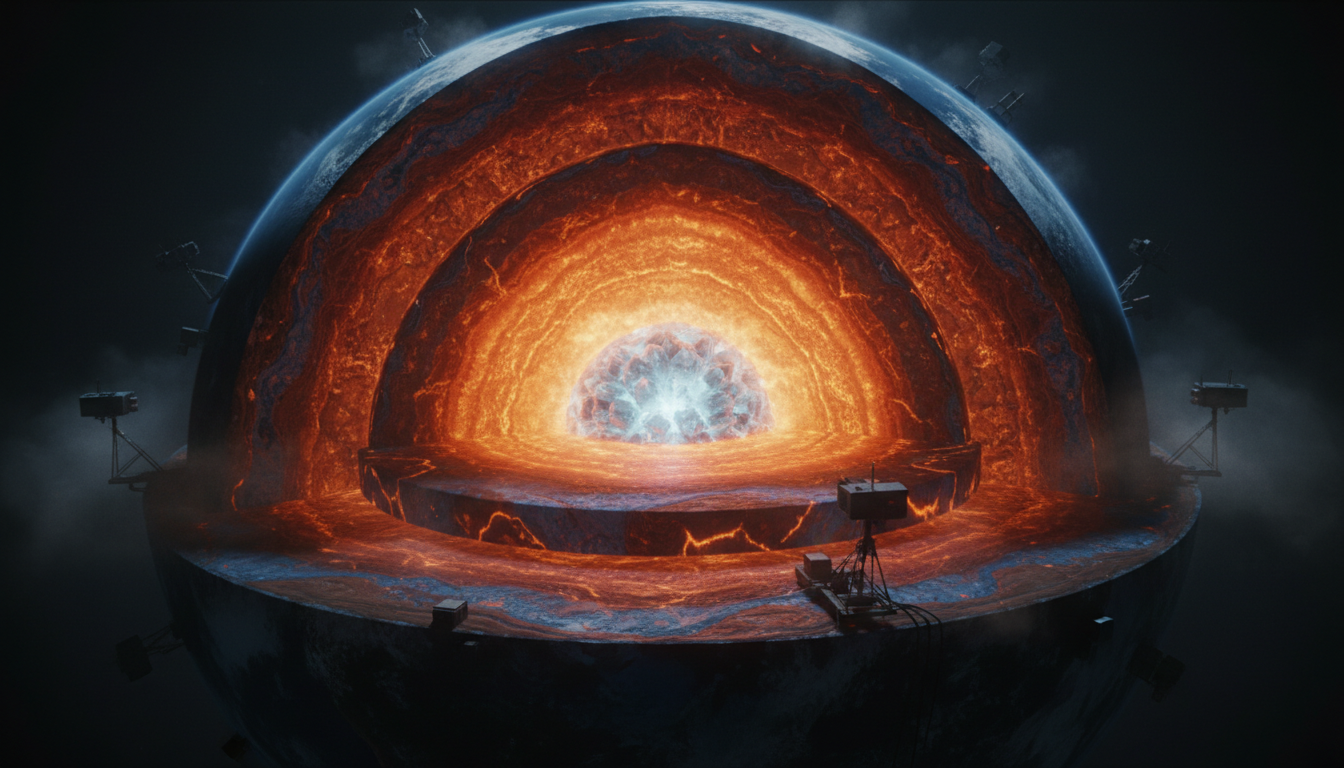
A further ball inside the inner core is disputed: the papers do not agree on its size or its position. A U.S. Geological Survey booklet still describes a liquid outer core and a solid inner core, and it does not print a third ball. Seismology papers propose an innermost region, then give different radii, thicknesses, and positions. A 2023 commentary says that region was, until recently, treated as a possible artefact, and that two analyses reach opposing conclusions about where it sits.
What the survey booklet prints
The Interior of the Earth, a U.S. Geological Survey general-interest publication, says the planet is made of three main shells: crust, mantle, and core, and that the mantle and the core are each divided into two parts. It says the core was identified in 1906 by R. D. Oldham from earthquake records. It says the outer core is presumed liquid because it does not transmit shear waves and because compressional waves slow sharply as they pass through it. It says the inner core is considered solid because of the behavior of P and S waves that pass through it. It says data from earthquake waves, the Earth's rotation and inertia, magnetic-field dynamo theory, and laboratory work on iron point to a core composed principally of iron, with about 10 percent alloy. That booklet does not name an innermost inner core, and it does not give a radius for a ball inside the inner core.
U.S. Geological Survey, The Interior of the Earth: https://pubs.usgs.gov/gip/interior/
A proposed innermost region
In 2002 Miaki Ishii and Adam M. Dziewoński wrote, in the Proceedings of the National Academy of Sciences, that since the discovery of the inner core in 1936, no additional spherical subshell of the Earth had been observed. From an extensive seismic data set they propose an innermost inner core with a radius of about 300 kilometers, with a distinct transverse isotropy relative to the bulk of the inner core. They write that, within that innermost region, the slowest direction of wave propagation is about 45 degrees from the east-west direction. The paper proposes the region. It does not say the proposal ends the argument, and it does not print a hollow interior.
Ishii and Dziewoński, Proceedings of the National Academy of Sciences, 8 October 2002: https://pmc.ncbi.nlm.nih.gov/articles/PMC137830/
On 21 February 2023 Thanh-Son Phạm and Hrvoje Tkalčić reported, in Nature Communications, stacked waveforms from global stations and up-to-fivefold reverberating waves from selected earthquakes along the Earth's diameter. They call those arrival pairs hitherto unreported. Their inferred model contains a roughly 650-kilometer-thick innermost ball, with P-wave speeds about 4 percent slower at about 50 degrees from the rotation axis. They write that the inner core's outer shell shows much weaker anisotropy, with the slowest direction in the equatorial plane. They say the findings strengthen the evidence for an anisotropically distinct innermost inner core and a transition to a weakly anisotropic outer shell, which could be a fossil of a significant global event. The paper does not say that thickness is the 2002 radius.
Phạm and Tkalčić, Nature Communications, 21 February 2023: https://pmc.ncbi.nlm.nih.gov/articles/PMC9944935/
A commentary that leaves the position open
On 27 September 2023 Lauren Waszek, Jessica Irving, Thanh-Son Phạm, and Hrvoje Tkalčić published a commentary, also in Nature Communications, titled Seismic insights into Earth's core. Under the heading of the innermost inner core, they write that until recently the region was considered a possible artefact, but that current work is iterating toward a consensus on its properties. They describe it as a few hundred kilometers in radius, with different anisotropy from the bulk of the inner core and a gradual transition. They write that it has been proposed the region displays hemispherical asymmetry, while recent work argues it may instead be shifted off-centre. They then say those two analyses define the region with different criteria, one using the polar-equatorial difference in wavespeed and the other the direction of slowest wavespeed, and that the analyses subsequently reach opposing conclusions for its position. They list possible dynamical readings, including a gradual change in iron's crystalline structure, a relic of two-stage formation, or the onset or cessation of external texturing, and they say they anticipate further improvements to the models. The commentary does not choose between the opposing position results.
Waszek, Irving, Phạm, and Tkalčić, Nature Communications, 27 September 2023: https://pmc.ncbi.nlm.nih.gov/articles/PMC10533822/
Later papers that use the region, and do not settle it
On 8 December 2025 Efim Kolesnikov and coauthors, in Nature Communications, treat depth-dependent anisotropy in the inner core as well documented and poorly understood, and as plausibly related to alignment of iron-alloy crystals. They write that anisotropy reported by seismic studies for the outer region of the inner core is more than 50 percent lower than that reported for the innermost inner core, about 4 to 6 percent. They hypothesize that the depth-dependent pattern may result from chemical stratification of silicon and carbon as the inner core crystallizes from the center outward. The hypothesis uses those seismic reports. It does not publish a new radius.
Kolesnikov and coauthors, Nature Communications, 8 December 2025: https://pmc.ncbi.nlm.nih.gov/articles/PMC12689643/
On 19 July 2022 Tinghong Zhou, John A. Tarduno, and coauthors, in Nature Communications, use paleomagnetism to ask when inner-core crystallization started. The abstract says new single-crystal paleointensity data show the geomagnetic field was renewed in the early Cambrian after a near collapse in the Ediacaran, and that this implies the innermost and outermost structure of the inner core formed 450 million years ago. The paper also says the imprint of an older degree-1 pattern is preserved in the innermost inner core. That "implies" is the paper's inference from the magnetic record. It is not a travel-time radius, and it does not close the position disagreement in the 2023 commentary.
Zhou, Tarduno, and coauthors, Nature Communications, 19 July 2022: https://pmc.ncbi.nlm.nih.gov/articles/PMC9296475/
Beside the claim
The survey booklet prints a two-part core, liquid outside and solid inside, and stops there. Ishii and Dziewoński propose an innermost ball of about 300 kilometers' radius. Phạm and Tkalčić infer a roughly 650-kilometer-thick innermost ball with a different slow direction from the outer shell of the inner core. Waszek and coauthors say the region was lately a possible artefact, describe it as a few hundred kilometers in radius, and say two definitions produce opposing conclusions about position. Kolesnikov and coauthors cite a stronger innermost anisotropy of about 4 to 6 percent and offer a chemical-stratification hypothesis. Zhou and coauthors infer a 450-million-year age for an innermost and outermost structure from paleomagnetic renewal. None of these doors prints a hollow Earth, and none of them declares a single winning radius.