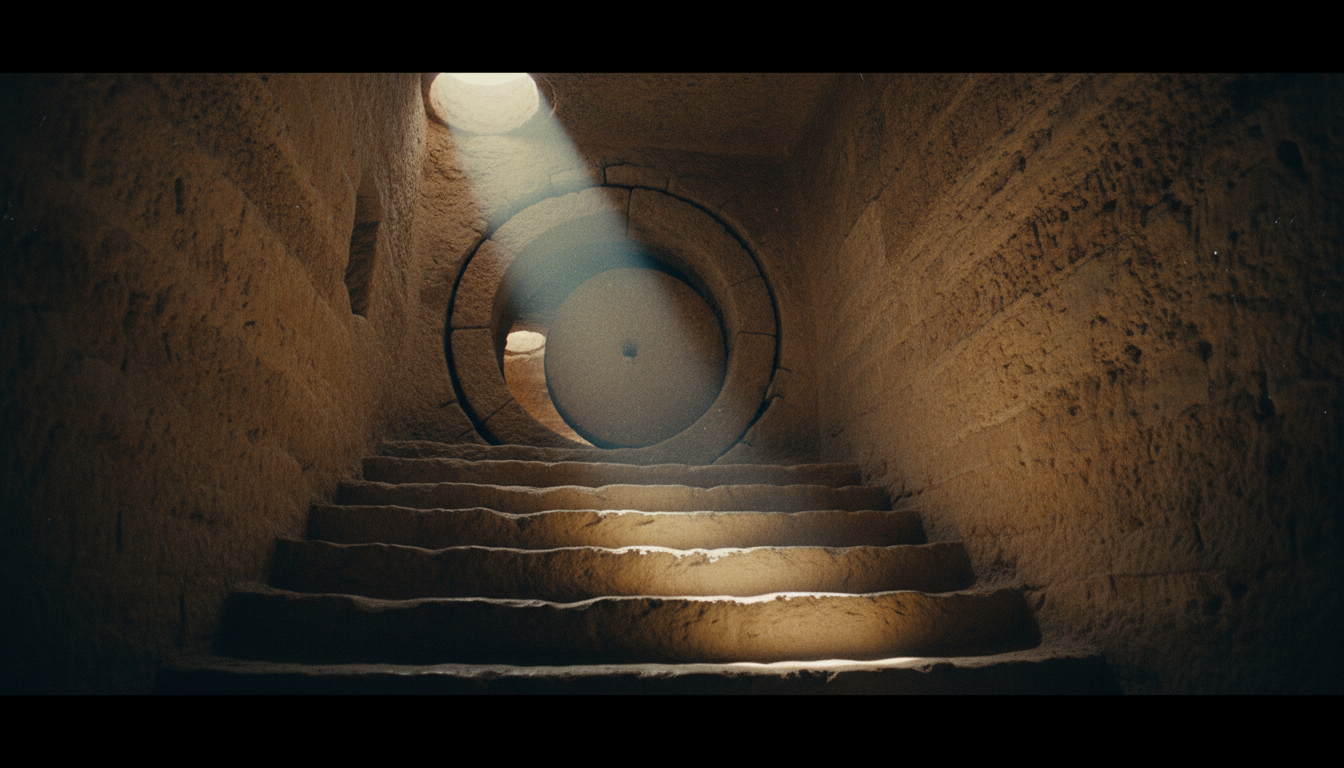
Somewhere under a Cappadocian town, people once rolled a millstone-sized door across a tunnel and waited in the dark, with their animals, their wine presses and their wells, for whoever was above to go away. That much nobody disputes. The theory is about who first cut those tunnels and when. Ancient-alien writers and lost-civilization researchers argue that Derinkuyu is far older than the textbooks allow, that its first levels may date back thousands of years before the Byzantines and even to the end of the Ice Age, and that a city dug this deep was built against something worse than raiders: a cataclysm, or visitors from elsewhere. The official dates, in this reading, are a convenient floor that no one has wanted to dig beneath.
Crystalinks' page on the underground cities (https://www.crystalinks.com/derinkuyu.html) puts the adherent case plainly. It describes a city joined to others by miles of tunnels and says that "no one is certain how it was created and what its original purpose was." Ancient-alien theorists, it says, "speculate that it is thousands of years older than believed, and created by alien visitors" who later abandoned it, and the page groups Derinkuyu with Göbekli Tepe and Karahan Tepe as signs of "an advanced civilization that existed thousands of years ago." It also gives the conventional view: that Christians fleeing Roman persecution hid there, and that some finds belong to the Middle Byzantine period, between the fifth and tenth centuries. The tension between those two readings is the whole debate in a single web page.
The oldest text that people bring into the argument is Xenophon's Anabasis, written around 370 BCE. In book 4 (https://www.perseus.tufts.edu/hopper/text?doc=Perseus:text:1999.01.0202:book=4:chapter=5:section=25), the retreating Greek army reaches villages where "the houses here were underground, with a mouth like that of a well, but spacious below." Tunnels were cut for the pack animals, while people climbed down by ladder, and goats, sheep, cattle and fowl lived and fed in the houses. The translator adds that such underground villages could still be found in modern Armenia. Xenophon was describing Armenia, not Cappadocia, so the passage is not a description of Derinkuyu itself. What it shows is that cutting homes into the ground, animals and all, was an established way of living in Anatolia more than two thousand years ago, which is the strongest written support for an early start.
BBC Travel's "Turkey's underground city of 20,000 people" (https://www.bbc.com/travel/article/20220810-derinkuyu-turkeys-underground-city-of-20000-people), published in 2022, is the version most readers meet. It describes the city of Elengubu, now Derinkuyu, as more than 85 metres deep with 18 levels, able to hide up to 20,000 people for months, and in near-constant use for thousands of years, passing from Phrygians to Persians to Byzantine Christians. It was finally abandoned in the 1920s, when the Cappadocian Greeks left for Greece. The article tells the story that a local man rediscovered it in 1963 when his chickens kept vanishing into a crevice during a house renovation, and says more than 600 entrances have been found inside private homes. It also links Derinkuyu to Xenophon, while noting that its exact date of construction is contested.
The figures in that story are where the questions start. A site devoted to the city, "Derinkuyu: popular claims and documented evidence" (https://derinkuyuyeraltisehri.com/en/myths-and-evidence/), checks each number against Turkish official and academic sources. The figure of 20,000 people appears in no official Turkish source or UNESCO document, and its documented extent is not compatible with that many permanent residents. Official sources describe eight levels open today and twelve or thirteen estimated once cleared; nothing traceable supports eighteen. Depth is 40 metres to one ventilation shaft and 85 to a water shaft with no surface opening. The date of 1963 is confirmed as a rediscovery, but the chicken story is not published by any official source. On dating, the page notes that Turkish official bodies do not agree with one another: one points to around 3000 BCE and a Proto-Hittite era, another to the Assyrian colonies. No published find context shows Hittite construction. The often-repeated Phrygian date of the eighth and seventh centuries BCE traces back to Martin Urban's regional survey of the 1960s and is presented as a hypothesis. The rolling stone doors, closable from inside, and wells left unconnected to the surface so they could not be poisoned are documented. A secret escape tunnel is not.
UNESCO's listing for Göreme National Park and the Rock Sites of Cappadocia (https://whc.unesco.org/en/list/357/), inscribed in 1985, names Derinkuyu and Kaymaklı among the region's subterranean cities. It places the dwellings, troglodyte villages and underground towns in "a traditional human habitat dating back to the 4th century," and says that later, "in order to resist Arab invasions," people began banding together in underground towns "which served as places of refuge." That is the anchor of the official account: the deep city as we see it is Byzantine in its main use, a shelter against the raids of the seventh to tenth centuries, whatever lies beneath it.
A 2025 cultural-geography study in Asia Minor Studies, "Evaluation of Underground Cities in Nevşehir and its Surroundings in Terms of Cultural Geography" (https://dergipark.org.tr/en/pub/asm/article/1583507), describes the underground cities as places "used by many individuals, societies and groups from ancient times to the present." Its fieldwork covered Derinkuyu, Kaymaklı, Özkonak, Güzelyurt and Tatlarin, and found them concentrated north of Derinkuyu, northwest of Ürgüp and around Güzelyurt and Gülağaç. That phrasing, from ancient times to the present, is close to what adherents say: the cities were reused and re-cut over and over, so the oldest layer may lie under centuries of later work.
Derinkuyu is a real refuge city whose date of first cutting no one has fixed. Adherents argue it is thousands of years older than official accounts and possibly built against a cataclysm or by visitors; UNESCO and Turkish sources place its main use in Byzantine resistance to Arab raids, with an earlier Phrygian start offered only as a hypothesis.
What Stays Contested
The first cutting of Derinkuyu has never been dated by excavation. Cut rock cannot be carbon-dated, and centuries of re-cutting have blurred older work. Until a sealed deposit is found and dated, the Phrygian, Hittite and much older readings all rest on comparison, not on a date from the rock.