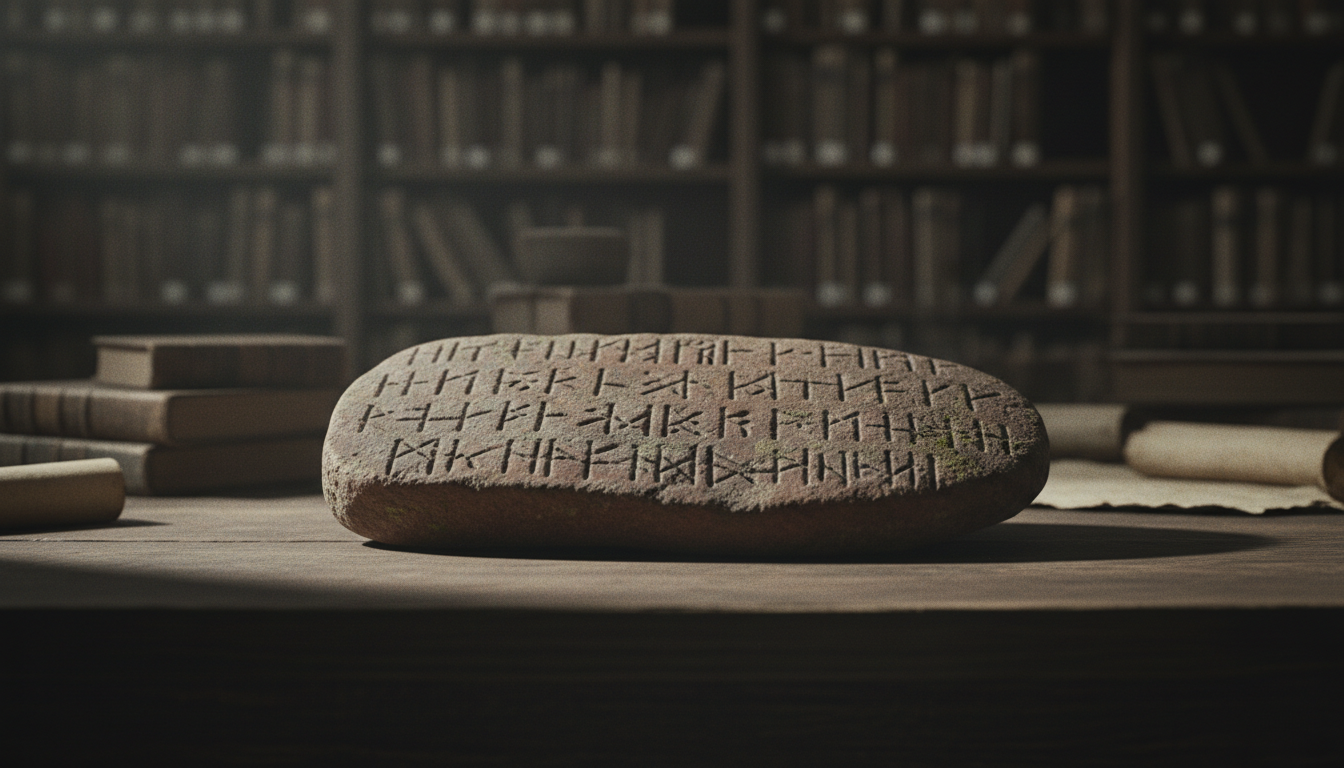
In 1898, on Olof Öhman’s farm near Kensington, Minnesota, a stone slab turned up in aspen roots. Its runic inscription claims a party of Swedes and Norwegians reached the region in 1362. The slab is real. The medieval voyage is not settled history. Local museum prestige in Alexandria, mid-century Smithsonian display episodes, and Minnesota identity symbolism pull one way. Runology and historical scholarship—increasingly tied to late-nineteenth-century Swedish secret-rune traditions—pull another. This Archive file stays contested. It maps the authenticity debate without baptizing a 1362 Midwestern Norse colony as fact.
The Find and the Advocacy Chain
Öhman’s discovery story became a regional legend: stone clutched in roots, inscription dated 1362, scholars summoned and divided. Hjalmar Holand’s decades of advocacy kept the stone in print and in courtrooms of opinion. Minnesota Historical Society committees, early geological and linguistic opinions, and later transfers of interest left a paper trail MNopedia still summarizes: museum library titles stacked high, expert majority leaning forgery, unanswered “if a hoax, who and why” questions that keep local belief alive.
MNopedia — Kensington Runestone: https://www.mnhs.org/mnopedia/search/index/thing/kensington-runestone.
The stone’s public life includes Smithsonian Institution display and a 1965 New York World’s Fair Minnesota Pavilion appearance. Prestige travel is not the same thing as authentication. Contested filing records how institutional stages can amplify an object without closing a runological case.
Local Custody, Local Symbol
The Runestone Museum in Alexandria presents the stone as its hallmark artifact—the founding draw when the museum opened in 1958. Museum prose stresses enduring mystery and invites visitors to the Ohman farm park landscape. Regional business iconography and even the Minnesota Vikings’ nickname folklore sit in the stone’s cultural weather. That weather is documentary. A community can build identity around an unresolved inscription without converting the inscription into medieval chronicle fact.
Runestone Museum — stone page: https://runestonemuseum.org/runestone/.
Runestone Museum home: https://runestonemuseum.org/.
Runology Against the 1362 Reading
Swedish National Heritage Board essays in English have traced Kensington rune forms toward late-nineteenth-century secret writing traditions in Hälsingland and related Swedish districts, including Hassela and Haverö comparisons. The argument is not “Minnesota cannot have Vikings” as ethnic sneer. It is that the graphemes and language patterns fit modern Swedish rune play better than fourteenth-century epigraphy. Peer-reviewed runic studies venues such as Futhark carry dialect and form analyses in the same specialist register.
RAÄ — Hassela to Minnesota: https://www.raa.se/in-english/how-the-runes-went-from-hassela-to-minnesota/.
RAÄ — Haverö runes: https://www.raa.se/in-english/the-havero-runes-the-key-to-the-mystery-of-the-kensington-stone/.
Futhark journal: https://www.futhark-journal.com/.
Mid-century American scholarly books by Erik Wahlgren and Theodore Blegen already argued hoax on historical and linguistic grounds. Later Swedish runology sharpened the “where did these runes live in the 1880s” question. Contested filing keeps that specialist track beside museum mystery framing rather than pretending only one Minnesota voice exists.
Why the File Stays Contested
Settled enough for documentary purposes: a inscribed stone was reported from the Öhman farm in 1898; it is exhibited in Alexandria; MNHS and MNopedia document advocacy, display, and majority scholarly skepticism; Swedish heritage-board runology publishes modern-parallels arguments. Not settled as historical fact on this page: that a Scandinavian expedition carved a genuine 1362 record in Douglas County.
Local belief is not erased by a journal article. Specialist consensus is not erased by a museum gift shop. The Archive’s job is the double shelf—object prestige and authenticity dispute—without tabloid conquest maps.
Archive Siblings
Other North American “rune stone” and pre-Columbian European-contact claim files belong beside Kensington as reception studies. Vinland archaeology in Newfoundland is a different evidence class and should not be merged by caption into Kensington proof. Keep the Minnesota stone on the MNHS / RAÄ debate spine.
Prestige Versus Paleography
World’s Fair lighting and football-team folklore reward belonging. Rune tables and dialect papers reward slow comparison with Swedish farmhand ciphers. Contested status is honest about that mismatch. Readers who want only Viking heroes will not be moved by a Haverö parallel. Readers who want only hoax theater will miss why Alexandria still builds civic identity around the slab. The file holds both without inventing a fourteenth-century Minnesota landnám.
Hoax Ecology Without a Courtroom
If the inscription is modern, motive still matters as cultural history: ethnic pride among Scandinavian immigrants, joke that escaped its makers, antiquarian one-upmanship, or a local wonder that outgrew private knowledge. MNopedia’s unanswered “who, how, when, and why” line is the honest remainder after forgery lean. Contested filing can say majority scholarship rejects 1362 without pretending every social detail of a possible hoax is solved. That is not soft hesitation about medieval fleets. It is refusal to invent a named carver where the paper trail does not deliver one.
Authenticity believers will keep citing root scarring, weathering, or outlier geological reports. Specialists will keep citing rune inventories from 1880s Sweden. The Archive records both citation habits. It does not convert either into a verdict sermon.
What Remains Open
Museum doors settle custody and public presentation. Heritage-board and journal doors settle that serious runology treats the inscription as modern. Open for cultural history: motive, humor, ethnic pride, and the exact social path of a possible late-1800s carving. Those questions are not the same as proving 1362.
The tension that remains is forgery debate versus museum prestige. Officials and runologists argue about graphemes and nineteenth-century Sweden. Local institutions argue about wonder and rooted mystery. The Kensington Runestone is that argument—read with MNopedia and RAÄ open, and with tabloid Viking conquest left labeled as claim.