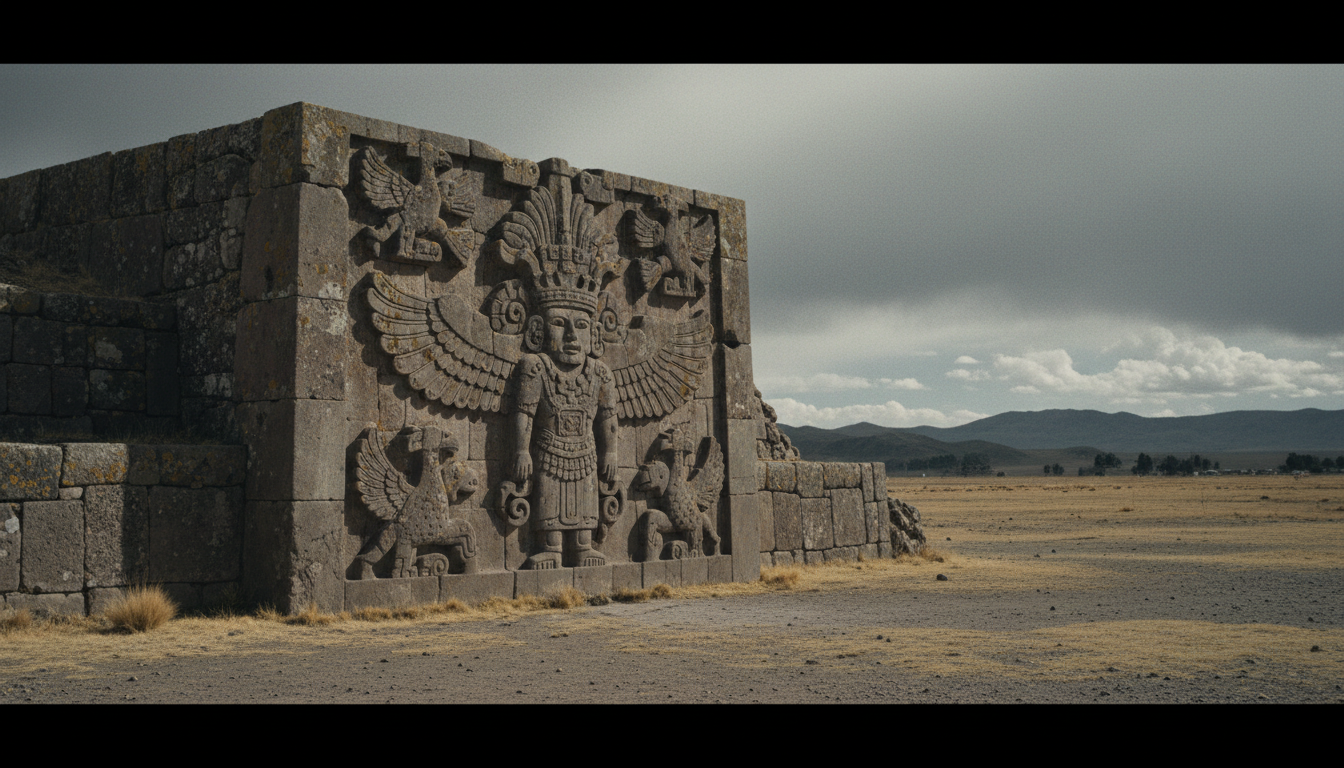
Above the southern shore of Lake Titicaca, at about 3,850 meters, the Tiwanaku ceremonial core still holds one of the Andes’ most photographed monoliths: the Gate of the Sun, carved from a single andesite slab and set today in the Kalasasaya courtyard. Frieze figures march across its lintel. Writers have long read those figures as a calendar—agricultural, solar, sometimes impossibly ancient. Ancient-astronaut captions borrow the same doorway for paleocontact lore. This Archive file stays contested. The stones are real. UNESCO lists the city. Deep-time calendar machines and extraterrestrial authorship remain claims against excavation chronology.
The Gateway Visitors Actually Meet
The Gate stands roughly three meters high and four wide, cracked from a period when European travelers found it fallen. UNESCO’s Outstanding Universal Value text places it inside Kalasasaya, notes the central Staff God figure with staffs and headdress, flanking bird-anthropomorphs, and a lower band of faces, and records that “the ensemble has been interpreted as an agricultural calendar.” That sentence is institutional honesty: interpretation, not a downloaded ephemeris. Researchers also doubt the present courtyard spot is original.
UNESCO Tiwanaku property: https://whc.unesco.org/en/list/567.
UNESCO gallery: https://whc.unesco.org/en/list/567/gallery/.
Bennett and Ponce monoliths drew similar rollout calendar proposals; keep them interpretive beside the stone, not above it.
Chronology Against Posnansky Deep Time
Arthur Posnansky dominated early twentieth-century Tiwanaku publicity. He treated alignments and iconography as proof of ages far older than the ceramic and radiocarbon sequences modern Andeanists accept. The Bulletin of the History of Archaeology’s article on Posnansky as “czar” of Tiwanaku archaeology is the compact door for that personality-and-method story: immense influence, weak method by later standards, dating claims that later fieldwork would not carry.
Bulletin of the History of Archaeology — Posnansky: https://archaeologybulletin.org/articles/10.5334/bha.255.
UNESCO’s brief synthesis for the inscribed property speaks of a planned city flourishing between about 400 and 900 CE, with political decline into the twelfth century. That World Heritage chronology is the public foil to 15,000-year calendar romance. Contested filing does not need to sneer at Posnansky’s readers. It needs to keep his deep time labeled as historical claim against the radiocarbon-and-ceramic spine.
Calendar Readings Without Baptism
Even inside mainstream Andean studies, some scholars still explore archaeoastronomical and calendrical structures in Tiwanaku imagery—month counts on rollouts, solar or lunar templates, ritual calendars rather than Posnansky’s geological ages. Those debates are ordinary interpretation fights. They are not the same object as viral posts asserting a precision stone computer older than Mesopotamia. Contested status on this page exists so calendar overclaim stays visible as overclaim while the gateway itself stays documented as monument.
Ancient-astronaut bleed uses neighboring Puma Punku precision-stone folklore and Tiwanaku’s ashlar reputation interchangeably. Puma Punku remains a separate media-HOLD file in this catalog. This page notes the bleed without merging rewrite packets or baptizing paleocontact authorship.
Frieze Figures Without a Rosetta Stone
The central deity with twin staffs sits inside a wider Staff God tradition that travels Andean art-historical debate beyond any single spreadsheet. Flanking winged attendants and the lower face band invite counting. Counting invites months. Months invite certainty. Contested filing allows the invitation and still withholds the baptism. A frieze can encode ritual time without dating the city’s foundation to a vanished ice age.
When popular reels collapse Gate of the Sun, Kalasasaya solstice folklore, and Puma Punku megablocks into one impossible-technology clip, they are doing reception editing. UNESCO’s property description keeps ceremonial architecture, drainage, and sukakollo agriculture in one civilization story without nonhuman contractors.
Conservation Is the Present Tense
Tiwanaku is not only a calendar argument. It is a managed World Heritage property under Bolivian law and CIAAAT-related administration, with buffer-zone and weather risks that fill UNESCO state-of-conservation paperwork. A 2012 UNESCO experts’ meeting focused on Tiwanaku and the Akapana Pyramid. U.S. Embassy La Paz has publicly described Ambassadors Fund support for conserving stone heritage at the site. Those doors return attention to andesite surfaces, salts, and tourism load—the material facts calendar slogans skip.
UNESCO experts’ meeting 2012: https://whc.unesco.org/en/events/883/.
UNESCO documents index: https://whc.unesco.org/en/list/567/documents/.
U.S. Embassy — Tiwanaku preservation: https://bo.usembassy.gov/u-s-supports-bolivia-in-preserving-the-ancient-legacy-of-tiwanaku/.
Why Contested Remains Honest
Settled enough for documentary purposes: Tiwanaku is a major Andean ceremonial city on the World Heritage List; the Gate of the Sun is a real andesite monolith with a complex frieze; UNESCO itself notes agricultural-calendar interpretation as interpretation; Posnansky’s deep-time program shaped popular calendar lore and is treated critically in history-of-archaeology literature; conservation and management paperwork continues. Not settled as historical fact on this page: that the frieze is a fully decoded prehistoric super-calendar dating the site to the Pleistocene, or that nonhuman engineers cut the stones.
Calendar adherents will keep counting figures into months. Excavators will keep citing strata and dates. Ancient-astronaut channels will keep filming joints. The Archive records those citation habits. It does not convert any of them into a verdict sermon.
Prestige Stone Versus Cosmic Spreadsheet
World Heritage lighting rewards pilgrimage. Rollout drawings reward pattern hunger. Contested status is honest about that mismatch. Readers who want only alien masons will not be moved by a 500–900 CE apogee line. Readers who want only debunk theater will miss why the Staff God panel still organizes Andean iconographic debate. The file holds monument, contested calendar readings, and conservation paperwork on one page.
What Remains Open
UNESCO doors settle outstanding universal value and management vocabulary. BHA doors settle Posnansky’s outsized role in calendar deep-time folklore. Open for iconographers: how much calendrical information the frieze actually encodes, and for which ritual community. Those questions are not the same as proving a 15,000-year machine or paleocontact yard.
The tension that remains is excavation chronology versus calendar and paleocontact overclaim. Heritage managers argue about drainage and ashlar. Promoters argue about cosmic clocks. Tiwanaku’s calendar stones are that argument—read with UNESCO list 567 and the Posnansky history article open, and with ancient-astronaut certainty left labeled as claim.