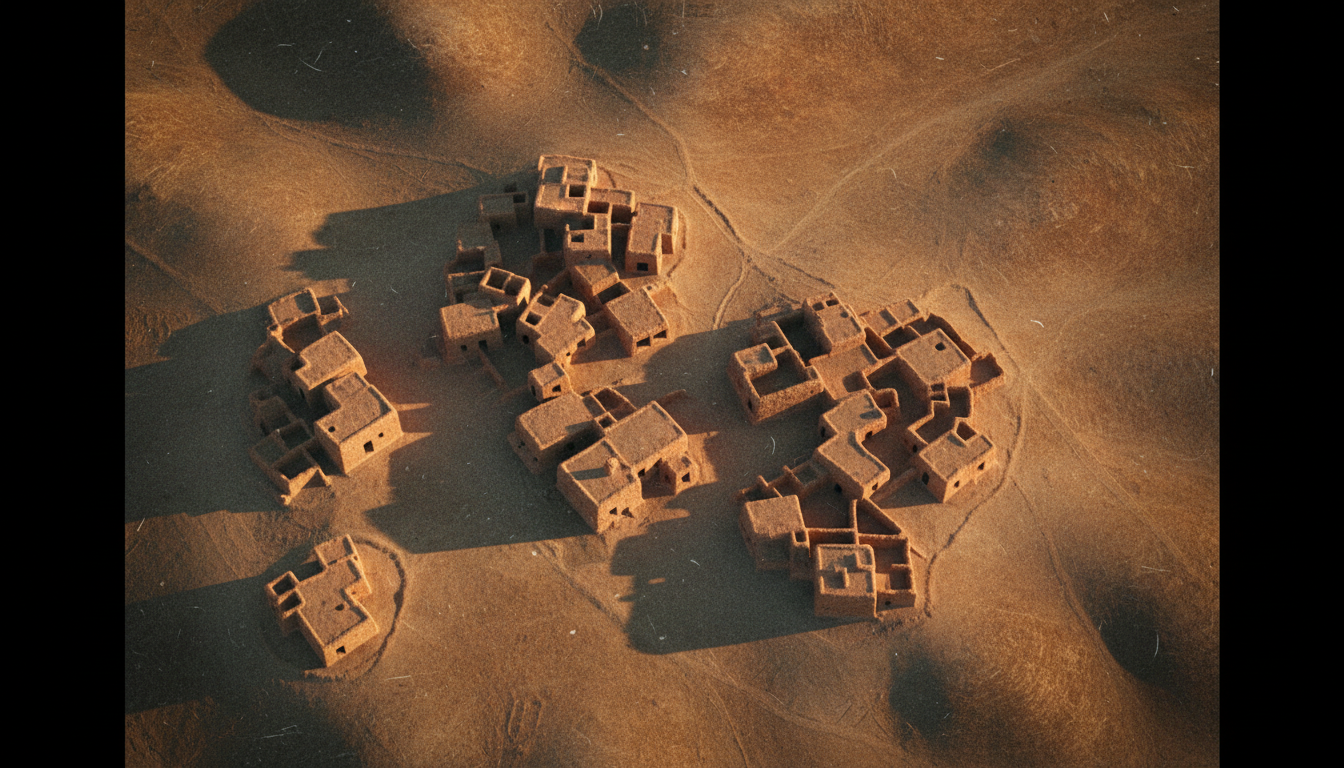
Çatalhöyük rises as twin tells on the Konya plain of southern Anatolia: a taller East Mound with dense Neolithic occupation and a West Mound continuing into Chalcolithic levels. Excavations revealed a streetless settlement of mudbrick houses packed back to back, entered from the roof, rebuilt in stacked levels across centuries of sedentary life. Wall paintings, reliefs, burials beneath floors, and a rich portable assemblage made the site a global reference for early agricultural communities. UNESCO inscribed the Neolithic Site of Çatalhöyük as World Heritage List 1405 in 2012 on criteria (iii) and (iv). This file follows the excavation history from James Mellaart’s 1960s fame to Ian Hodder’s long reflexive project. It refuses mother-goddess absolutism and alien-builder captions as substitutes for published Neolithic urbanism.
Mellaart’s Shock and the First Map
British survey in the 1950s flagged the mound’s extraordinary size. Mellaart, with Arlette Mellaart’s essential partnership, excavated between 1961 and 1965, exposing houses level by level and publishing reconstructions of elaborate installations—paintings, bucrania, modelled features—that reshaped textbooks on the Neolithic. At a time when early farming towns were still being plotted mainly inside older Fertile Crescent expectations, Çatalhöyük’s scale on the Anatolian plateau forced a wider map. UNESCO’s nomination dossier recounts discovery, legal protection under Turkish monument law, and the limits of 1960s method: large exposures, limited sieving, sparse scientific sampling by later standards. Fame outran the incomplete archive. Goddess-centered readings of female figurines and shrine rooms travelled farther than the cautious footnotes.
UNESCO List 1405: https://whc.unesco.org/en/list/1405/.
UNESCO Decision 36 COM 8B.36: https://whc.unesco.org/en/decisions/4807/.
UNESCO nomination PDF: https://whc.unesco.org/uploads/nominations/1405.pdf.
After 1965 the site lay largely dormant for nearly three decades. Popular and scholarly images froze around Mellaart’s plans and reconstruction drawings. That freeze was temporary custody of memory, not the last word on the mound.
Hodder’s Reopening and Reflexive Method
In 1993 Ian Hodder obtained a permit and, with Turkish and international collaborators, reopened Çatalhöyük as a research project that ran summer after summer into the late 2010s. The official project history traces continuity of Turkish authority, blessing from the Mellaarts, and expansion onto the West Mound under specialist teams. Method was the second shock after Mellaart’s fame: reflexive diaries, multivocal interpretation, intensive sampling, priority on micro-stratigraphy and laboratory science. Archive reports published season by season made the dig’s reasoning inspectable. Post-processual theory met flotation machines and residue studies. The point was not to deny earlier discoveries; it was to re-excavate with recording density that 1960s campaigns could not match.
Çatalhöyük project history: https://www.catalhoyuk.com/project/history.
Archive reports: http://www.catalhoyuk.com/research/archive_reports.
Project home: https://www.catalhoyuk.com/.
House biography replaced shrine typologies as a guiding analytic. Burials, buildings, and paintings were read inside domestic cycles rather than as a separate temple quarter alone. Figurines and wall art still matter; their meanings multiplied. Hodder and colleagues have argued that female imagery is only one thread in a diverse symbolic set, and that “mother goddess” as site-wide religion overreached what the new sample supports. That revision is ordinary science correcting a mid-century interpretive fashion—not a culture-war stunt.
Mellaart’s publications—especially the 1960s site books that carried reconstruction drawings into classrooms—created a visual canon that Hodder’s teams had to excavate beside as well as beneath. Reflexivity meant acknowledging that prior fame shaped what diggers expected to see in plaster and paint. Diary entries, priority tours, and community involvement were methodological instruments, not publicity extras. West Mound work under successive team leads filled Chalcolithic chapters that the first East Mound spectacle had underplayed. When the Hodder permit era closed and Turkish authorities resumed full management leadership, the research archive and shelters remained as the scientific afterlife of a generation’s fieldwork.
Documented Neolithic Urbanism
WH brief synthesis dates East Mound Neolithic occupation roughly 7400–6200 BCE across many rebuilding levels, with West Mound Chalcolithic continuation afterward. Criterion (iii) language in the Committee decision emphasizes testimony to early settled life readable in plan, architecture, paintings, and burials across many layers; criterion (iv) highlights the settlement as an outstanding example of a Neolithic agglomeration. Those WH sentences are the caption this page keeps. Roof-access clustering, longevity in one place, and the symbolic assemblage underwrite criteria language about early settled agricultural life and the passage toward urban agglomeration. Authenticity statements credit decades of documented research for the site’s readability. Conservation shelters, visitor routes, and Turkish management frameworks are living WH practice after the Hodder permit era’s research crescendo. Alien architects are unnecessary when mudbrick, plaster, and obsidian already explain the labour.
Open research continues on hierarchy versus neighbourhood equality, the tempo of plant and animal domestication in the local sequence, and how Çatalhöyük sits beside earlier and later Anatolian and Levantine sites. Those debates need more tables and dates, not sky-people. Mother-goddess absolutism likewise fails as a total caption: female forms exist; so do bulls, hands, geometric fields, and burial rites that do not collapse into one deity dossier.
What Documented Settles
Settled for documentary purposes: Çatalhöyük is a UNESCO-listed Neolithic/Chalcolithic tell complex with roof-entry house urbanism and rich symbolic material; Mellaart’s 1961–65 excavations created global fame; Hodder’s 1993–2018 project reopened the site with reflexive methods and published archive reports; WH criteria and nomination text frame early sedentary agricultural life without paleocontact. Still open as normal Neolithic research: social models, West Mound transitions, every motif’s meaning. Those open questions do not authorize alien builders or a mandatory single goddess religion, and they do not demote either excavation generation’s real discoveries. Çatalhöyük is documented Anatolian Neolithic urbanism—read with UNESCO and catalhoyuk.com doors open, and with absolutist goddess or alien folklore left off the mound.