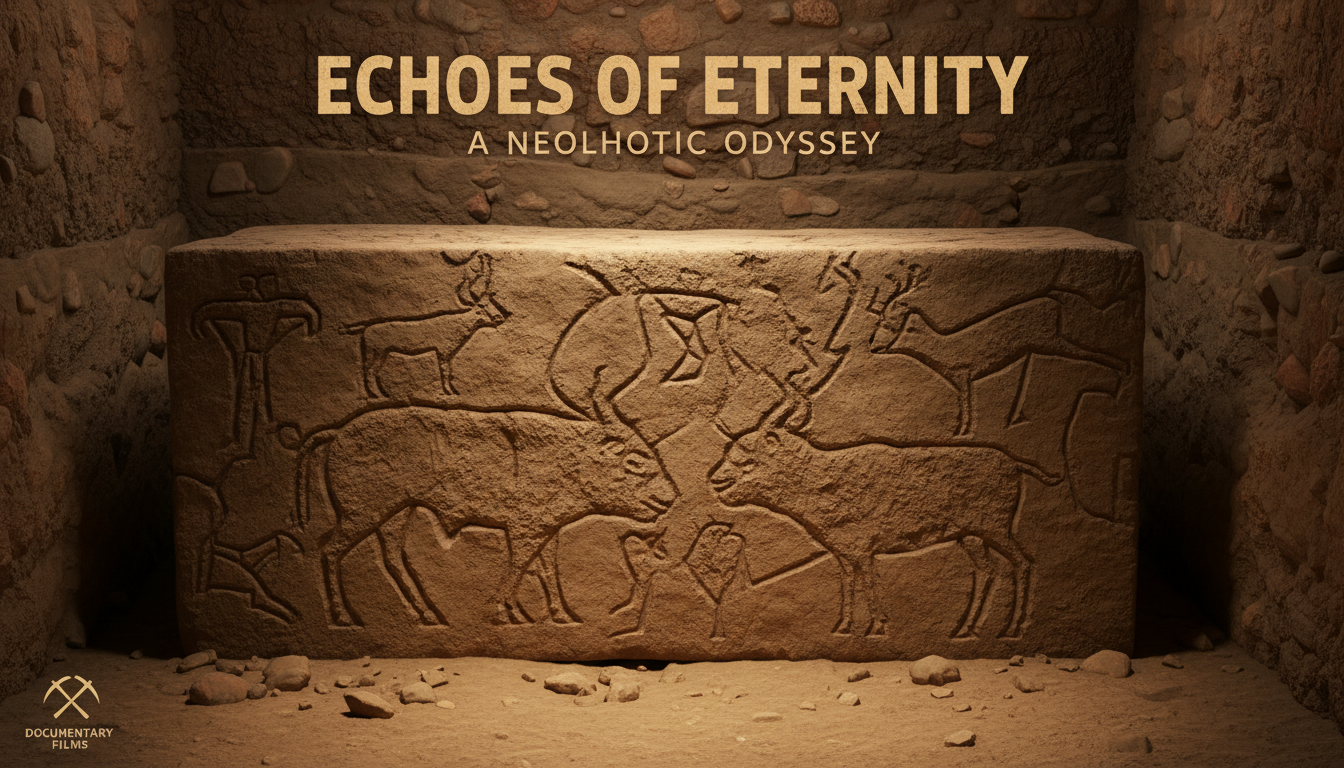
Under the modern village of Sayburç in Şanlıurfa province, excavators working in 2021 opened a Pre-Pottery Neolithic communal building carved into limestone bedrock. On an interior bench they found a ~3.7 m horizontal relief of five interacting human and animal figures; Eylem Özdoğan published the panel in Antiquity in 2022 as narrative art from the ninth millennium BCE.
Under the modern village of Sayburç in Şanlıurfa province, southeastern Türkiye, excavators working in 2021 opened a Pre-Pottery Neolithic communal building carved into limestone bedrock. On the face of an interior bench they found a horizontal relief about 3.7 meters long: five figures arranged so humans and animals appear to interact across two related scenes. Eylem Özdoğan published the panel in Antiquity in 2022 as a narrative scene from the ninth millennium BCE—part of the wider Taş Tepeler (“stone hills”) research landscape that also includes Göbekli Tepe and Karahan Tepe. This file is that excavation and peer report. It is not a warrant to baptize the bulls and leopards as ancient-astronaut storyboards spilled over from Göbekli mythos.
Taş Tepeler Field Context
Sayburç sits roughly sixty kilometers east of the Euphrates on the southern fringe of the eastern Taurus. Modern house-building after 1949 covered much of the mound; ditch-digging villagers sometimes reused Neolithic stones in garden walls, which drew museum and project attention. Excavation distinguished a northern zone with communal buildings—near a later Roman scatter—and a residential zone about seventy meters south. The relief building measures about eleven meters in diameter. Only half could be cleared at first because concrete and stone houses still stood on the rest; Turkish authorities later moved to acquire overlying dwellings so the structure could be exposed fully. That sequence—village overlay, rescue attention, systematic trench, peer publication—is ordinary heritage archaeology under Turkish doors, not a secret dig.
GoTürkiye’s Taş Tepeler press frames a regional Neolithic program across Şanlıurfa. The project explainer at tastepeler.net lists Sayburç among sibling mounds. UNESCO’s Göbekli Tepe listing (1572) remains the flagship World Heritage door for the same cultural horizon without transferring Göbekli’s internet mythology onto every new bench panel.
Sibling talk is archaeological geography. Göbekli’s T-pillars, Karahan’s carved predators, and Sayburç’s bench narrative share a PPN visual world of humans, snakes, bovids, and felines. Sharing a world is not sharing a spaceship, a star temple franchise, or a single “oldest temple on Earth” slogan pasted onto every new trench.
What the Bench Shows
Özdoğan’s Antiquity paper describes five carved figures on the bench face inside the communal building. One scene pairs a human—holding what may be a snake or rattle—with a threatening bull. Another presents a prominently phallic human flanked by leopards. Unlike many contemporaneous images at Göbekli and Karahan, where animals and anthropomorphs often stand as isolated emblems or vertical stacks on pillars, Sayburç’s figures share a horizontal register with gestures and facing relations that read as narrative interaction. The claim that this is among the earliest known Near Eastern Neolithic “scenes” is a scholarly argument grounded in comparison—not a caption that every hunter-gatherer carving secretly encodes zodiac myth.
Communal architecture matters as much as style. Bedrock-cut circular buildings with stone benches belong to the same PPN gathering grammar documented across Taş Tepeler. Reliefs on furniture inside those rooms suggest stories told in place—memory work for groups negotiating sedentism, hunting symbolism, and social display. Phallic humans and dangerous animals are recurrent PPN motifs; Sayburç’s contribution is compositional narrative, not proof of a lost high technology.
Comparanda sharpen the point. At Göbekli Tepe, animals and abstract symbols dominate T-pillar faces; human forms appear, but rarely as actors inside a left-to-right story strip. Karahan Tepe’s carved predators and anthropomorphic statues intensify presence without necessarily sequencing an episode. Sayburç’s bench puts confrontation and flanking into one furniture program inside a gathering room. That is why Özdoğan’s “narrative scene” language travels in peer discourse. It is also why tourism copy should stay tethered to the PDF rather than to sky-god fan fiction.
Against Mythos Bleed
Göbekli Tepe’s global fame attracted ancient-astronaut television, star-map overlays, and “temple older than civilization” maximalism that often skips excavation reports. Sayburç arrives already inside that attention economy. The corrective is boring and sufficient: read Özdoğan; keep Turkish ministry and project press in view; treat UNESCO Göbekli as a sibling WH property, not a portal for ET exegesis. Predators and bulls carved by PPN communities do not become spacecraft supervisory committees because a YouTube thumbnail says so. Documented wonder—early narrative relief in a communal building—survives without the baptism.
Field logistics remain part of the evidence trail: half-buildings under modern floors, spoil from bedrock cutting, and planned demolition of overlying houses are constraints every trench notebook records. Future seasons that open the rest of the building will refine phasing, find inventories, and architectural comparisons. That is how Neolithic archaeology works. It is not a cliffhanger for disclosure day.
What Documented Settles
Settled for documentary purposes: Sayburç is a PPN site in the Taş Tepeler zone; 2021 excavations exposed a bedrock communal building with a multi-figure bench relief; Özdoğan’s 2022 Antiquity article is the peer door; regional framing sits under Turkish Neolithic research and Göbekli WH adjacency. Still open as normal fieldwork: full building plan after house removal; exact chronological fine-tuning; how narrative art relates to ritual practice. Those open questions do not reopen the relief as alien instruction, as a star-map codebook, or as a forgery planted for tourism. Peer figures and trench constraints already carry more wonder than the caption farms. Sayburç is a stone storyboard from early sedentary communities—read with Antiquity, Taş Tepeler, GoTürkiye, and UNESCO Göbekli doors open, and with ancient-astronaut captions left outside the trench.