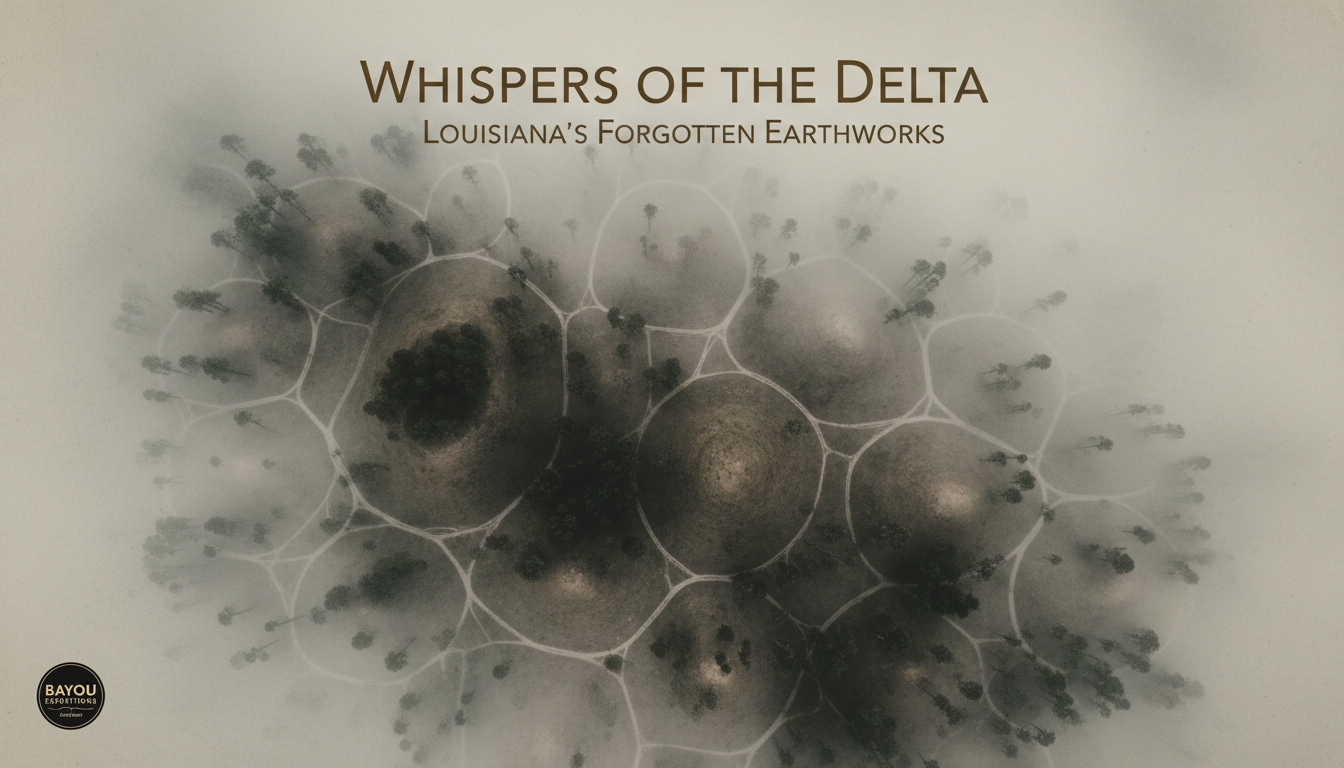
Northeast of Monroe, on a stream terrace in Ouachita Parish, Louisiana, eleven earthen mounds linked by ridges enclose an oval plaza. The complex is called Watson Brake. Radiocarbon and luminescence dating published in Science in 1997 by Joe W. Saunders and colleagues placed major construction around 5400 to 5000 years before present—Middle Archaic, centuries of staged building that began near 3500 BCE and ran past 3000 BCE. That is nearly two millennia earlier than the famous Late Archaic earthworks at Poverty Point. The builders were fisher-hunter-gatherers, not maize states. This Archive file is documented Louisiana archaeology: peer-reviewed dating, stratigraphy, and heritage interpretation—not a ranking exercise about who was “civilized enough” to move dirt.
The Enclosure on the Terrace
Watson Brake’s plan is compact and deliberate. Two curved ridges link northern and southern mound groups into an enclosure on the order of a thousand by several hundred feet. Mound A, the tallest, rises about twenty-five feet and shows multiple construction stages; other mounds are lower, some raised in single episodes. Between building bursts, people lived on the ridges and mound surfaces—lithics, fire-cracked rock, and fired clay objects scattered through fills. Basal middens preserve nuts, fish, and deer from all-season foraging. The plaza interior stayed comparatively clean, a pattern Saunders’s team read as ritual or communal space rather than ordinary refuse yard. Artifacts speak to fishing tackle, cooking, and ornament as much as to spectacle. The site is monumental without being a city wall.
64 Parishes site entry: https://64parishes.org/entry/watson-brake-archaeological-site.
1997: Science Dates Rewrite the Timeline
Before Saunders’s team published, North American archaeology routinely treated large mound complexes as products of later, more sedentary societies. The 19 September 1997 Science paper forced a revision: eleven mounds at Watson Brake, dated by radiocarbon suites and supported by thermoluminescence on sediments, predated other known surviving mound complexes by roughly nineteen hundred years. University of Washington luminescence work by Jim Feathers entered the same news cycle as independent chronological support. The point was not a single magic year. It was a multi-method argument that Middle Archaic people organized centuries of earthmoving on a planned footprint. Reca Jones and earlier Ouachita Valley survey had already put the earthworks on the map; Science made the antiquity impossible to ignore in textbook timelines.
Science Saunders et al. 1997: https://www.science.org/doi/10.1126/science.277.5333.1796.
ScienceDaily / UW 1997 context: https://www.sciencedaily.com/releases/1997/09/970923033351.htm.
American Antiquity: Stages, Soils, and Stress
A later American Antiquity treatment expanded the coring and stratigraphic story: minor earthworks near 3500 BCE, substantial moundraising from about 3350 BCE, abandonment sometime after 3000 BCE, twenty-five radiocarbon dates and six luminescence dates, soils forming on temporary surfaces between bursts. Faunal and floral baselines show broad-spectrum foraging centered on the terrace edge. Acidic fills higher in the mounds destroy organics, so much of the dietary picture rides on basal middens. Some building pulses covary with documented increases in El Niño–Southern Oscillation variability—erratic rainfall and flooding that could stress a floodplain food base. Causality remains interpretive. The construction sequence and antiquity do not. Occupation before moundraising, then repeated enlargement, shows a place revisited and remade rather than a one-weekend earthwork stunt.
American Antiquity Watson Brake article: https://www.cambridge.org/core/journals/american-antiquity/article/abs/watson-brake-a-middle-archaic-mound-complex-in-northeast-louisiana/4A722B1B6A8330E4F26BB9EE3E7FCD74.
Before Poverty Point, Not Instead of It
Poverty Point’s monumental earthworks—UNESCO List 1435 and a National Park Service unit—belong to a later Archaic chapter, often framed as a trade and ceremonial hub around 1700–1100 BCE. Watson Brake does not erase Poverty Point. It relocates the starting line for large Lower Mississippi mound arcs. Public heritage doors for Poverty Point remain essential neighbors for visitors who know only the World Heritage silhouette. Documented filing keeps both on the shelf: early Middle Archaic enclosure first; later Archaic mega-earthworks second. Comparing them is chronology, not a contest over which site “counts” as real civilization.
NPS Poverty Point: https://www.nps.gov/popo/index.htm.
UNESCO Poverty Point List 1435: https://whc.unesco.org/en/list/1435/.
Folklore That Ranks “Civilization”
Popular captions sometimes imply that only agricultural states, lost races, or outside contractors can raise coordinated mounds. Watson Brake’s paper trail says otherwise: mobile and seasonally resident foragers engineered ridges, stages, and a kept plaza over centuries. That finding shocked mid-1990s assumptions; it does not require alien surveyors or vanished master races. Indigenous labor and landscape knowledge are the documentary baseline. Civilization-rank folklore is reception pressure, not a stratigraphic result. Comparing Watson Brake to Egyptian pyramids or Stonehenge made good 1997 headlines; the lasting scientific claim is simpler and harder: Middle Archaic foragers in Louisiana ran multi-century earthwork programs on a planned enclosure. The same prejudice once discounted other early Southeastern earthworks; peer dating and excavation plans, not sneer contests, are what moved the timeline.
What Documented Settles
Settled for documentary purposes: Watson Brake is a Middle Archaic mound-and-ridge enclosure in northeast Louisiana; Saunders et al. established a construction window near 3500–2800 BCE with radiocarbon and luminescence; builders practiced broad-spectrum foraging; the complex predates Poverty Point by roughly nineteen hundred years; peer and Louisiana heritage doors carry the site description. Still open as research detail: full ritual meaning of the plaza, exact social mechanisms of labor recruitment, and how every ENSO correlation should be weighted. Those open questions do not reopen lost-race authorship or slogans that hunter-gatherers could not plan earthworks.
The tension that remains is paperwork versus ranking. Archaeologists argue with cores, dates, and middens. Folklore argues with who was allowed to be monumental early. Watson Brake is that argument—read with Science, American Antiquity, 64 Parishes, and the Poverty Point World Heritage contrast open, and with Middle Archaic Indigenous earthwork kept on the timeline where it belongs.