ʿAin Ghazal Plaster Statues: Neolithic Figures from Jordan
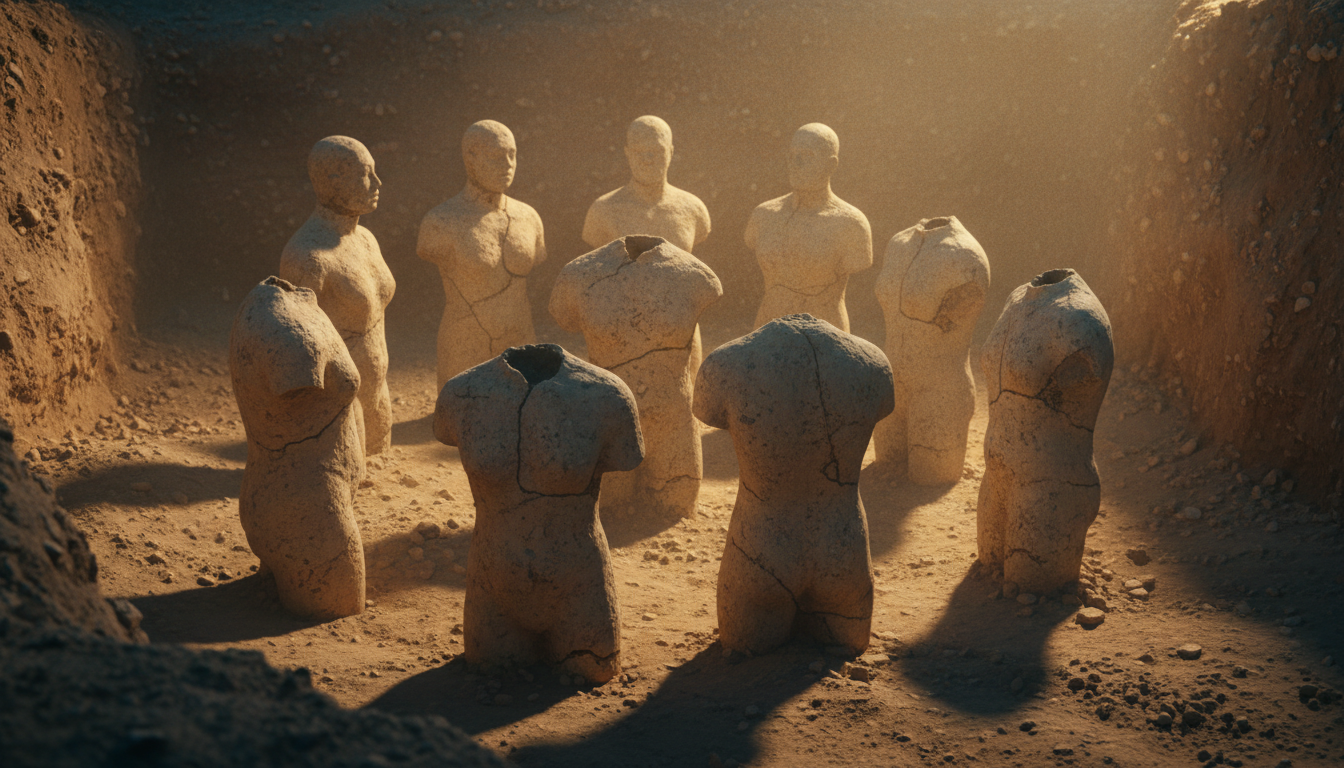
On the eastern outskirts of Amman, the Pre-Pottery Neolithic B settlement of ʿAin Ghazal produced some of the earliest large-scale human statues known from the Near East. Lime-plaster figures and busts—standing forms about a metre tall, plus striking two-headed busts—were deposited in carefully dug caches in the mid-seventh millennium BCE.
On the eastern outskirts of Amman, the Pre-Pottery Neolithic B settlement of ʿAin Ghazal produced some of the earliest large-scale human statues known from the Near East. Lime-plaster figures and busts—standing forms about a metre tall, plus striking two-headed busts—were deposited in carefully dug caches in the mid-seventh millennium BCE. Fragility forced excavators to blocklift entire pits for laboratory excavation: one cache to London, another to the Smithsonian’s Museum Conservation Institute for a seven-year conservation campaign before return to Jordan. The statues remain property of Jordan’s Department of Antiquities; The Jordan Museum displays them; the Louvre presents a loaned figure. World Monuments Fund attention flags urban pressure on the site itself. This file is that excavation, conservation, and custody paper trail. It refuses alien, giant, or “watcher” baptism.
Caches, Dates, Construction
Gary Rollefson’s teams encountered the first major statue cache in 1983 when construction and excavation intersected on the Amman periphery. Because lime plaster after millennia in soil is structurally treacherous, the pit contents were wrapped, foamed, and crated as a block for laboratory excavation at the Institute of Archaeology in London—preserving joins and surface that field digging would have destroyed. A second cache, found in 1985, traveled to Smithsonian facilities near Washington for the same slow excavation-under-conservation protocol. Radiocarbon samples associated with the deposits cluster around the later seventh millennium BCE uncalibrated determinations published with the find; calibrated PPNB chronology places the figures among the oldest known monumental plaster humans.
Carol Grissom’s American Journal of Archaeology study, “Neolithic Statues from 'Ain Ghazal: Construction and Form,” documents reed-and-cordage armatures, layered lime plaster, and assembly sequences visible only because laboratory excavation exposed construction evidence. Bitumen traces mark eyes and hairlines; some heads were modeled separately. Two-headed busts are not sci-fi props—they are a documented formal type within the assemblage. An open Smithsonian repository bitstream carries Grissom’s AJA text for readers who need the technical description beside museum labels. Replication experiments published through conservation channels have tested how reed bundles and plaster skins behave at that scale, reinforcing that these were skilled Neolithic craft products, not anomalous materials.
Comparable plaster-figure fragments from Jericho and Nahal Hemar survive in poorer condition; ʿAin Ghazal’s blocklift strategy is why this corpus can be studied as statues rather than as powder. Standing figures near a metre tall dominate public memory; busts and the two-headed forms expand the typology beyond a single “idol” stereotype. Find context—pits cut into abandoned house floors—supports intentional deposition, often read as ritual retirement of figures, without requiring a finished theology to hold the archaeological fact. Paint traces and modeled features remind viewers these were finished display objects before they became buried assemblages.
Custody, Loans, Site Risk
After conservation and a 1996–1997 exhibition at the Smithsonian’s Arthur M. Sackler Gallery, the Smithsonian-treated group returned to Jordan for display at the Jordanian Archaeological Museum on the Citadel and, later, at The Jordan Museum in Amman. Grissom’s publication notes Department of Antiquities ownership and early loan arrangements, including a statue at the Louvre. The Louvre’s public Ain Ghazal page presents the Jordanian Neolithic sculpture in that museum’s interpretive program. British Museum loans of related fragments appear in the same international circulation pattern. Living custody is therefore split by design: Jordanian museums as home institutions, selective international loans as diplomacy and public science—not as evidence the figures “belong” to European mystique. Inventory control and loan paperwork are the documentary opposite of folklore that treats the statues as orphan wonders without a state owner.
The archaeological site itself faces Amman’s urban expansion. World Monuments Fund listing attention underscores that only portions of ʿAin Ghazal enjoy strong protection and that Department of Antiquities hopes for broader open-air museum treatment have contended with development pressure. Statue survival in labs does not automatically save the settlement that produced them. Site-risk reporting belongs beside object wonder: both are documentary, neither needs giants.
Internet folklore periodically baptizes the metre-tall plaster bodies as evidence of ancient giants, Nephilim, or non-human makers. Measured heights, reed armatures, and lime chemistry contradict that baptism. Two-headed busts become “hybrid aliens” in the same folklore; Grissom’s construction analysis makes them plaster over cordage like their single-headed cousins. Wonder at wide-staring bitumen eyes and at the decision to bury whole figures under house floors is allowed. Wonder that needs DNA from plaster or spacecraft in PPNB Amman is not. The conservation film record MCI describes—years of lab work before the Sackler show—already supplies drama without inventing species.
What Documented Settles
Settled for documentary purposes: ʿAin Ghazal yielded PPNB plaster statue and bust caches; blocklift laboratory conservation in London and at the Smithsonian preserved them; Grissom’s AJA analysis documents construction; Jordanian institutions hold ownership and primary display; Louvre and WMF doors publish loan and site-risk context. Still open as normal Neolithic research and heritage management: precise ritual function; full site protection against sprawl; how many related figures remain unrecovered. Those open questions do not authorize giant or alien captions, and they do not demote the statues to tourist curios without excavation notes. ʿAin Ghazal’s plaster figures are documented Neolithic sculpture and conservation archaeology—Smithsonian, AJA, WMF, Louvre, and Jordan Museum doors open, giant folklore left out of the foam crate.
Museum Conservation Institute project page on the 1985 cache blocklift, seven-year lab excavation/conservation, Sackler exhibition, and return to Jordan—primary conservation door.
National museum in Amman holding and displaying ʿAin Ghazal statues after repatriation from conservation labs—Jordanian living-institution custody door.