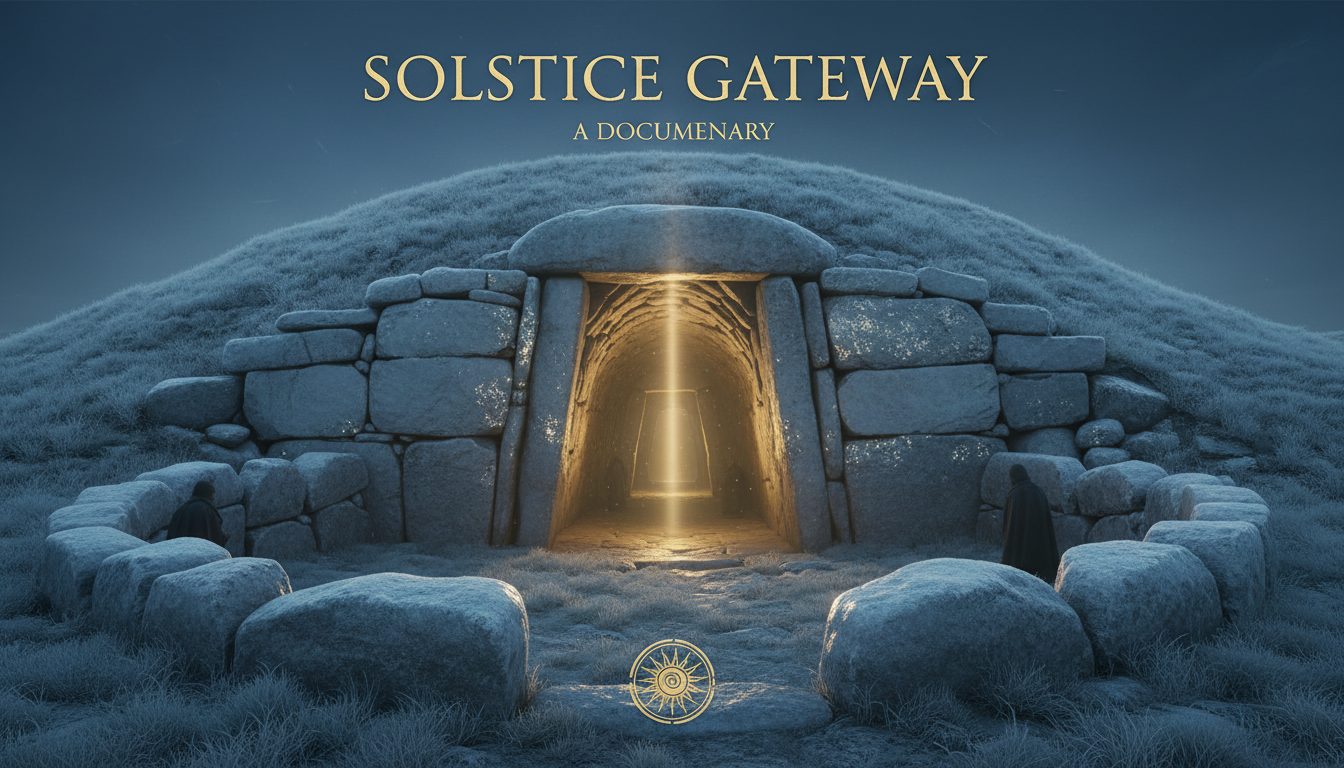
In the Bend of the Boyne, a grass-covered mound edged with kerbstones holds a nineteen-metre stone passage and a cruciform chamber under a corbelled roof that has stayed weather-tight across more than five thousand years. Above the entrance, a small constructed opening—the roof-box—admits the midwinter sunrise. On clear mornings around 19–23 December, a beam can run the passage and brighten the chamber floor for roughly seventeen minutes before the light withdraws. Newgrange sits with Knowth and Dowth inside the UNESCO World Heritage property Brú na Bóinne (List 659), managed for visitors through the Office of Public Works and Heritage Ireland. This file holds that Neolithic monument and that observed illumination. It refuses alien surveyors and leprechaun-builder folklore as evidence for the alignment.
Passage Tomb, Kerb, Art
Brú na Bóinne’s Outstanding Universal Value language centres on a Neolithic funerary landscape of passage tombs, satellite mounds, and one of the densest concentrations of megalithic art in Europe. Spirals, lozenges, and nested arcs cover kerbstones and interior orthostats; the entrance stone at Newgrange is among the most photographed carved surfaces in Atlantic Europe. Knowth’s clustered tombs and Dowth’s less-restored mound complete a river bend that was already monumental before the pyramids of Giza rose. World Heritage Ireland and the Centre’s property pages publish boundaries, buffer zones, and management expectations for a landscape under tourism pressure.
UNESCO Brú na Bóinne List 659: https://whc.unesco.org/en/list/659/.
UNESCO Decision 17 COM XI: https://whc.unesco.org/en/decisions/3335/.
World Heritage Ireland — Brú na Bóinne: https://www.worldheritageireland.ie/world-heritage-properties/bru-na-boinne/.
UNESCO documents portal: https://whc.unesco.org/en/list/659/documents/.
OUV statement (document 164224): https://whc.unesco.org/document/164224.
Michael J. O’Kelly’s mid-twentieth-century excavation and restoration work clarified the roof-box as an intentional architectural feature rather than accidental damage. Solstice demonstrations and later public livestreams are modern ways of showing an ancient solar geometry; they are not proof that every tourist caption about “portals” is archaeology. The chamber’s cruciform plan, basin stones, and burnt bone deposits speak to funerary and commemorative use. Exact ritual scripts remain interpretive.
Roof-Box Mechanics and OPW Practice
The roof-box sits above the doorway so that the midwinter sun need not rely on the door threshold alone. As the sun climbs, the beam widens along the passage and briefly floods the rear chamber before fading. Cloud to the southeast can cancel the live show on any given morning; the architecture does not guarantee a clear sky. Heritage Ireland routes ordinary visitors through the Brú na Bóinne Visitor Centre; chamber access at sunrise on solstice mornings is rationed by lottery while the public may gather outside. Those management facts are as documentary as the orthostats.
Heritage Ireland — Brú na Bóinne Visitor Centre: https://heritageireland.ie/places-to-visit/bru-na-boinne-visitor-centre-newgrange-knowth-and-dowth/.
Livestreams and recorded illuminations extend access without pretending that every viewer stands in Neolithic time. Queues, buses, and overflow parking are twenty-first-century infrastructure wrapped around a Stone Age instrument. Conservation limits how many bodies may stand in the chamber; astronomy does not care about ticket systems, but heritage law does.
Comparative Atlantic passage tombs and other solstice-aligned monuments show that Newgrange is exceptional in preservation and public demonstration, not unique in the idea that megalithic builders watched the sun. Neighbouring Knowth carries its own complex of alignments and art. Reducing the whole Boyne bend to a single viral clip of a golden floor misses the serial property UNESCO inscribed.
Folklore Captions Are Not Survey Data
Leprechaun masonry, fairy engineering, and ancient-astronaut theodolites recycle wonder into authorship reassignment. Neolithic communities in the Boyne Valley had labour organisation, quarrying, carpentry for roof-box fittings, and generational knowledge of horizon astronomy sufficient to explain the instrument. Claiming extraterrestrial surveyors because the beam is elegant is an argument from disbelief in human skill. Claiming fairy builders because folklore loves the mound is reception history, not find context.
Failed popular claims that Newgrange is a stargate, a battery, or a landing beacon confuse metaphor with measured orientation. Open questions about seasonal gatherings, feasting debris, and how the light rite related to the dead are ordinary archaeological problems. They do not require non-human architects, and they do not vanish because a livestream went viral.
Art-historical counting of motifs across the three great mounds shows shared vocabularies and local hands; the roof-box at Newgrange is therefore best read inside that Boyne workshop world, not as an isolated miracle dropped from elsewhere. Kerbstone 52 and other carved faces reward close looking without needing a decoded “star map” sermon for every spiral. When conservation scaffolding or turf repair temporarily changes how the mound photographs, the underlying passage geometry remains the instrument O’Kelly reconstructed and UNESCO’s property description still names.
Solstice mornings also expose the gap between astronomical reliability and heritage capacity: only a handful of people fit in the chamber, while thousands may stand the frost outside or watch a stream. That scarcity is why lottery language appears in official visitor guidance. It is crowd management for a fragile interior, not a mystery cult password.
What Documented Settles
Settled for documentary purposes: Newgrange is a Neolithic passage tomb within UNESCO List 659; a roof-box alignment illuminates the chamber around the winter solstice when skies allow; OPW/Heritage Ireland manage access, lottery chamber places, and visitor routing; World Heritage Ireland and Centre dossiers frame OUV and documents. Still open as normal research: fine social meanings of the midwinter rite, landscape relationships among Newgrange, Knowth, and Dowth, and long-term tourism impact on the kerb and mound. Those open questions do not authorize alien or fairy authorship as explanations of the roof-box. Newgrange’s light is documented Neolithic architecture—read with UNESCO and Heritage Ireland doors open, and with folklore surveyors left outside the kerb.