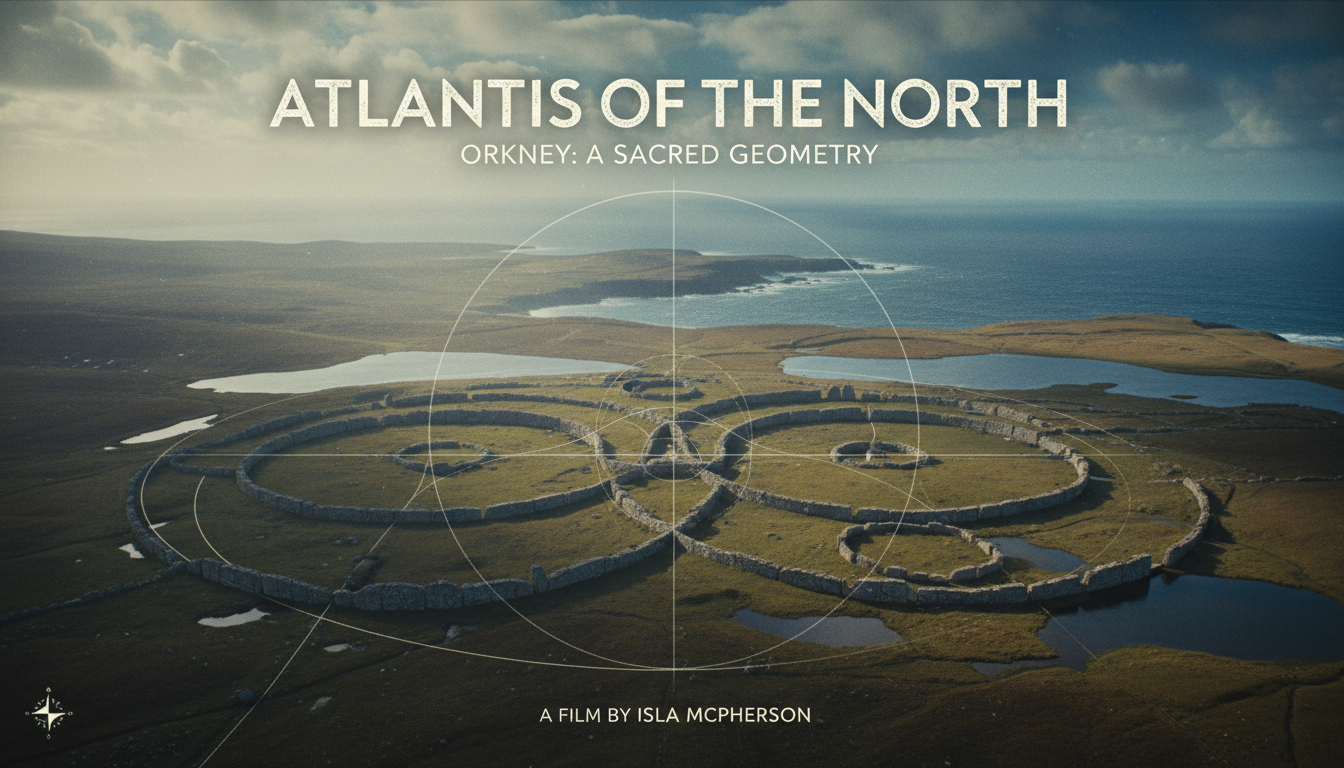
For a century the land between the Stones of Stenness and the Ring of Brodgar could be walked as open ground: two ceremonial circles, a natural bowl of hills and lochs, and apparently empty pasture on the isthmus. That picture is what the 1999 World Heritage inscription still describes in its brief synthesis — Stenness and Brodgar as the two stone circles of the Heart of Neolithic Orkney, with other sites noted as not yet dug. It is the picture a visitor still gets from the roadside. It is no longer a true account of the ridge. Survey and excavation have shown that the ground between the circles was built. The Ness of Brodgar is a Neolithic complex of monumental stone buildings, art, and midden, sitting on the strip between Loch of Harray and Loch of Stenness, inside the same World Heritage landscape and under the care of a university dig rather than under a lost-continent caption.
The break in the empty-land story is dated and ordinary. In 2002 a geophysical survey, part of a programme across the World Heritage Site, mapped a cluster of sub-soil anomalies over about two and a half hectares at the south-eastern end of the Ness, read at the time as a sign of settlement. The density surprised the surveyors. In April 2003 a plough turned up a large notched slab. It was first taken for a Bronze Age cist. Beverley Ballin-Smith and Gert Petersen, of the Glasgow University research division, dug a rescue trench because human remains might have been disturbed. There was no cist. There was part of a rectangular stone building, kin to House Two at the nearby Barnhouse settlement. That fragment is Structure One. It was not the site. It was the corner of it.
In 2004 eight test trenches, with Nick Card reading the new resistivity plots against the earlier gradiometer survey, showed that the mounded ridge itself is artificial: Neolithic structures and middens, not a natural rise with two circles parked at either end. The excavations that followed, managed by the University of the Highlands and Islands Archaeology Institute and the Ness of Brodgar Trust, ran as a research dig until 2024. At the main phase now under study, around 3100 BC, the Ness was dominated by huge freestanding buildings inside a massive stone wall. The project record describes tiled roofs, coloured wall surfaces, hundreds of decorated stones, and rich finds. This is not a farm that happened to be large. The excavators treat it as a place where people from across Orkney, and likely from beyond the archipelago, met, feasted, and exchanged things, with room in the evidence for ritual and for gatherings tied to the politics and the calendar of that society. Function changed over the life of the site. “Temple of Atlantis” does not. The architecture sits in a known Orcadian Neolithic — Barnhouse, Skara Brae, the stone-built houses and halls of this same archipelago — not in an imported mother-civilisation.
Historic Environment Scotland cares for the circles that frame the isthmus. The Ring of Brodgar and the Stones of Stenness are monuments in state care, and the Heart of Neolithic Orkney is a World Heritage property under Scottish historic-environment law. The Ness trenches were not an HES spectacle laid on for the circles. They were a UHI-led excavation in the landscape those circles already occupied. That distinction matters. The circles remain authentic Neolithic monuments with their own antiquarian repairs and their own outstanding value. The complex does not demote them. It removes the pretence that the land between them was a blank processional gap. UNESCO’s own integrity note already says the designated boundaries are tight and do not take in the wider setting. The Ness is part of what that sentence was pointing at, dug after the 1999 list entry was written.
Fieldwork on the open trenches ended after the 2024 season. The project has said the trenches would be filled and the site returned to grass, with the work shifting to post-excavation: pottery, stone, bone, and the long publication. A later limited return to the ground has been flagged by the project; it does not restore the years of open-plan digging. The public story from here is archives, specialist reports, and whatever virtual access the team builds. The interpretation that already stands does not need another season to make its main point. The isthmus was a built ceremonial neighbourhood around 3000 BC, walled and roofed, not the empty middle of a postcard of two circles.
What remains properly open is use, not existence. How far any one building was a hall, a temple, a workshop, or all three in sequence; how the great wall related to movement between Stenness and Brodgar; how far painted and incised stone was display, dedication, or both. Those are excavation questions with a post-excavation future. They are not a licence to rename the Ness as a survivor of a drowned civilisation, or to treat the circles as window-dressing for a myth the trenches never produced.
Ness of Brodgar Project: https://www.nessofbrodgar.co.uk/.
UHI Archaeology Orkney, the complex between the circles: https://archaeologyorkney.com/nessofbrodgar/.
UNESCO Heart of Neolithic Orkney, List 514: https://whc.unesco.org/en/list/514/.
Historic Environment Scotland, the World Heritage Site: https://www.historicenvironment.scot/protect-and-care/protected-historic-places/world-heritage-sites/heart-of-neolithic-orkney/.
Historic Environment Scotland, Ring of Brodgar: https://www.historicenvironment.scot/visit-a-place/places/ring-of-brodgar-stone-circle-and-henge/.
Project note on the end of the 2024 fieldwork: https://www.nessofbrodgar.co.uk/2024-excavation-end/.
What Documented Settles
Settled: between the Ring of Brodgar and the Stones of Stenness, on the Ness, a large Neolithic building complex was located by survey in 2002, sampled from 2003, and excavated under UHI Archaeology Institute direction through 2024, inside the Heart of Neolithic Orkney landscape that HES helps steward. The empty-land picture does not survive that dig. Still open: the finer reading of rooms, gatherings, and art. An Atlantic lost-civilisation temple is not one of the open questions.