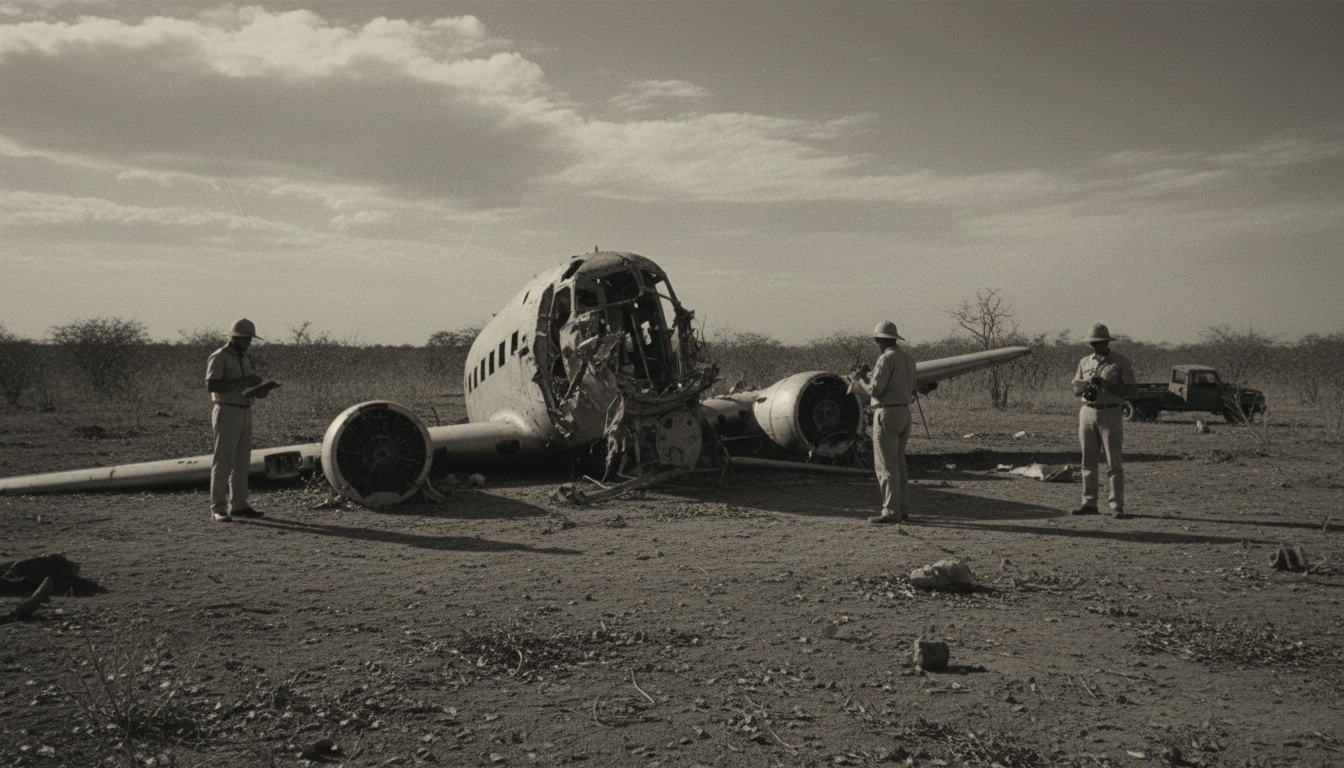
UN Secretary-General Dag Hammarskjöld died when SE-BDY crashed near Ndola on 17–18 September 1961. Successive UN reviews from the 2013 Jurists report through the 2024 Eminent Person transmission (A/78/1006) treat external attack or threat as still plausible and stress undisclosed Member State intercepts—without closing an assassination verdict.
On the night of 17–18 September 1961, United Nations Secretary-General Dag Hammarskjöld and fifteen companions died when DC-6B SE-BDY crashed near Ndola in Northern Rhodesia (now Zambia). He was flying into the Congo Crisis’s diplomatic thicket to meet Katangese leadership. Early official inquiries treated the wreck as a navigational accident. Decades later, successive United Nations reviews—especially after 2015—reopened the file around intercept claims, Katangese air capacity, and foreign paramilitary presence. The Archive’s job is narrow: follow the UN paper trail. Document what successive inquiries found plausible. Do not convert unfinished mandates into an assassination verdict.
Congo Fog and the First Official Line
Hammarskjöld’s mission sat inside a civil war with Cold War overlays, Belgian and other foreign interests, and a UN Operation in the Congo that had already taken casualties. That context makes foul-play hypotheses psychologically easy. Ease is not proof. The first Rhodesian and UN-era accident narratives emphasized approach procedures, altitude, and possible pilot error on a night landing. Those early conclusions closed the story for many readers. They never closed the documentary fight for families, researchers, and later General Assembly mandates that treated new information as worth weighing.
Reopening: Jurists, Then a Panel of Experts
In 2013 an Independent Commission of Jurists examined whether newly available material justified another look. Its report to the General Assembly, issued as A/68/800, helped drive Assembly resolution 69/246. In March 2015 the Secretary-General appointed an Independent Panel of Experts headed by Mohamed Chande Othman, then Chief Justice of Tanzania, with aviation and ballistics specialists. The Panel’s June 2015 report (A/70/132) concluded that information warranted further inquiry into a possible aerial attack or other interference as a cause of the crash, and flagged intercepts of relevant communications as a research frontier. That is the documentary hinge: not a courtroom conviction, but an official finding that pilot-error closure was incomplete.
Assembly resolutions converted the Panel’s unfinished business into successive Eminent Person mandates, again under Judge Othman. The 2017 work assessed Member State disclosures and polished the intercept and attack-capacity questions. A Note to Correspondents dated 9 August 2017 recorded that the Eminent Person had completed that phase of review. Later reports in 2019, 2022, and 2024 continued the same method: request archives; weigh probative value; report what remains plausible without pretending the file is closed.
On 18 October 2024 the Secretary-General transmitted the latest Eminent Person report as General Assembly document A/78/1006. The Spokesperson’s statement summarizing that transmission is the clean public door. It records that significant new information arrived on probable Member State intercepts; Katangese or other capacity for a possible attack on SE-BDY; foreign paramilitary and intelligence personnel in the area; and surrounding 1961 context. At that juncture the Eminent Person still assessed an external attack or threat as a plausible cause. Alternative hypotheses that remained available: sabotage, or unintentional human error. The statement also stresses that crucial undisclosed information almost certainly still sits in Member State archives, and that some specific queries still lacked specific answers.
The intercept theme that runs through the 2015 Panel and later Eminent Person reports is documentary, not theatrical. Successive mandates asked Member States whether their signals-intelligence or diplomatic-listening archives held traffic about SE-BDY’s route, Ndola approach chatter, or contemporaneous Katanga air movements. Some States disclosed; some engaged without full file dumps; some left specific queries unanswered. The 2024 Spokesperson summary puts “probable intercepts by Member States of relevant communications” first among areas of new information—and still stops short of publishing a definitive intercept transcript that would settle cause. That pattern is the so-what: the Organization keeps documenting that intercept-relevant holdings likely exist, while the public record remains thinner than the inquiry’s questions.
What the Paper Trail Settles—and What It Does Not
Settled on UN documents: SE-BDY crashed near Ndola on 17–18 September 1961; Hammarskjöld and fifteen others died; early accident narratives did not end the matter; the 2013 Jurists report and 2015 Panel reopened aerial-attack and intercept lines of inquiry; successive Eminent Person reports through 2024 treat external attack or threat as still plausible while listing sabotage and human error as remaining alternatives; Member State archives remain a live disclosure problem. Overclaim to refuse: treating any single memoir, anonymous intercept anecdote, or secondary thriller as proof of assassination. The UN’s own language stops at plausibility and unfinished disclosure. So should this page.
The tension that remains is institutional, not cinematic. Families and the Organization keep asking for archives that key Member States have not fully opened. Inquiries keep finding enough to keep attack and intercept hypotheses on the table—and not enough to write a closed criminal caption. Read the successive UN reports beside each other. The so-what is the gap between a 1961 crash that was supposed to be settled and a 2024 General Assembly document that still calls for the full truth.