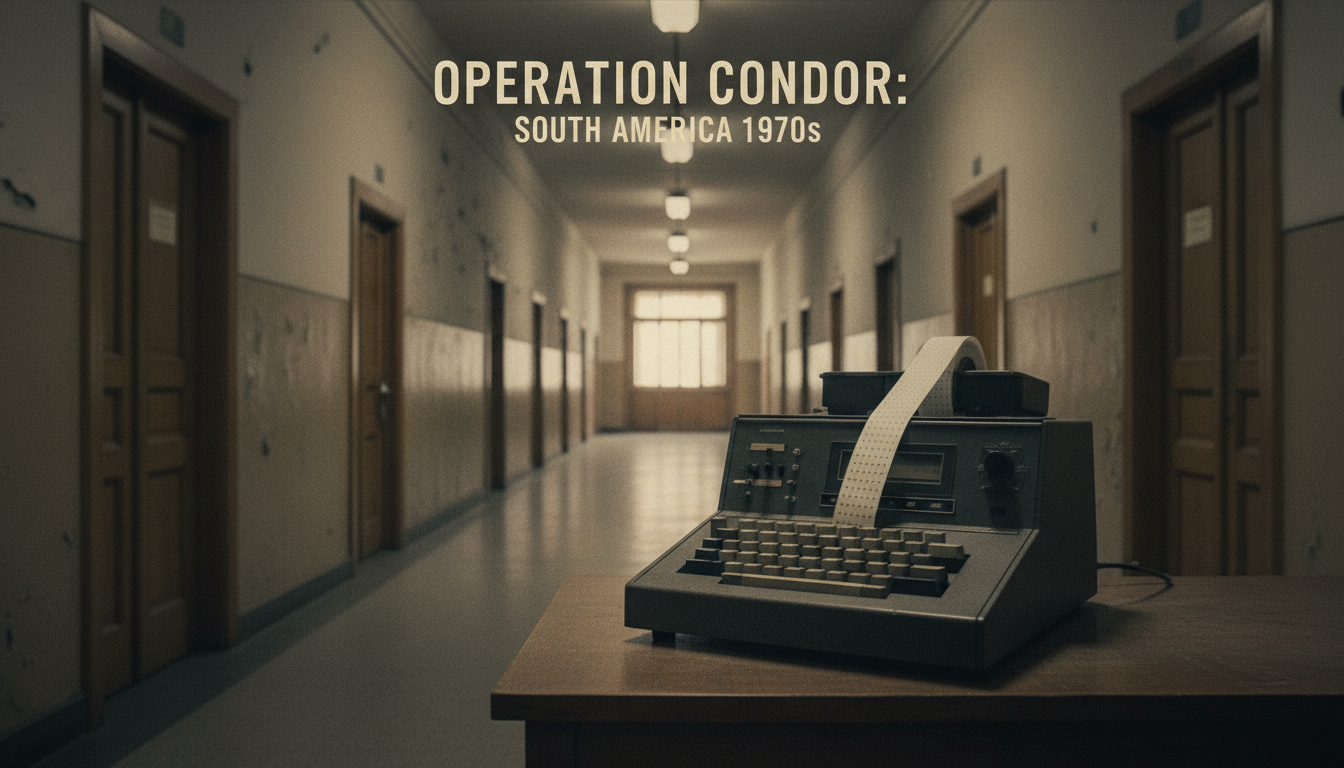
Operation Condor
In the mid-1970s, security services across South America's Southern Cone built something colder than parallel dictatorships: a shared hunting license. Exiles who thought a border meant safety learned otherwise. The network's name in the documentary record is Operation Condor.
A Multinational Desk
Condor linked intelligence and security organs in Chile, Argentina, Uruguay, Paraguay, Bolivia, and later Brazil. The product was not a press release. It was shared watch lists, joint operations, and cross-border seizures. A Uruguayan in Buenos Aires could be grabbed for Santiago. A Chilean in Europe could be marked for a hit team.
National Security Archive document releases—State cables, DIA assessments, and related traffic—map the structure without requiring conspiracy folklore. Diplomats and intelligence officers in Washington knew pieces of the machine. How much they steered versus how much they tolerated remains a live historiographical fight. The cables do not support a cartoon of Condor as a purely Yanqui puppet show. They also do not support innocence.
Trials After the Telexes
Decades later, courts in the region and in Europe treated Condor as prosecutable fact. Convictions and case files translated archival suspicion into judicial language: association to kidnap, murder, and disappearance as coordinated policy. Families of the disappeared used both archives and courtrooms. That combination matters. Condor is not only a FOIA story.
Cold War Frame Without Absolution
Condor's rulers sold themselves as anti-communist shields. Washington's regional policy often preferred those shields to elected left governments. Linking Condor to earlier U.S.-touched coups—Ajax in Iran, PBSUCCESS in Guatemala—is about pattern recognition in Cold War statecraft, not about proving every Condor murder was ordered from Langley. Paperclip's earlier moral bargain (useful Nazis, soft memory) sits in the same century of instrumental cruelty without being Condor's org chart.
What the Archive Should Hold Steady
Hold the multinational structure. Hold the cables. Hold the trials. Treat maximal "Washington ran every abduction" claims as arguments that need named documents. Treat denialism that Condor was merely unconnected national brutalities as contradicted by the coordination record. The middle is ugly enough.
Exile Geography
Condor's map was the Southern Cone plus the flight paths of refugees. European assassinations linked to the network—most famously in the Letelier case debates—show the hunt did not always stop at South American customs. Judicial findings differ by country and defendant. The multinational idea does not.
U.S. diplomats' cables sometimes read like horrified observers, sometimes like knowing neighbors. Historians argue the mixture. Readers should too—with the PDF open.