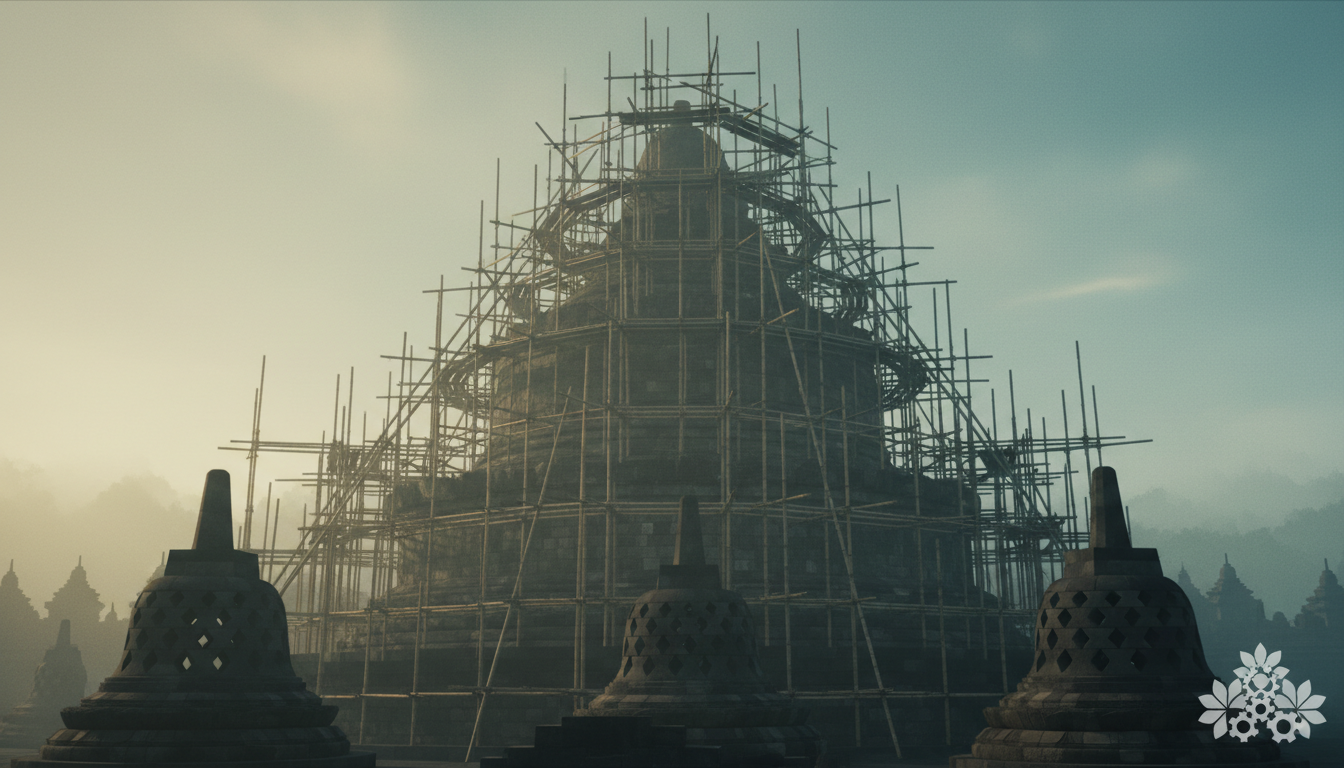
Borobudur rises from the Kedu Plain of Central Java as a Buddhist temple-mountain of terraces, galleries, and stupas. Dutch engineer Theodore van Erp stabilized upper levels between 1907 and 1911. By the 1960s Indonesian archaeologists led by Soekmono warned that water, settlement, and stone decay threatened the monument’s survival. UNESCO answered with an international campaign; the Borobudur Restoration Project ran roughly 1973–1983 as one of the largest cultural-rescue operations of its era and a precursor practice for the World Heritage system. In 1991 the Borobudur Temple Compounds entered the World Heritage List as property 592. This Archive file is documented conservation politics: campaign paperwork, technical intervention, Memory of the World archives, and later tourism management—not New Age mountain folklore and not a sneer that restoration “faked” the temple.
From Collapse Risk to International Campaign
Post-independence surveys made clear that galleries leaned, water pooled, and reliefs suffered. Indonesian appeals at international scholarly meetings pushed UNESCO toward a trust-fund model. Member states pledged voluntary contributions; work began in earnest in August 1973 with a roughly ten-year completion target and hundreds of workers on site. The political frame mattered as much as the engineering: Borobudur was framed as heritage of humankind, not only of one ministry. That framing raised money and also locked the project into visible international oversight. Earlier van Erp concrete and drainage already sat inside the fabric; the 1970s team inherited a monument that had been rescued once and was failing again under tropical hydrology. Indonesian training pipelines spun out of the project; ASEAN later treated Borobudur conservation know-how as a regional teaching hub. Soft power and stone science traveled together.
UNESCO World Heritage List 592: https://whc.unesco.org/en/list/592/.
UNESCO documents hub: https://whc.unesco.org/en/list/592/documents/.
Mega-Conservation Technique
The second restoration dismantled large stretches of terraces and balustrades so engineers could insert a reinforced-concrete substructure, waterproofing layers, and a redesigned internal drainage network. Specialist reviews describe epoxy-tar vertical barriers, horizontal lead sheets, PVC downpipes, and circular reinforcement intended to stiffen the temple-mountain against settlement and seepage. Stones were cleaned, consolidated, and reassembled; bas-reliefs that had suffered salts and biological growth received chemical and mechanical attention. The intervention was frankly modern. It was also the price of keeping the galleries standable for pilgrims and scholars. Later stone pathology—pustules, crusts, joint breakages from dismantling—entered conservation literature as the long tail of that choice. Documenting the concrete is not vandalizing the Buddha. It is naming what the rescue actually did. Pilgrims still circumambulate galleries whose hidden engineering is twentieth-century. Aura and armature share the same footprint; pretending otherwise is caption folklore.
Heidelberg Heritage conservation overview: https://journals.ub.uni-heidelberg.de/index.php/heritage/article/view/20031/13824.
Archives as Memory of the World
The project generated an enormous documentation corpus: tens of thousands of photographs, as-built drawings, glass negatives, film, and numbered project files. UNESCO’s Memory of the World register now carries the Borobudur Conservation Archives as a named documentary heritage of that campaign—explicitly linking the 1960s–1980s rescue to the genealogy of international cultural cooperation that fed the World Heritage Convention. Those archives are primary doors for restoration politics because they record decisions, not myths. Who measured which gallery, which epoxy batch sealed which terrace, which foreign expert signed which advice—these are bureaucratic facts with spiritual stakes for a living pilgrimage landscape. Without that paper mountain, later critics could invent either a pure untouched temple or a wholly fake rebuild. The MoW corpus blocks both cartoons.
UNESCO Memory of the World — Borobudur Conservation Archives: https://www.unesco.org/en/memory-world/borobudur-conservation-archives.
Inscription, Tourism, Management
Committee decision-making around the fifteenth session of the World Heritage Committee placed Borobudur on the List in 1991 under cultural criteria celebrating the temple compounds’ outstanding universal value. The official gallery and brief synthesis still present Mendut and Pawon with the main temple as a ritual landscape. After inscription, politics shifted from emergency rescue toward visitor load, vendor zones, parking, volcanic ash events, and debates over how much commercial perimeter a sacred monument can absorb. State-of-conservation reporting and management plans became the new paperwork genre. Critics who dislike concrete sometimes talk as if authenticity died in 1973; WHC integrity language instead treats the restored fabric as the protected resource under continuing risk. Both the rescue and the tourism pressure are documented. Neither requires Atlantis. Parking lots and ashfall contingency plans are as much part of Borobudur’s modern biography as the 1973 groundbreaking ceremony. Heritage politics did not end when the last PVC pipe was buried.
UNESCO WHC Decision 15 COM XV: https://whc.unesco.org/en/decisions/3521/.
UNESCO WHC gallery: https://whc.unesco.org/en/list/592/gallery/.
What Documented Settles
Settled for documentary purposes: Borobudur underwent a UNESCO–Indonesia mega-restoration in the 1970s–80s involving dismantling, concrete stabilization, drainage, and reassembly; the campaign’s photographic and technical archives are inscribed in Memory of the World; the temple compounds were listed as World Heritage in 1991; later management fights concern tourism, environment, and conservation ethics on that restored fabric. Still open as heritage politics: how much further intervention the stones can take, how to balance pilgrimage and mass tourism, and how frankly labels should disclose modern substructure. Those open questions do not reopen alien architects or erase Indonesian agency in the rescue.
The tension that remains is rescue versus aura. Engineers and WHC officers argue about water, concrete, and visitor numbers. Mystical captions argue about untouched ancient energy. Borobudur’s restoration politics are that argument—read with List 592, MoW archives, and conservation journals open, and with the mega-project kept on the heritage timeline where it belongs.