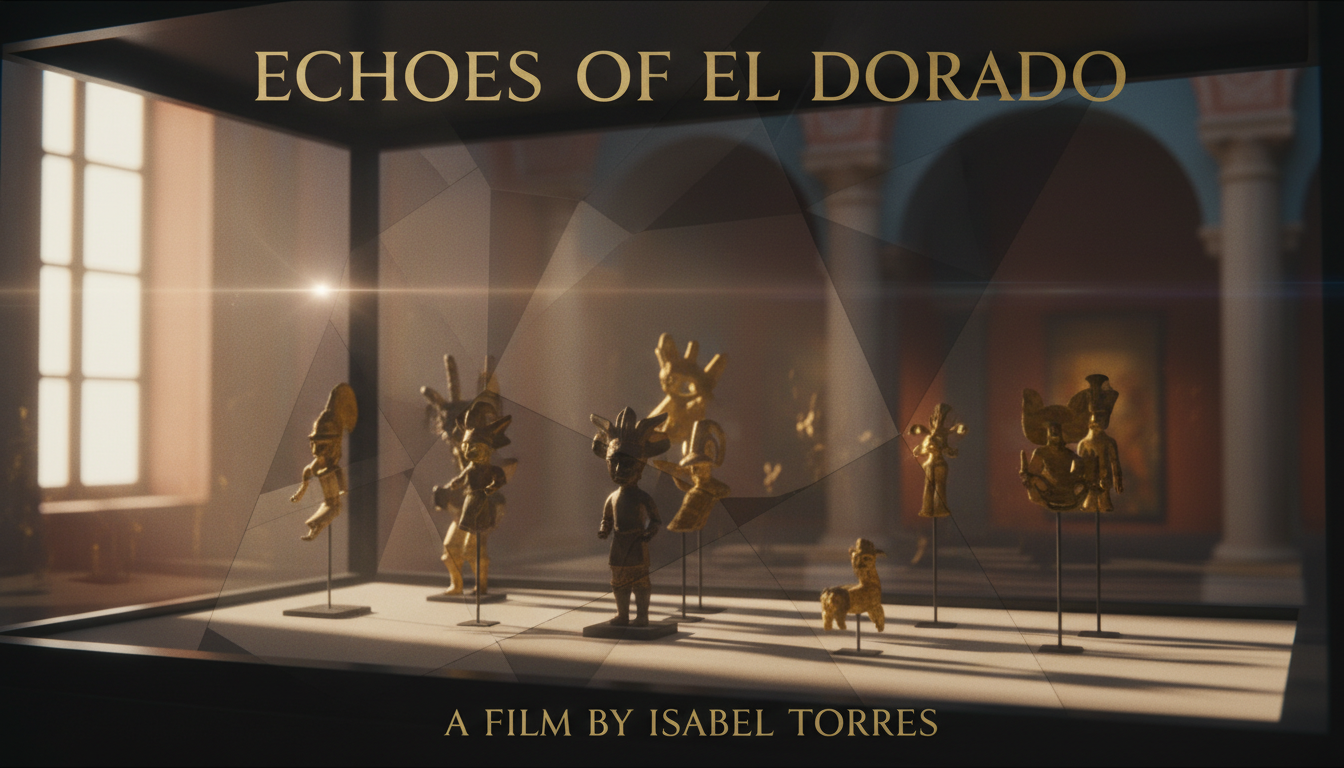
The gold in Madrid is not there because a Spanish court awarded it, and it is not there because a Colombian court has already carried it home. The fight is over what the 1893 delivery was. Spain’s government, answering a written question in Congress on 17 January 2024, says the set known as the Tesoro Quimbaya, or Tesoro de los Quimbayas, has formed part of the Spanish state’s collections since 1893, when it was given to Queen Regent María Cristina by Carlos Holguín, president of the government of Colombia. The answer says there is no doubt about title, or about the legality of how Spain obtained the pieces, and that the Ministry of Culture will watch the wider argument over works from the colonial period now outside their countries of origin. Colombia’s Constitutional Court, in judgment SU-649 of 19 October 2017, treated the same delivery as a failure of Colombian public law. Its syllabus says that in 1893 the collection was a fiscal good, public property, and that the constitution then in force required a treaty with Spain, taken through Congress, before a transfer of that kind. The court ordered the Ministry of Foreign Affairs and the Ministry of Culture, under the President, to carry through the administrative, legal, diplomatic, and if needed economic steps to repatriate or reacquire the 122 gold pieces known as the Tesoro Quimbaya, including payment to holders in good faith. That order binds offices in Bogotá. It does not move the cases in Madrid.
The court’s narrative of the handover is a gift on paper, not a conquest scene, and it should stay that narrow. On 20 July 1892 the acting president, Carlos Holguín Mallarino, told the chambers, in a message printed in the Diario Oficial, that the richest gold collection in the Americas had been sent to Madrid. On 4 May 1893, under President Miguel Antonio Caro, Colombia’s minister in Spain, Julio Betancourt, wrote to Foreign Minister Marco Fidel Suárez that he had that day delivered to the Queen Regent the gold objects of the Quimbaya collection, sent by the government as a gift. The pieces named in the court’s order are those 122. They are at the Museo de América. The 2017 judgment tells the Colombian state to seek them. It is not a Spanish judgment refusing return — no such Spanish judgment is on the pages used here — and it is not a completed restitution.
What the museum says the objects are is a funerary set, not a machine. A cinerary urn at the Museo de América, inventory 17459, is catalogued as Quimbaya style, gold, lost-wax, from La Soledad, Filandia, in a museum date range of 250 BC to 430. The record describes a seated woman on a ceremonial seat, with headdress, nose ornament, and ear ornaments, rings for suspension, and a hole in the head, identified as a woman cacique, from the funerary context called the Tesoro de los Quimbayas. The Consejo Superior de Investigaciones Científicas, in the 2016 catalogue El Tesoro Quimbaya, published with the culture ministry, calls the set one of the museum’s emblematic holdings: the largest group of Quimbaya lost-wax goldwork, one find, the grave goods of two adjacent tombs at La Soledad near Filandia, in Quindío, which is why it was called a treasure from the start. The museum’s research page puts the same gold under archaeometallurgy, iconography, and chronology. A folklore reading that turns some figures into ancient aircraft is not what those records describe. It is named here only to be refused.
The custody fight is therefore still between a Spanish assertion of a lawful 1893 gift and a Colombian order that the gift should not have been made without Congress and a treaty, and that Colombia must now ask for the pieces back. UNESCO’s database of national cultural-heritage laws lists SU-649 as Colombian case-law on the collection. A listing is not a transfer. Until the Museo de América or the Spanish government documents a handover, the gold stays in Madrid, and the 2017 order stays an instruction to the Colombian state.
Constitutional Court of Colombia, SU-649 of 2017: https://www.corteconstitucional.gov.co/relatoria/2017/su649-17.htm.
UNESCO database of national cultural heritage laws, entry for SU-649: https://www.unesco.org/en/cultnatlaws/constitutional-court-ruling-su-649-2017-regarding-quimbaya-collection.
Government of Spain, written answer to Congress, 17 January 2024: https://www.congreso.es/entradap/l15p/e0/e_0008527_n_000.pdf.
Museo de América, research on the Tesoro de los Quimbayas: https://www.cultura.gob.es/museodeamerica/investigacion/tesoro-quimbaya.html.
Museo de América, cinerary urn from the Tesoro, inventory 17459: https://www.cultura.gob.es/museodeamerica/coleccion/america-prehispanica/quimbaya.html.
CSIC catalogue, El Tesoro Quimbaya (2016): https://editorial.csic.es/publicaciones/libros/12723/0/el-tesoro-quimbaya.html.
The January 2024 answer does not discuss aircraft, tombs, or a defeat in court. It discusses title. The 2017 judgment does not announce a victory already enforced against the museum. It discusses a duty to try, by diplomacy and law, and if needed by paying good-faith holders. Collapsing the two papers into “Spain was ordered to give the gold back,” or into “Colombia has no claim,” reads neither. The objects’ recorded life is grave goods from Filandia. Their present argument is who may keep them.
The museum research page is explicit about the work still in front of the objects, and none of it is a redesign of them as vehicles. Projects listed there run through the scanning electron microscope, ion-beam analysis, and archaeometallurgy of pre-Columbian gold, with a complementary study of chronological and technological markers, plus a conservation project at the Instituto del Patrimonio Histórico Español under a Museo de América investigator. The point of that labour is origin, technique, and date. It assumes the figures are goldwork from a funerary find. It does not assume they flew.
What Documented Settles
Settled on these papers: 122 Quimbaya gold pieces were delivered to the Queen Regent in Madrid on 4 May 1893 as a gift from the Colombian government; they are at the Museo de América; Spain’s government in 2024 asserts title from that gift; Colombia’s Constitutional Court in 2017 ordered Colombian ministries to pursue repatriation or reacquisition. Not settled on these records is a physical return. Not settled by any Spanish judgment cited here is a court refusal in Spain. The figures are funerary gold. They are not aircraft.