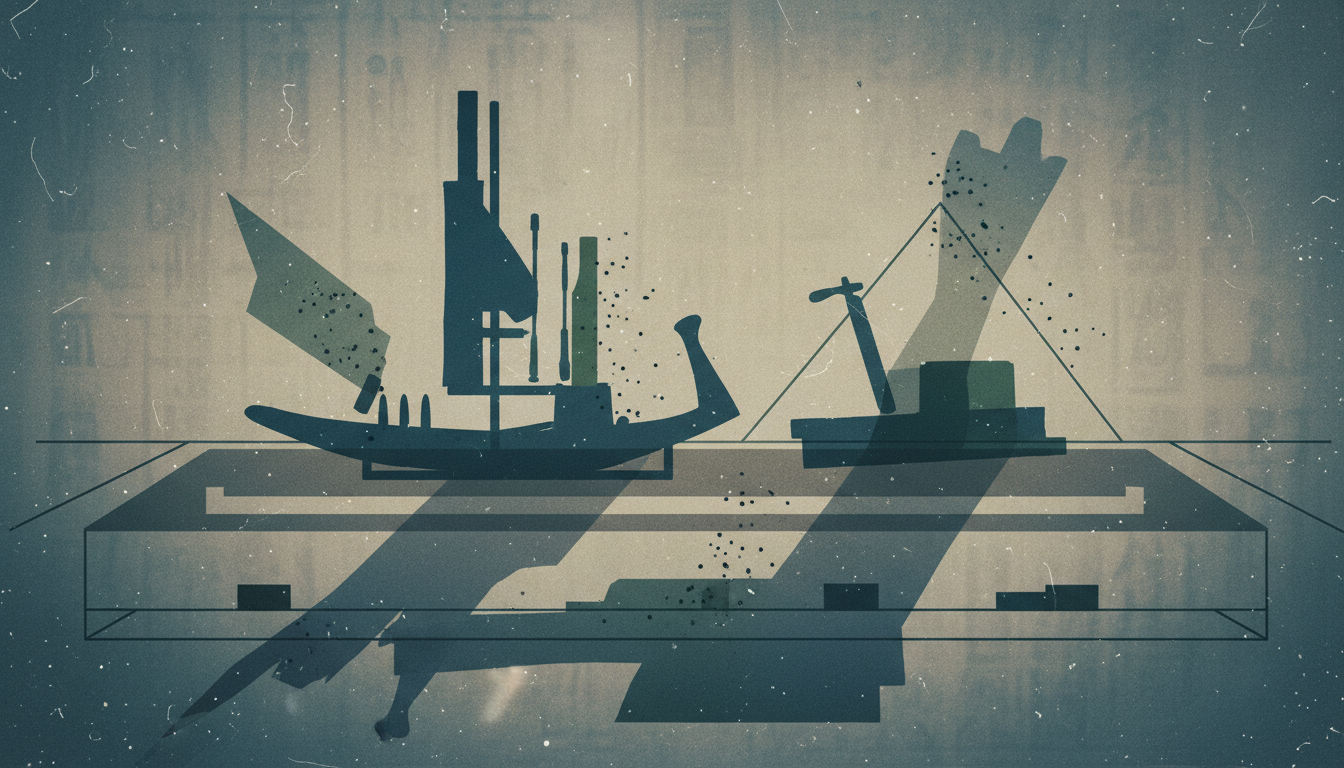

On 26 May 1954, Egyptian antiquities architect Kamal el-Mallakh uncovered a row of limestone roofing blocks on the south side of Khufu’s pyramid at Giza. Beneath them lay a sealed, rock-cut pit packed with carefully stacked cedar planks, oars, and rope—still aromatic after four and a half millennia. The dismantled ship that conservators later reassembled became the Khufu solar bark: one of the oldest and most complete large wooden hulls known from the ancient world. A companion pit held a second boat. Egyptian ministry and museum custody carried the first ship from a purpose-built Giza museum into the Grand Egyptian Museum in 2021. This Archive file is documented. It is about boat pits you can photograph in excavation history—not about ScanPyramids muon voids, which remain a media HOLD elsewhere and are not rewritten here as chambers of fact.
1954: Sealed Pits, Not Speculation
Clearance work along the pyramid’s southern enclosure exposed the covering slabs. El-Mallakh’s team cut an inspection hole, looked down on ordered timber, and recognized a royal boat burial. Removal took many months; reconstruction under Hag Ahmed Youssef Moustafa took years of joining roughly twelve hundred pieces into a hull more than forty meters long. Shell-first planking, lashed fastening, and fine cedar work reset textbooks on Old Kingdom shipbuilding. Function debates continue—solar cult bark, funerary transport, both—but the find itself is not optional folklore. It is a sealed pit with a ship inside.
PBS NOVA — Explore a Pharaoh’s Boat: https://www.pbs.org/wgbh/nova/pharaoh/expl-nf.html.
PBS NOVA project hub: https://www.pbs.org/wgbh/nova/pharaoh/.
The second pit, recorded in the same 1954 campaign zone, preserved another dismantled vessel. Later recording and lifting campaigns treated it as conservation archaeology under Egyptian authority and international partners. That is still boat-pit documentation. It is not a warrant to paste speculative void maps from unrelated scan projects onto this page.
Photographs from 1954 remain the discovery grammar: limestone “sardine” slabs, then the dark rectangular pit, then timber still ordered as the ancient packers left it. Conservators numbered pieces, recorded lashing evidence, and rebuilt a hull that could, in principle, float—whether or not it ever sailed the Nile as a working boat. Public galleries taught that sequence for a generation beside the pyramid before the GEM move.
Museum Doors and the 2021 Move
For decades the reconstructed first boat stood in the Giza Solar Boat Museum beside the pyramid, with the pit architecture incorporated into the visit. In 2021, under Ministry of Tourism and Antiquities logistics, the vessel moved to the Grand Egyptian Museum complex in a controlled transfer covered by contractor and press reportage. BESIX–Orascom published a project note on the successful transport. Smithsonian Magazine summarized the relocation for an international audience. Egyptian monuments portals remain the public face of state heritage framing for Giza and museum sites.
BESIX–Orascom GEM transport note: https://www.besix.com/en/news/besix-orascom-construction-successful-transport-of-the-king-khufu-solar-boat-to-the-grand-egyptian-museum.
Smithsonian Magazine move reportage: https://www.smithsonianmag.com/smart-news/egypts-ancient-solar-boat-moved-to-new-home-180978398/.
egymonuments.gov.eg: https://egymonuments.gov.eg/.
Custody changes buildings. It does not change the 1954 discovery ledger. Visitors who meet the bark under GEM lighting inherit the same cedar, the same reconstruction, and the same requirement to separate documented pits from speculative tomography elsewhere on the plateau.
Japanese–Egyptian cooperation on the second boat’s recording and lifting enters ministry and partner statements as conservation science, not as tomography tourism. Live reassembly halls, when opened, make process visible: fragments, cradles, climate control. That visibility is the documentary opposite of a muon headline. It shows wood.
UNESCO Landscape Frame
Khufu’s pyramid and its satellite architecture sit inside the World Heritage property “Memphis and its Necropolis – the Pyramid Fields from Giza to Dahshur.” Listing 86 is the international paperwork neighbor for the cemetery landscape that includes boat pits as part of royal funerary equipment. Conservation language for the pyramid fields worries about urban pressure, tourism, and fabric—ordinary WH management, not a mystery void bulletin.
UNESCO List 86: https://whc.unesco.org/en/list/86/.
What This Page Refuses
ScanPyramids and related muon or thermal campaigns generate separate media and specialist arguments about density anomalies inside Khufu’s pyramid masonry. Those titles are on media HOLD for rewrite purposes. This file does not promote voids, corridors, or chambers asserted from those campaigns as settled finds. Boat pits are open archaeology with timber, photographs, museum inventory, and transfer paperwork. Conflating the two is exactly the bleed documented filing is here to block.
Alien barge myths and “too advanced for Egyptians” captions fail the same test. Old Kingdom dockyards, copper tools, and cedar trade already sit in Egyptological literature. The wonder is preservation and craft—not a missing nonhuman shipwright.
What Documented Settles
Settled for documentary purposes: 1954 discovery of sealed boat pits south of Khufu’s pyramid; recovery and reconstruction of a major cedar solar bark; a second pit/boat context under Egyptian antiquities control; decades of Giza museum display followed by 2021 GEM transfer; UNESCO Memphite necropolis framing for the plateau. Still open as interpretation: precise ritual function of each bark; full publication details of ongoing second-boat conservation schedules. Still closed on this page: ScanPyramids void-as-fact claims.
Readers hunting only suppressed pyramid voids will be bored by cedar joinery. Readers hunting only a museum brochure will miss why HOLD scan titles must stay off this page. Documented filing keeps the boat pits on the 1954–museum timeline where they belong.
The tension that remains is pit versus caption. Officials and conservators argue about cedar, joinery, and museum climate. Mystery media argue about unseen chambers elsewhere in the masonry. Khufu’s boat pits are the first argument—read with UNESCO, NOVA, GEM-move doors, and Egyptian monuments portals open, and with HOLD scan voids left off this ledger.