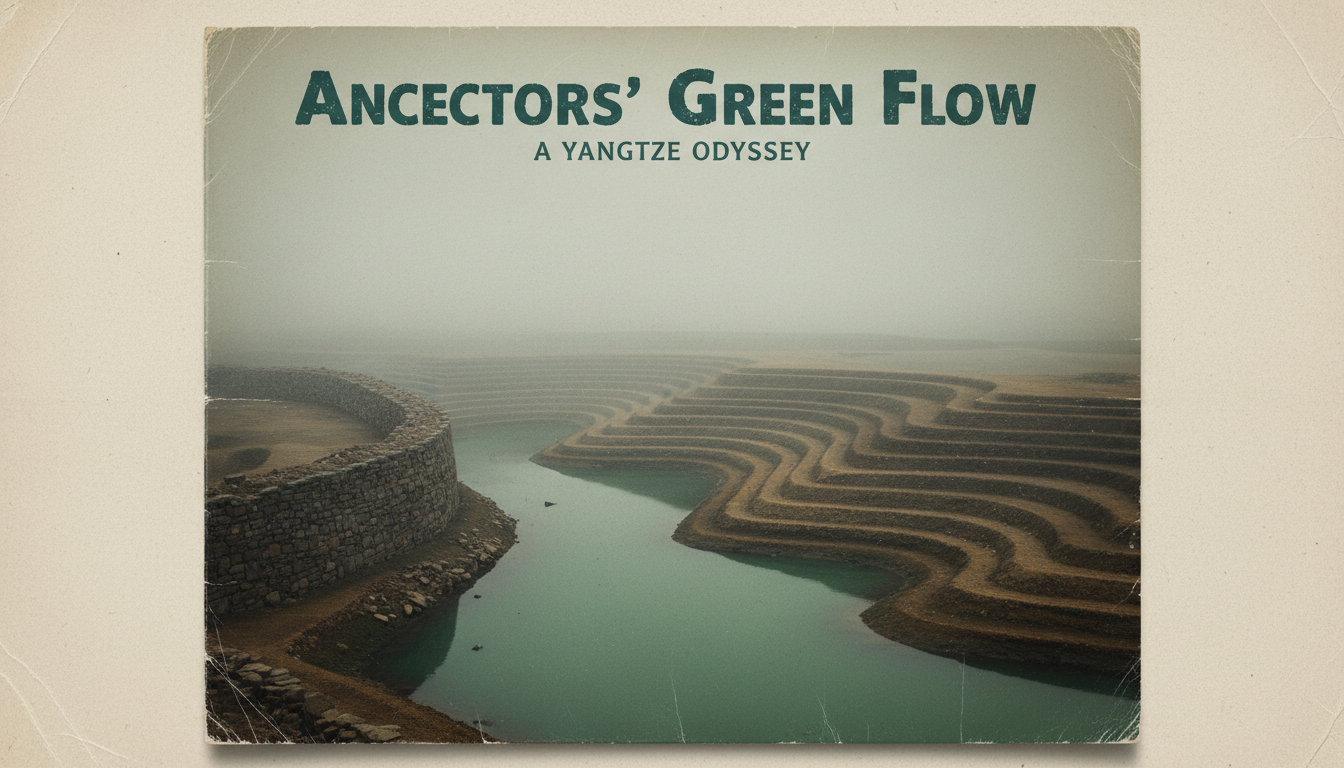
On the plain south of Taihu Lake in the Yangtze River basin, the Archaeological Ruins of Liangzhu City preserve a Late Neolithic center dated roughly 3300–2300 BCE: earthen city walls, elite cemeteries, jade assemblages, and—decisively for this file—a peripheral water-conservancy system of high dams, low dams, and levees. UNESCO inscribed the property in 2019 as List 1592 under criteria (iii) and (iv), calling out early urban civilization expressed in earthen monuments, planning, water conservation, and burial hierarchy tied to rice agriculture. Chinese excavation and geoarchaeology, including Liu and colleagues’ work on the dam complex, treat that hydraulic enterprise as documented engineering for an early regional state. This file holds the World Heritage and peer hydraulic record. It refuses lost-race, diffusion, and Atlantis overclaims that erase Yangtze Neolithic makers from their own levees.
Four Areas, One Hydraulic City
UNESCO’s brief synthesis divides the property into Yaoshan; the High-dam at the Mouth of the Valley; the Low-dam on the Plain with the mountain-front causeway; and the City Site. Together they map power, belief, and water control across more than a thousand hectares of property inside a much larger buffer. The city core shows functional zoning and outer terraces. Graded cemeteries, including altar contexts, materialize hierarchy. Jade objects index a shared belief system rather than random ornament. Rice cultivation underwrites the economic base. That package is why inscription language speaks of an early regional state in the Circum-Taihu area—not of a mysterious non-Asian civilizer depositing dams overnight.
UNESCO List 1592: https://whc.unesco.org/en/list/1592/.
Decision 43 COM 8B.15: https://whc.unesco.org/en/decisions/7372/.
Documents hub: https://whc.unesco.org/en/list/1592/documents/.
Management sits with the Hangzhou Liangzhu Archaeological Site Administrative District under Chinese cultural-relics law, with national and provincial protection layers for different components. Integrity language addresses urban development pressure; authenticity language leans on preserved site morphology, materials, and excavated jade technologies. Heritage bureaucracy is not a conspiracy to hide aliens. It is how a large earthen and hydraulic landscape stays researchable beside Hangzhou’s growth.
Dams as Early Statecraft
Field survey and excavation around Liangzhu identified a peripheral system often summarized as high dams linking valley mouths, low dams tying isolated hills on the plain, and long levees—on the order of eleven major structures in classic descriptions, with ongoing remote-sensing and machine-learning work still hunting additional eroded segments. Radiocarbon programs place major dam construction near the turn of the fifth millennium before present, centuries into the culture’s span. Functions discussed in the literature include flood control, water storage, and landscape management supporting intensive wet-rice farming on a flood-prone plain. UCL Discovery hosts the revised manuscript for Liu, Wang, Chen, and colleagues’ “Earliest hydraulic enterprise in China, 5,100 years ago,” the peer door tying dam stratigraphy to social complexity. A PNAS commentary on PMC, “The hydraulic lift of early states societies,” situates Liangzhu among comparative debates about water and early political integration.
UCL Discovery PDF: https://discovery.ucl.ac.uk/id/eprint/10040887/1/Revised%20manuscript.pdf.
UCL Discovery record: https://discovery.ucl.ac.uk/id/eprint/10040887/.
PMC commentary: https://pmc.ncbi.nlm.nih.gov/articles/PMC5748232/.
Hydraulic complexity does not require a fantasy precursor civilization. It requires labor coordination, surveying of catchments, earthen construction at scale, and maintenance—capacities already implied by city walls, elite jades, and cemetery ranking. Geoarchaeology of inner watercourses and mound edges further ties occupational sequences to changing wetness regimes. Abandonment debates invoke flooding and climate stress without needing a lost race to exit stage left.
Inner-city waterways and bankside mounds add micro-stratigraphic texture to the big dam story. Sediment sequences from channels such as Zhongjiagang help model how wetness, dredging, and occupation pulsed as the city grew and later thinned. Remote sensing and newer machine-learning surveys extend the known dam catalogue beyond the classic eleven-structure sketch, always subject to ground truth. Scale keeps growing in the literature without leaping into mythology.
Against Lost-Civilization Overclaim
Internet folklore sometimes folds Liangzhu into diffusion scripts: advanced foreigners, drowned mother cultures, or “forbidden” timelines that cast Chinese archaeology as either hiding or inventing deep antiquity. The UNESCO dossier and the dam papers do the opposite of hiding. They publish coordinates, criteria, and radiocarbon. National pride rhetoric can over-maximalize “origins of Chinese civilization” language; the corrective is still the property’s own wording—an outstanding Yangtze contribution to early urban and rice-cultivating complexity—not a sneer that Neolithic Hangzhou was impossible. Wonder at five-thousand-year-old dams is allowed. Wonder that deletes the excavators’ chronology is not.
Comparative early-state talk (irrigation theses, craft specialization, ritual jades) belongs in peer debate. Atlantis captions do not. Liangzhu’s hydraulic city is impressive because Late Neolithic communities in this basin built it—not because it proves a global reboot myth or a vanished master race.
What Documented Settles
Settled for documentary purposes: Liangzhu City and its peripheral water-conservancy system are UNESCO-listed archaeological remains of a Late Neolithic rice-based regional center; high and low dams and related levees are published as a large-scale hydraulic enterprise; Chinese heritage management and international WH paperwork frame custody and research. Still open as normal science: fine-grained abandonment drivers; full inventory of buried dam segments; exact political anthropology labels (“state,” “chiefdom”) in comparative theory. Those open questions do not reopen foreign civilizers or lost-race baptism. Jade cong and bi remain the belief-system index most visitors meet in museums; dams remain the landscape index most easily missed from a city-wall photo. Holding both in one file is the point of a hydraulic-civilization page. Liangzhu is documented hydraulic urbanism on the Yangtze plain—read with UNESCO, UCL Discovery, and PMC doors open, and with diffusion folklore left outside the levees.