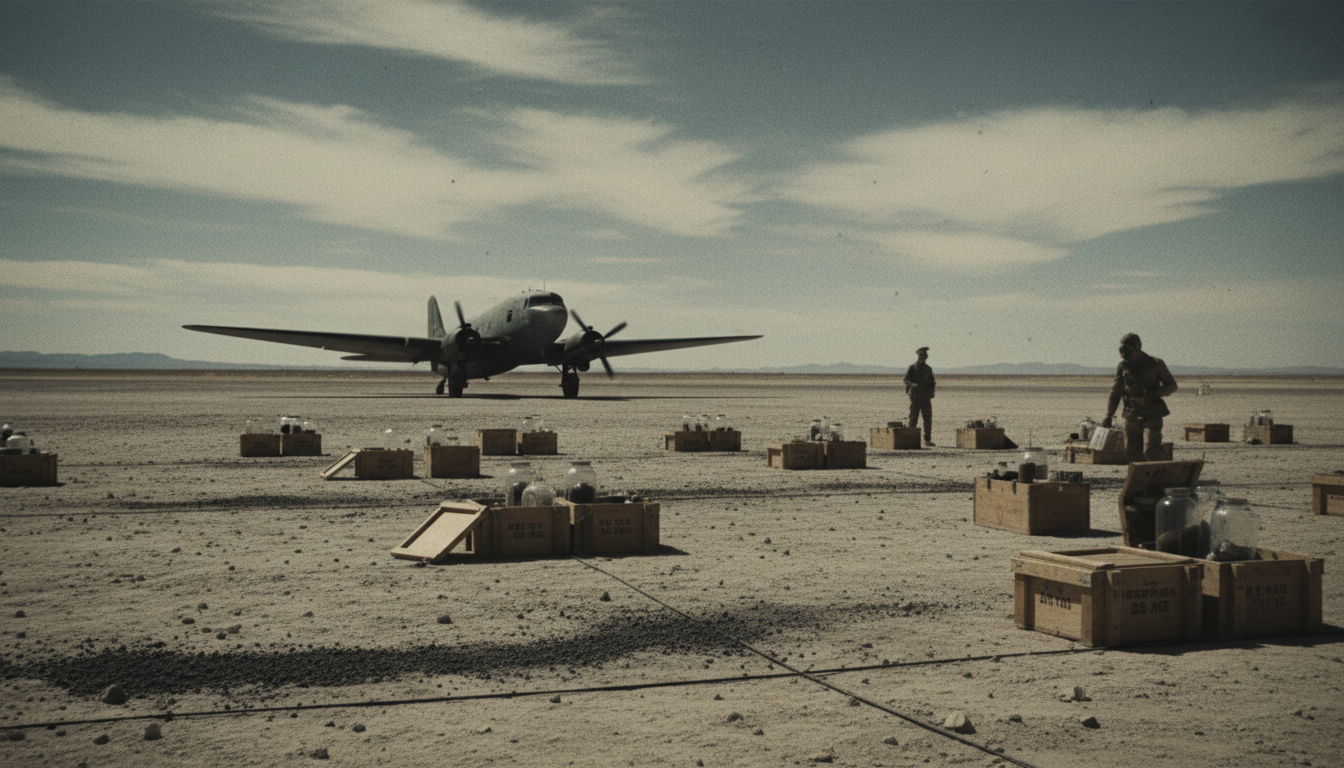
In September 1954, over the Salt Flat Grid at Utah’s Dugway Proving Ground, the U.S. Army Chemical Corps dropped fleas from aircraft. The fleas were Xenopsylla cheopis—the oriental rat flea, a classic plague vector—but they were not infected. The question on the clipboards was narrower and colder: could insect vectors survive aerial release, disperse across a measured grid, and find hosts fast enough to matter as munitions? The test series was called Operation Big Itch. The paperwork reads like entomology welded to ordnance.
Fleas as Munitions
Entomological warfare treats insects as delivery systems. Mid-century U.S. biological-weapons work did not invent the idea, but it industrialized the measurement problem. Big Itch evaluated cluster munitions built to scatter fleas: the E-14 bomblet (designed around roughly 100,000 fleas) and the higher-capacity E-23 (around 200,000). Clustered into larger casings, the bomblets were meant to open at about 1,000 or 2,000 feet, parachute, and release their cargo over a battalion-scale footprint.
Guinea pigs ringed a roughly 660-yard circular grid as sentinel hosts. Counts replaced slogans. The Chemical Corps wanted coverage patterns, survival after free-fall, and proof that released fleas would still seek blood meals. Camp Detrick breeding pipelines fed the Utah drops. The Salt Flat itself was chosen partly because establishment risk looked low: barren ground, few resident rodents of the kind X. cheopis prefers, wingless insects unlikely to self-disperse off-grid.
Primary Big Itch field documentation (FOIA/Black Vault): https://documents.theblackvault.com/documents/biological/bigitch.pdf
Entomological Warfare archive door: https://www.theblackvault.com/documentarchive/entomological-warfare/
What the Dugway Paper Shows
The drops worked well enough to keep the program interested. Uninfected fleas survived aerial dissemination and attached to hosts on the grid. Activity without a host was short—on the order of a day—so the “weapon effect” window was measured in hours, not weeks of ecological establishment. That limit is in the field language, not later myth. Coverage estimates talked in battalion-sized disruption for roughly a day of flea activity, contingent on hosts being present.
Hardware failed in ways the reports do not soften. E-23 munitions malfunctioned repeatedly in preliminary work. Fleas escaped into the aircraft when seals and actuating gear misbehaved. Pilot, bombardier, and observer were bitten. Remaining trials leaned on the smaller E-14. The episode is not comedy filler. It is munitions-safety data written into a biological-warfare test file—proof that vector weapons create handling hazards before they ever create epidemic captions.
Alastair Hay’s reconstruction of Chemical Corps parameters (E-14/E-23 dimensions, altitudes, crew bites) sits beside the FOIA PDFs: https://fightingmonarch.com/wp-content/uploads/2026/03/a-magic-sword-or-a-big-itch-an-historical-look-at-the-united-states-biological-weapons-programme-leeds-school-of-medicine.pdf
Deseret Continuity, Not a One-Off Oddity
Big Itch belongs to a family. Operation Big Buzz (mid-1950s) rehearsed mosquito dissemination elsewhere in the Chemical Corps catalogue. Later Dugway work under Chemical Corps Research and Development Command—including the Bellwether series—tried to standardize quantitative entomological field-test technology against urban, jungle, and guerrilla-terrain target models. The December 1961 Bellwether II volume (BIO 531) is the Deseret-era methods sibling: how to score insect munitions outdoors once laboratory demos were no longer enough. Deseret Test Center’s outdoor BW mandate and Dugway’s proving-ground infrastructure sit on the same Utah complex that had already flown fleas in 1954.
Bellwether II entomological field-test PDF: https://documents.theblackvault.com/documents/biological/EntomologicalFieldTest.pdf
Dugway / West Desert Technical Information Center report inventory (1950–1960): https://documents.theblackvault.com/documents/weapons/TechRptsDPG_1950-1960.pdf
DTIC companion technical report (AD0596046): https://apps.dtic.mil/sti/pdfs/AD0596046.pdf
Outdoor vulnerability trials and anti-crop experiments elsewhere in the U.S. BW catalogue share the same premise: rehearse attack and defense with live agents or simulants, then write the results into technical reports that stayed classified for decades. Big Itch is one named node in that paper trail—vector hardware scored the way a bomb range scores fragments.
Myth Discipline
Do not convert an uninfected vector-munition trial into proof of a plague strike on American cities. The Dugway packets measure fleas as hardware. They do not publish a civilian epidemic attributed to Big Itch. Do not collapse Unit 731’s wartime crimes, South Africa’s later Project Coast, or every rumor of insect attack into a single U.S. command chain. Method family is not shared authorship. Prefer the FOIA PDFs and Chemical Corps parameters over cable-news captions about “weaponized plague fleas” without the uninfected qualifier the technical reports themselves keep repeating.
Also refuse the opposite soft eraser: the claim that entomological warfare was only enemy folklore. Big Itch, Big Buzz, and Bellwether are U.S. Army paper—Dugway grids, munition designations, host counts. Renunciation of the offensive biological-weapons program in 1969 did not un-write the 1950s test grids. It closed a chapter the Archive can still open by reading the FOIA packets instead of the rumor mill.
What the Paper Trail Settles
Settled on the documents: September 1954 Dugway Operation Big Itch; aerial E-14/E-23 flea munitions using uninfected X. cheopis; grid host-acquisition and short activity window; E-23 malfunction with in-aircraft bites; later Dugway/Deseret-era entomological field-test standardization (Bellwether). Overclaim to refuse: treating Big Itch as a completed plague weapon drop on U.S. populations, or erasing the uninfected test design that the technical reports themselves record.
The tension that remains is institutional. Officials later renounced offensive biological weapons. The same record shows how carefully insect vectors were quantified as munitions first—coverage, survival, host-seeking, handling failures. Big Itch is that measurement—read with the Dugway PDFs open, beside Bellwether’s later attempt to turn insect drops into a repeatable field science rather than a one-off desert stunt.