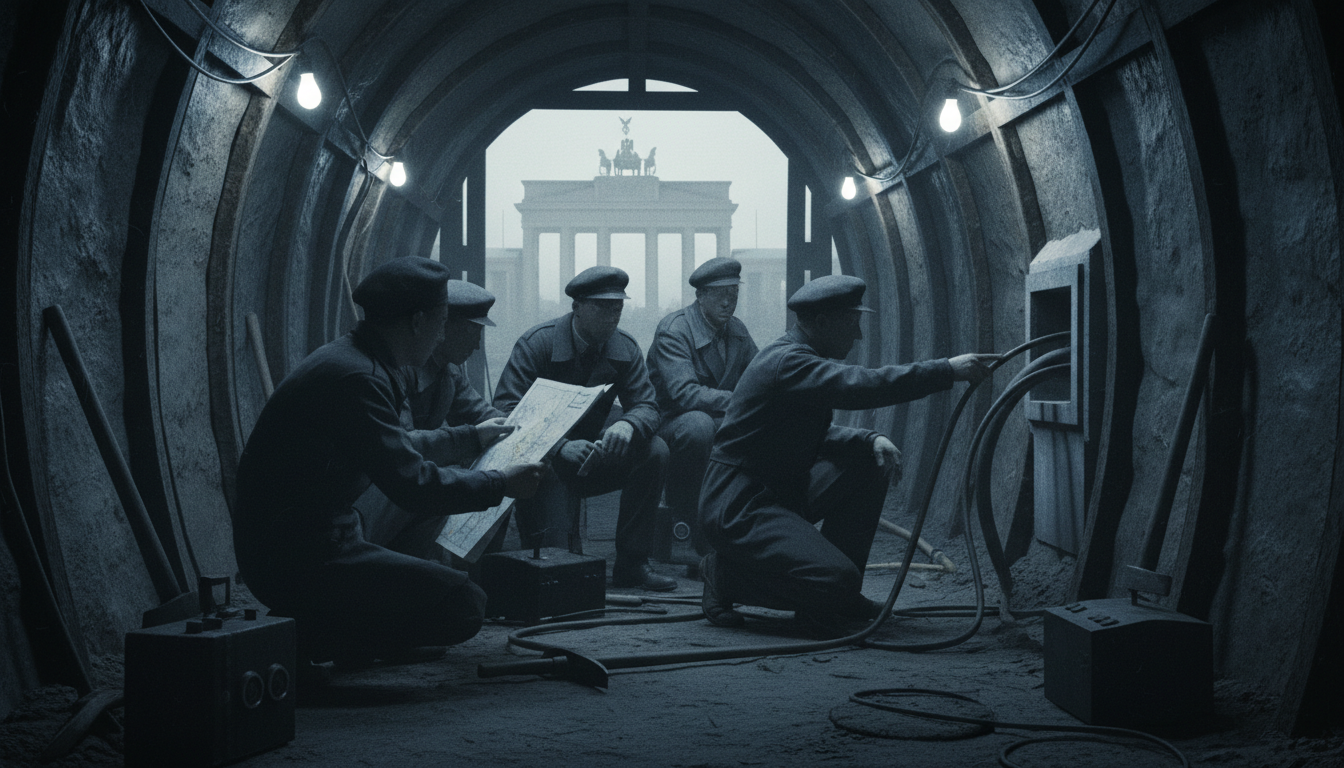
In January 1954 Allen Dulles approved a joint CIA–MI6 plan to dig from West Berlin under the sector border and tap Soviet military landlines in the East. The finished tunnel ran 1,476 feet, steel-lined, hidden under an Air Force radar site and warehouse cover. British technicians installed the taps; collection began in May 1955. For eleven months the West thought it had an ear on Moscow’s European military traffic. The KGB had known since the planning meetings—because George Blake, an SIS officer in the room, had already told them.
Digging Under Altglienicke
Before satellites, landline taps were a primary way to read Soviet order of battle. Berlin sat astride cables linking Moscow to Warsaw Pact nodes. Encrypted and clear traffic both rode those lines. The CIA and SIS judged a tunnel from the American sector to those cables feasible if cover held and the dirt problem could be solved without advertising a spoil pile to East German observers. Dirt—more than three thousand tons—went into a purpose-built basement under the warehouse. Steel rings formed a six-foot bore; a shield and hydraulic jacks pushed the liner forward through sandy soil. On 11 May 1955 the taps went live. CIA’s later public account tallies tens of thousands of tape reels, hundreds of thousands of transcribed conversations, millions of teletype hours, and well over a thousand finished intelligence reports processed after the shutdown. Processing alone ran more than two years past the tunnel’s death. Analysts in London and Washington worked the take in parallel—teletype imagery alone, CIA later said, would have filled a small room if printed as books—while the diggers’ cover story had already died in the East Berlin mud.
CIA Stories — Berlin Tunnel: https://www.cia.gov/stories/story/berlin-tunnel-americas-ear-behind-the-iron-curtain/
Official Posture: Audacity, Then Discovery
When Soviet and East German teams “found” the tap while digging near Altglienicke in April 1956—after a wet spring and cable faults—Moscow staged outrage for the cameras. Western coverage often marveled at the engineering instead. That was the public fight Dulles could live with. Internally he had wanted as little as possible reduced to writing when the project was authorized. The institutional autopsy researchers can now open is the Clandestine Services History of the Berlin Tunnel Operation—CSHP-150—later declassified through FOIA channels and mirrored by the National Security Archive.
CIA FOIA — CSHP-150 PDF: https://www.cia.gov/readingroom/docs/CSHP-150%20-%20THE%20BERLIN%20TUN%5B16277510%5D.pdf
CIA FOIA — CSHP-150 document page: https://www.cia.gov/readingroom/document/01225490
National Security Archive — Doc 15: https://nsarchive.gwu.edu/document/28373-document-15-central-intelligence-agency-berlin-tunnel-operation-1952-1956-june-24
Blake: Compromised from the Start
Blake attended early Anglo-American planning meetings and passed the substance to his KGB handlers—minutes and all. The Soviets did not shut the tunnel on day one. CIA’s institutional narrative is blunt about why: protecting Blake mattered more than silencing every cable. The KGB kept the existence of the tap compartmented even from many Soviet military users of those lines, and from East German services that might have blown the mole by reacting too fast. When Blake was safely repositioned, the “accidental” discovery followed. Western services did not fully understand that prior compromise until Blake’s 1961 arrest and Official Secrets Act conviction—forty-two years, a parliamentary scandal as much as a courtroom one.
Hansard Commons — Security Procedures (Case of George Blake), 4 May 1961: https://api.parliament.uk/historic-hansard/commons/1961/may/04/security-procedures-case-of-george-blake
Hansard Lords — Official Secrets Act Prosecution, 4 May 1961: https://api.parliament.uk/historic-hansard/lords/1961/may/04/official-secrets-act-prosecution
Was the Take Poison?
If Moscow knew, was every conversation theater? Later CIA assessment says no: studies after the fact found the Soviets had not run a systematic disinformation feed over the tapped lines. Order-of-battle material, atomic-energy personnel identifiers, East German military early warnings, railway and Polish-tension reporting, and evidence that Soviet forces were not postured for an imminent invasion of Western Europe were treated as genuine product. Secondary historians still argue over relative value—some NSA-era skepticism surfaces in the literature—but the Agency’s public line is that Blake’s tip did not automatically convert the tunnel into a KGB stage set. The so-what is the trade: years of real traffic purchased by burning some Soviet military privacy to keep a mole alive.
Siblings and Myth Discipline
Vienna’s smaller Operation Silver was the precursor idea—short dig, same wiretap logic. Blake belongs with the SIS mole problem that also shadows Cambridge Five historiography—same service weather, different access and product. Documented: joint tunnel; Blake tip before dig; April 1956 exposure; 1961 Blake conviction; CIA CS history and Stories narrative. Overclaim to refuse: “worthless from day one” as settled fact against CIA’s later genuine-product assessment, and “total triumph” captions that delete the mole. Dulles wanted little in writing. The Archive’s job is the writing that survived—CSHP-150, the Stories page, and the Hansard day Blake became impossible to contain.
Date discipline: planning through 1952–54; construction roughly a year; collection May 1955 to April 1956; Blake convicted 1961; CSHP-150 written in the 1960s and opened later.
The warehouse cover story mattered as much as the steel liner. A fenced radar site the size of a city block explained generators, barracks, and night work to anyone watching from the East. What it could not explain—once Blake had spoken—was why the KGB waited. That wait is the documentary hinge: compromise without immediate kill, product without proven poison, discovery timed to a mole’s safety rather than to a cable short alone.
What the Paper Trail Settles
Settled on the documents: CIA and MI6 built and ran the Berlin Tunnel; Blake compromised it early; the Soviets staged discovery in April 1956; Blake’s 1961 conviction opened the Western realization of that prior betrayal; CIA’s later institutional account holds the collected intelligence was largely genuine because disinformation was not the KGB’s chosen protection method. Officials celebrated audacity. The paper trail adds the mole—and the price Moscow paid to keep him.