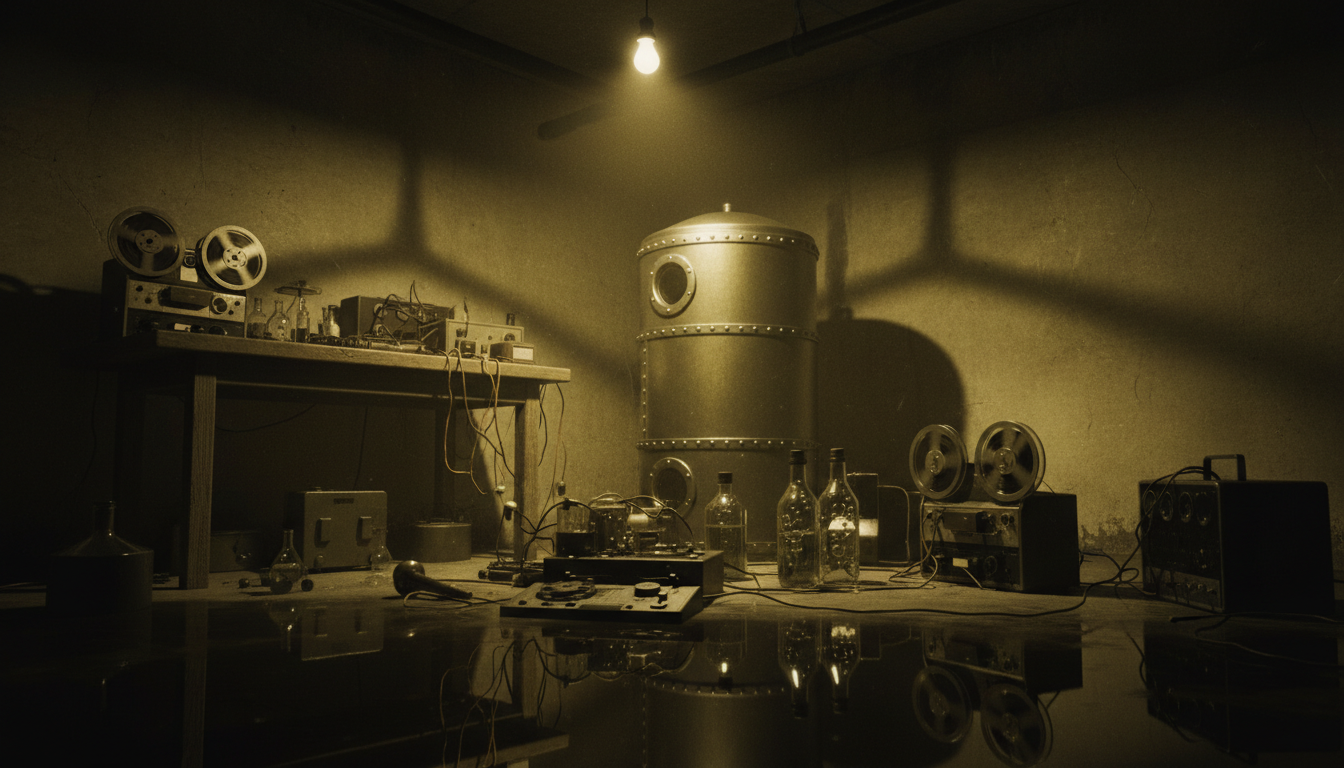
The Mind Control Program That Was Not a Rumor
For decades, late-night radio hosts and underground pamphlets insisted that the Central Intelligence Agency had been dosing Americans with LSD, wiring hospitals for behavioral experiments, and hunting for a chemical key to erase and rebuild a human personality. Mainstream coverage often treated the claim as pulp fiction—until congressional investigators opened the files and found that the pulp had a cryptonym.
That cryptonym was MKUltra.
Church Committee and FOIA Ash
Project MKUltra was authorized in 1953 under CIA Director Allen Dulles as an umbrella for research into behavioral modification, interrogation aids, and drugs that might serve as "truth serums" or incapacitating agents in the Cold War contest with the Soviet bloc and China. Oversight sat with the Agency's Technical Services Staff; Sidney Gottlieb became the figure most associated with running the drug and chemical work. Predecessor efforts under cryptonyms such as BLUEBIRD and ARTICHOKE had already explored hypnosis, isolation, and pharmacological interrogation.
What made MKUltra notorious was not only laboratory pharmacology but field practice. Subprojects funded work at universities, prisons, hospitals, and safehouses. Some subjects were informed volunteers; others were not. The Agency's own Inspector General report in 1963 flagged surreptitious administration of LSD to unwitting persons—practice later curtailed, according to Agency statements to Congress. The death of Army scientist Frank Olson in November 1953, after he was secretly dosed with LSD at a CIA-linked retreat, became one of the most publicly litigated cases tied to the program.
In 1973, as Watergate-era scrutiny intensified, CIA Director Richard Helms and Technical Services leadership ordered destruction of MKUltra files. Investigators in the mid-1970s therefore worked largely from the 1963 IG report, survivor testimony, and scraps that survived the purge. The Rockefeller Commission and the Senate Select Committee chaired by Frank Church brought the cryptonym into public view in 1975. In 1977, DCI Stansfield Turner informed Congress that seven boxes of financial and administrative records related to MKUltra had been located; those remnants, plus FOIA releases compiled by researchers such as John Marks, remain the documentary backbone.
Canadian psychiatric experiments associated with Dr. Ewen Cameron at Montreal's Allan Memorial Institute—intensive "psychic driving," prolonged sleep, and electroconvulsive regimes funded in part through cutouts—illustrate how MKUltra money could travel through academic and medical fronts beyond U.S. borders. Survivors and estates later pursued compensation claims; the United States and Canada have both faced legal and political reckoning over aspects of that research.
LSD and Behavioral Experiments
Archive readers encounter MKUltra in two registers. The documented register is grim enough: illegal or unethical human experimentation, secrecy from Congress and often from subjects, destruction of records, and a Cold War rationale that treated civilian minds as fair game for technical exploitation. The contested register expands outward—alleging continuous modern "mind control" programs, mass media programming, or celebrity programming lineages that cannot be verified from surviving MKUltra paperwork.
Serious researchers distinguish what Church Committee hearings and FOIA dumps establish from what later conspiracy literature extrapolates. Surviving files show dozens of subprojects with uneven documentation; they do not prove every later claim attached to the brand name. Conversely, the Agency's own file destruction means absence of a paper trail is not proof of innocence—only of incomplete archives.
Proven Program, Inflated Spin-Offs
Defenders of Cold War intelligence argue that Soviet and Chinese interrogation research created a genuine race for countermeasures, and that some MKUltra work was theoretical or animal-based. Critics reply that unwitting dosing of U.S. persons, use of psychiatric patients and prisoners, and the Olson case demonstrate institutional contempt for consent and law. Courts, settlements, and official apologies have acknowledged harm in specific cases without endorsing every maximal theory.
As an Archive entry, MKUltra sits among the rare "conspiracy" topics that graduated into declassified institutional history. The open questions are less "did it happen?" than "how far did it go, what was destroyed, and what successor research—if any—continued under other names?" Those questions remain partly unanswered because the primary record was deliberately burned.