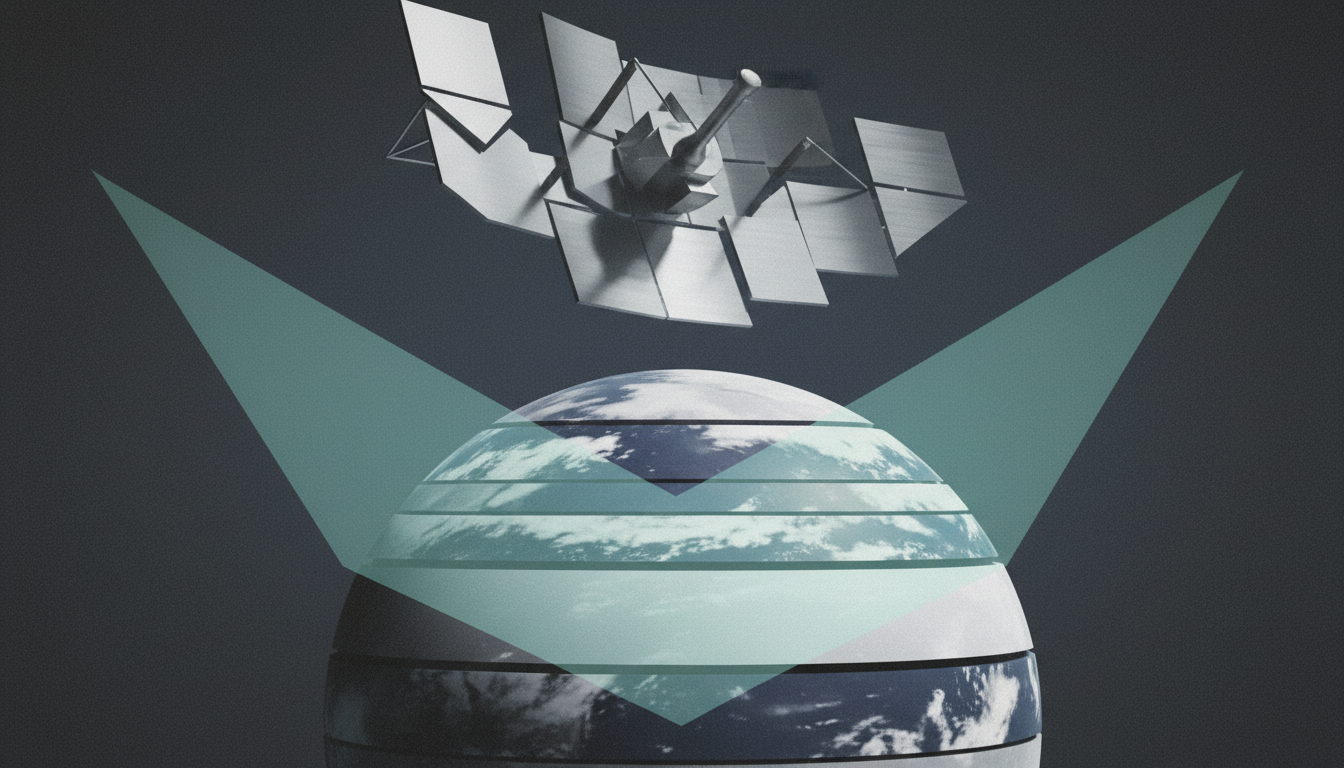
On 21 December 1964 an experimental National Reconnaissance Office satellite left Vandenberg Air Force Base carrying a side-looking radar built to answer a question photography could not: whether synthetic aperture radar would still cohere after the beam had crossed a large slab of atmosphere and ionosphere from low Earth orbit. The vehicle—code-named Quill, program label P-40—was not an operational constellation. It was a proof-of-concept bolted onto Corona-family Agena hardware, flown under deep compartmentation, and pointed only at selected targets inside the United States. Decades later, NRO declassification put the histories and lecture packets where readers can check the constraint instead of inventing a global radar empire.
The Flight
Quill rode a Thor/Agena-D stack. The radar, a heavily modified Goodyear KP-II derived from airborne hardware, was battery-limited to roughly four days of useful life. Dual readout mattered as much as the antenna: a film-return capsule recorded radar product for optical processing on the ground, while a wideband downlink tested realtime delivery to stations in view. NRO’s public history page states the diplomatic logic in plain institutional prose. Imaging only U.S. targets let analysts walk the ground truth without alerting the Soviets to an orbital SAR capability or inviting protest over active illumination of foreign territory.
Fourteen radar passes covered large swaths of the northeastern and western United States. Film from early passes returned for Precision Optical Processor work; batteries died on schedule around 26 December 1964. Official histories later called the flight record unusually clean for the era—launch, orbit, readout, recovery—exactly the kind of sentence that only becomes publishable after declassification.
NRO Quill history hub: https://www.nro.gov/About-NRO/history/history-quill/
Official Posture: Experiment, Not Fleet
The program’s predominant goal was feasibility, not search-and-surveillance cadence. Resolution expectations were inferior to contemporary experimental airborne SAR; managers already knew that. What they did not know—and would not risk discovering over denied territory on a first try—was whether ionospheric and tropospheric propagation would wreck the synthetic aperture. A single successful vehicle was enough. A backup airframe existed; it was not needed. That posture is the opposite of folklore that treats every Cold War acronym as an invisible global camera.
NRO FOIA declassified programs hub: https://www.nro.gov/foia-home/foia-declassified-nro-programs-and-projects/
Compartmentation and Cover
Quill’s security paperwork was not theater. Product control discussions mapped the take into the BYEMAN system; cover stories and flow plans governed what uncleared contractors could be told; evaluation teams at NPIC were commissioned after the orbit succeeded. Much working documentation was destroyed before later declassification, which is why surviving packets lean on final reports, histories, and a headquarters lecture rather than a complete image library with gray-scale fidelity. The missing intermediate tones in surviving image copies are themselves a documentary fact: secrecy and storage ate the pretty pictures, not a conspiracy to hide cities.
Declassification Path
The “fact of Quill” as a 1964 NRO radar-imagery experiment moved into the public domain through NRO/DNI declassification action around late 2009, with further releases of histories and a 2011 Chantilly lecture by Jeffrey Charlston. Robert Perry’s earlier Radar in Orbit and Robert L. Butterworth’s later The First Imaging Radar Satellite (2004 revision) are the narrative spines NRO itself lists. The National Security Archive’s published Butterworth extract lets readers cite a concrete PDF rather than a rumor about a rumor.
NRO Quill Lecture Pamphlet: https://www.nro.gov/Portals/65/documents/foia/declass/QUILL/31.%20QUILL%20Lecture%20Pamphlet.pdf
NRO Quill Lecture Transcript: https://www.nro.gov/Portals/65/documents/foia/declass/QUILL/32.%20QUILL%20Lecture%20Transcript.pdf
NS Archive — Butterworth Quill history: https://nsarchive.gwu.edu/document/28397-document-39-robert-l-butterworth-national-reconnaissance-office-quill-first-imaging
NS Archive — Butterworth extract PDF: https://nsarchive.gwu.edu/sites/default/files/documents/rd5srh-6d4a/ciasignals_39.pdf
Ground truth was the quiet advantage. Because each imaged patch sat on U.S. soil, interpreters could drive to rivers, airfields, and debris fields and ask whether the radar product matched reality—an audit foreign denied-area imaging could not offer on a first flight. That is why the U.S.-only rule was not a failure of ambition. It was the experimental design: prove the aperture, price the politics, keep the Soviets guessing whether the United States had even tried.
What Orbital SAR Changed—Later
Quill did not instantly become a radar Corona. Clouds and darkness were the strategic itch; film-return photography still dominated the 1960s search problem. The experiment’s so-what is technological and bureaucratic: it proved the aperture could survive the path, priced the security and diplomatic risks of active illumination, and left a classified seed for later radar reconnaissance generations that this page does not pretend to declassify. Treating Quill as “the spy satellite that saw through weather everywhere in 1964” collapses proof-of-concept into operations.
The engineering plot is almost dull once the logo comes off. Lockheed Agena bus, Goodyear radar, Corona-style recovery, NPIC evaluation—available hardware pressed into a question. Cost discipline and cover discipline traveled together. That is why Quill can look, in declassified histories, like both a perfect short flight and a missing chapter of aerospace textbooks: the chapter was stamped before it could be assigned as homework.
What the Paper Trail Settles
Settled on the documents: Quill flew on 21 December 1964 as an NRO experimental orbital SAR; it imaged selected U.S. targets only; film and downlink products were evaluated as a feasibility demonstration; NRO has published a history hub, lecture pamphlet/transcript, and related FOIA releases; Butterworth’s NRO history extract is publicly mirrored. Overclaim to refuse: an operational worldwide radar reconnaissance fleet in 1964; foreign-territory imaging the official hub expressly says was avoided; treating sparse surviving imagery as proof of a cover-up rather than of classification and archival loss.
The tension that remains is visibility. Officials once denied even the fact. Histories now describe a five-day American experiment that answered a propagation question. Quill is that first aperture—read with the NRO hub and the Butterworth extract open, not with a folklore constellation doing the declassification’s job.