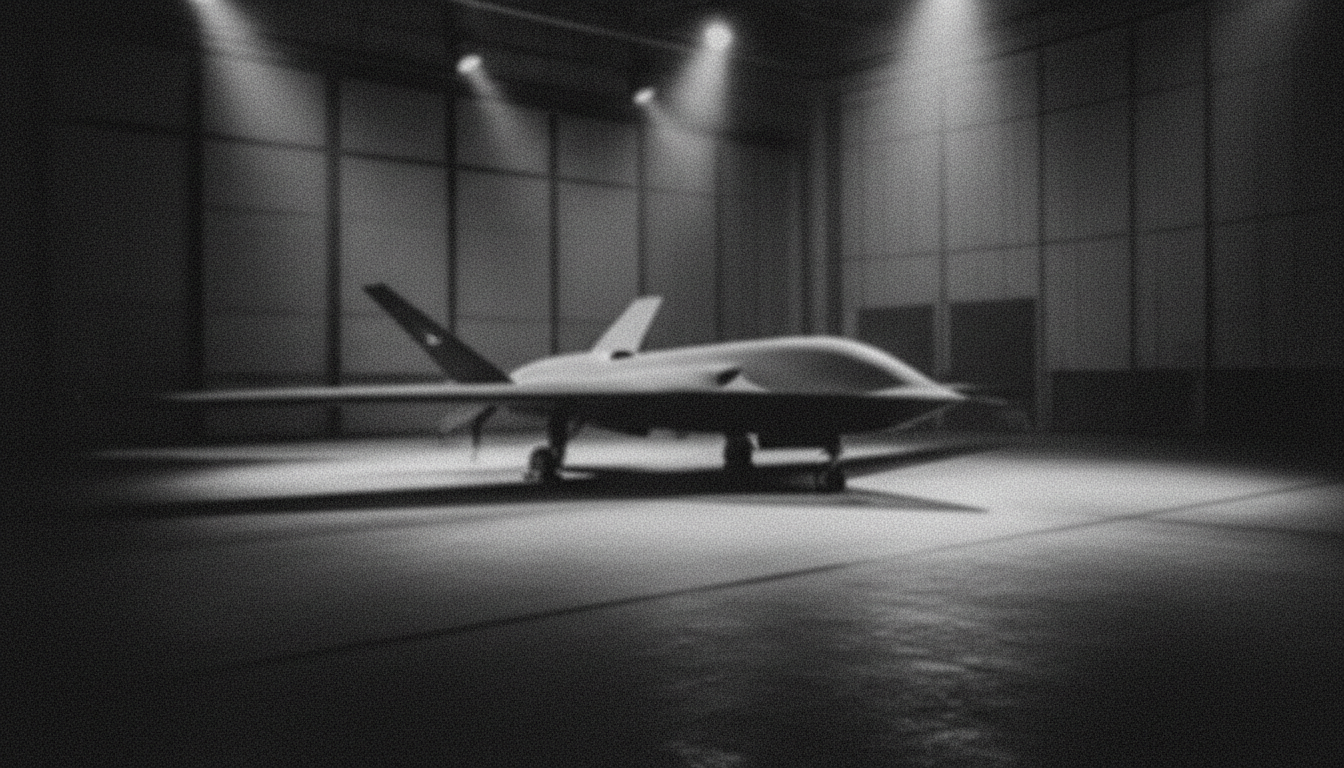
In early December 2011 Iranian state media claimed Iranian forces had brought down a U.S. stealth drone and soon displayed a bat-wing unmanned aircraft. The American-led International Security Assistance Force in Afghanistan issued a short statement: the UAV Iranians were discussing might be a U.S. unarmed reconnaissance aircraft that had been flying a mission over western Afghanistan late the previous week; operators had lost control and were working to determine its status. Within days President Barack Obama said publicly that the United States had asked Iran to return the aircraft. Defense Secretary Leon Panetta declined to discuss RQ-170 details on the record while calling the return request appropriate and unlikely to succeed. Documented core: a lost U.S. reconnaissance UAV and a presidential ask. Iranian electronic-warfare victory narratives remain claims.
The Loss Week
Iranian outlets described an RQ-170 Sentinel—already nicknamed in the press after earlier Kandahar sightings—downed inside Iranian territory. U.S. officials speaking on background to major newspapers cast doubt on a shoot-down by hostile fire and struggled with how an aircraft said to fly high could appear largely intact on Iranian television. Pentagon spokespeople George Little and Capt. John Kirby, in an 8 December briefing, acknowledged a missing UAV, said the missing aircraft had not been recovered, and refused to authenticate the Iranian video beyond noting that analysts were looking at the images.
ISAF statement (mirror): https://www.globalsecurity.org/military/library/news/2011/12/mil-111204-isaf01.htm
DoD briefing mirror (Little/Kirby): https://cryptome.wikileaks.org/0005/pentagon-rq170.htm
BBC contemporaneous report: https://www.bbc.com/news/world-us-canada-16043626
Official U.S. Posture
The on-record American line stayed narrow. Sensitive reconnaissance missions would not be discussed in detail. The aircraft was described as unarmed reconnaissance. Anonymous senior officials told U.S. outlets they had no indication of hostile fire; some suggested mechanical or navigational failure. Separate background reporting described CIA tasking and Afghanistan-based operations—useful context, still not a substitute for the thin public statements.
That thinness is deliberate classification, not Archive invention of a cover-up. It is also why mechanism claims—cyber spoofing, GPS manipulation, soft landing—cannot inherit the same documented seal as the loss acknowledgment itself.
The Return Request
On 12 December 2011, in a joint press conference with Iraqi Prime Minister Nuri al-Maliki, Obama confirmed the United States had asked Iran to send the drone back and said Washington would see how Tehran responded. Panetta, speaking days later in Kabul and to reporters en route in the region, called the request appropriate, said he did not expect compliance, and added that it was difficult to know what engineering value Iran could extract without knowing the condition of the parts.
White House archives transcript: https://obamawhitehouse.archives.gov/the-press-office/2011/12/12/remarks-president-obama-and-prime-minister-al-maliki-iraq-joint-press-co
American Presidency Project transcript: https://www.presidency.ucsb.edu/documents/the-presidents-news-conference-with-prime-minister-nuri-al-maliki-iraq-0
AF.mil / AFPS — Panetta remarks: https://www.af.mil/News/Article-Display/Article/111985/panetta-defends-intelligence-operations/
Iran refused. State-media and official Iranian commentary framed reverse-engineering and electronic-warfare success. Those statements are Iranian claims. They are not U.S. forensic admissions.
Iran Claims as Claims
Caption-ready Iranian display footage showed a Sentinel-shaped airframe. U.S. spokespeople would not confirm the video on the record. Later commentary argued about whether debris had been reassembled or painted. None of that secondary argument upgrades Tehran's cyber-downing story into adjudicated fact. The Archive's rule here is simple: ISAF/DoD/White House language for what the United States acknowledged; labeled Iranian claims for how Iran says it happened and what Iran says it learned.
Classification Versus Spectacle
Iranian television could show an airframe; U.S. classification rules still blocked program briefings. That asymmetry produced a global news cycle in which Tehran spoke expansively and Washington spoke in sentences measured for classification review. Readers should not mistake Iranian confidence for U.S. corroboration, or U.S. silence for proof that every Iranian technical claim is true. The checkable move is to keep ISAF, the White House transcript, and Panetta's AFNS remarks in one column, and state-media EW boasts in another.
Secondary outlets filled the gap with maps, CIA-mission reconstructions, and engineering speculation about GPS spoofing. Some of that reporting was serious. None of it converts into a public DoD fault-tree released for this incident. Until such a packet appears, mechanism talk stays contested even while the loss event does not.
Why Clearance Stays L2
The loss and the return request are documented on-record. Exact mission coordinates, sensor payload, command-and-control path, and the technical cause of the loss remain sparsely described in public U.S. packets. Treating those edges as fully documented would overclaim. Keeping the page at documented/L2 preserves the presidential and ISAF spine without laundering EW folklore.
Sibling lost-UAV incidents belong on their own pages. This entry stays on December 2011 and the RQ-170 display fight. Press nicknames such as "Beast of Kandahar" describe earlier sightings of the airframe type; they are not a substitute for the ISAF loss statement or the presidential return ask.
What the Paper Trail Settles
Settled on the documents: early December 2011 loss of a U.S. unarmed reconnaissance UAV acknowledged by ISAF; Pentagon refusal to detail the program or fully authenticate Iranian video on the record; Obama's 12 December return request; Panetta's on-record support of that request and uncertainty about Iranian exploitation. Overclaim to refuse: Iranian EW/cyber narrative as proven; invented payload lists; folklore that the United States staged the loss.
Officials said an unarmed recon aircraft went missing and asked for it back. Iran said it captured a stealth drone by skill. RQ-170 2011 is that gap—read beside the White House transcript and the ISAF statement, with Iranian claims labeled as claims.