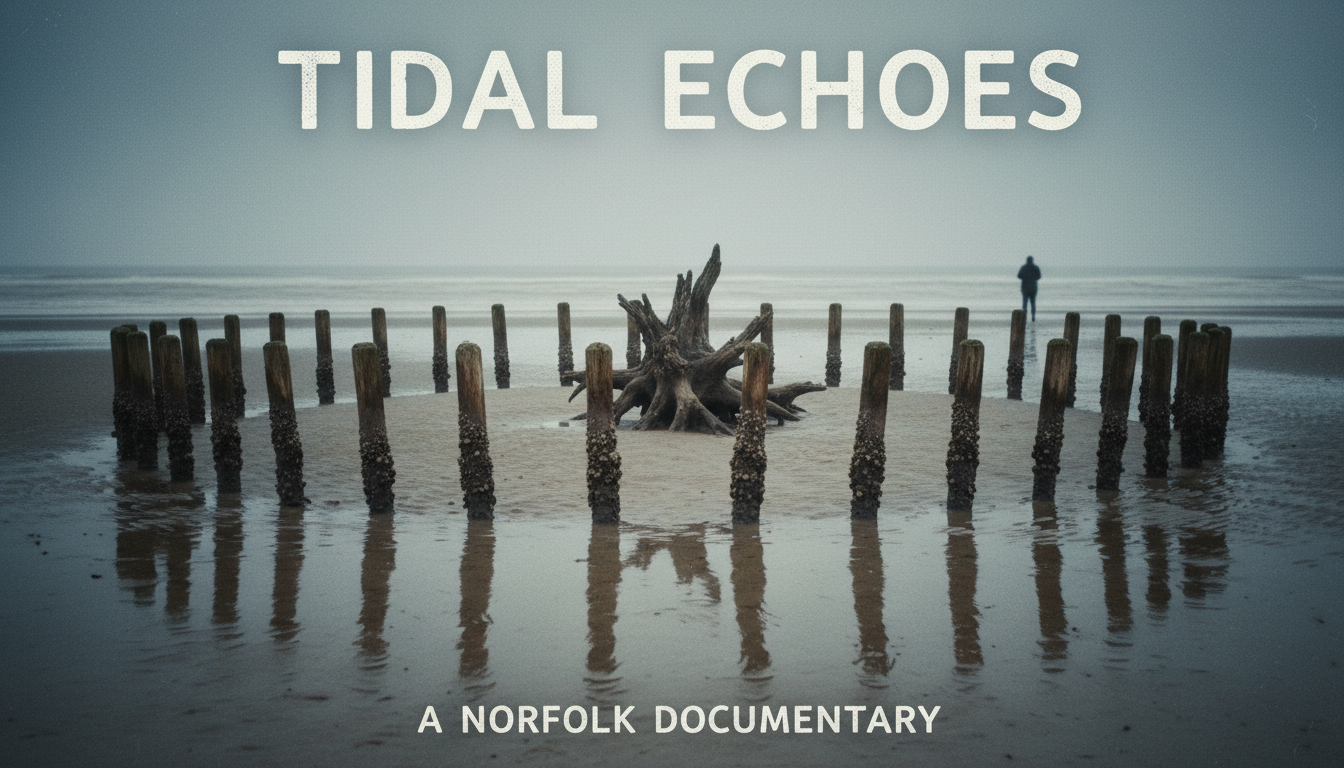
Seahenge (Holme I): The Timber Circle Exposed by the Tide
Holme I—Seahenge—an Early Bronze Age timber circle of about fifty-five split-oak posts around an inverted stump at Holme-next-the-Sea, Norfolk, was exposed by coastal change, discovered in 1998, and excavated in 1999 by the Norfolk Archaeological Unit because erosion threatened the timbers. Dendrochronology places construction in 2049 BC (spring/early summer) in standard site literature.
Emergency Dig on a Beach
Proceedings of the Prehistoric Society records the survey and excavation. Norfolk Museums collections pages and British Museum blog features track conservation at King's Lynn and later exhibition. Norfolk Heritage Explorer holds the formal monument record. Mark Brennand's excavation leadership appears in PPS literature; Francis Pryor's popular Seahenge (2002) carried the story to wider readers.
Holme II, a nearby mortuary-related timber setting, complicates any single-circle myth. The beach offered a pair of related timber architectures under threat from the sea.
Ritual Circle, Not Atlantis Jetty
Inverted central stump and surrounding posts read as ritual timber architecture in mainstream interpretation. Energy-vortex and alien-calendar claims are fringe. Preseli bluestone quarries and Must Farm pages nearby keep British prehistoric wood-and-stone problems in a documentary cluster without merging them.
Dendrochronology's 2049 BC felling date is unusually sharp for public Bronze Age stories. Sharp dates still do not license cosmic portals.
Tide as Excavator, Archaeologists as Rescuers
Coastal change revealed Holme I; erosion forced the dig. Rescue archaeology is often how Britain's prehistoric timber appears at all. Seahenge is a conservation success story as much as a ritual puzzle.
Dendro-Dated Circle Versus Energy Vortex Claims
Documented: timber circle, emergency excavation, dendro date, museum conservation. Fringe: energy-vortex / alien calendar claims.
The record settles that Early Bronze Age builders raised a dated oak circle on the Norfolk coast, recovered under rescue conditions. It does not settle mystical charge in the stump.
Hold paperwork above myth. Named digs, dates, and DOIs are the Archive cut.