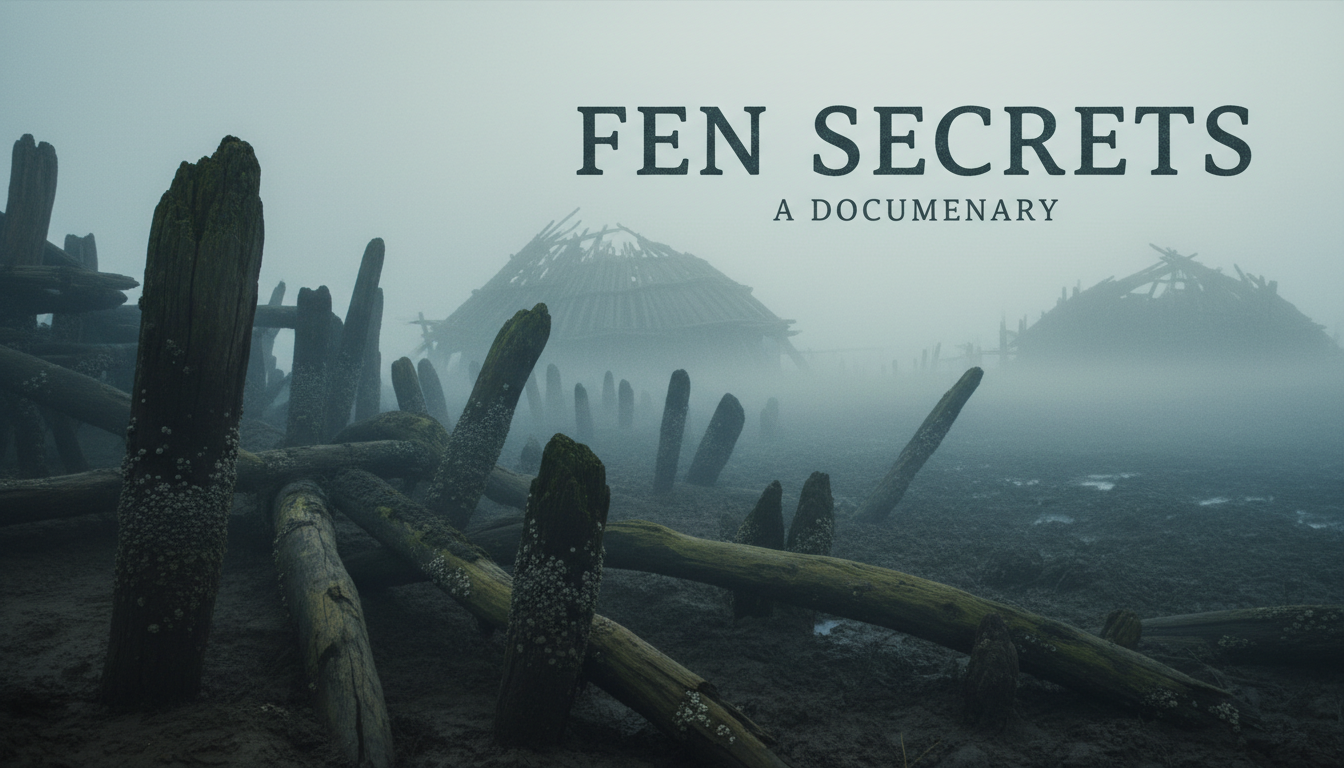
At Must Farm, on the edge of Whittlesey in Cambridgeshire’s Flag Fen basin, a Late Bronze Age community built roundhouses on stilts above a slow freshwater channel around 850 BCE. Fire took the settlement while it was still young. Charred timbers, pots, textiles, tools, and food remains collapsed into soft river silt and stayed there until the Cambridge Archaeological Unit opened the ground in 2015–2016. Historic England and landowner Forterra funded the dig. In 2024 the McDonald Institute for Archaeological Research issued two open-access volumes that synthesize landscape, architecture, and specialist science. This Archive file is documented wet-site archaeology—not a British Atlantis, and not only a tabloid “Pompeii of the Fens” nickname, though the nickname still points at the same excavation records.
Flag Fen Basin Setting
Must Farm sits inside one of Britain’s most intensively studied Bronze Age wetland landscapes. Earlier work nearby at Flag Fen had already shown how timber causeways and ritual deposits behave in deep peat and silt. The pile-dwelling at Must Farm occupied a palaeochannel margin: a curving palisade, stilt-raised houses, and an entrance structure built over water rather than dry gravel terrace. Quarrying had already removed part of the settlement before full excavation. What remained was enough to reconstruct domestic layouts in extraordinary detail because waterlogged and fire-carbonized organics survived together. The project’s own site hub frames that Flag Fen context for the public without inventing a lost continent under the fen. Deep Fenland geology—wet to dry and back again—means organic survival here is a landscape property, not a one-site miracle. Must Farm is the clearest domestic snapshot inside that longer wetland story, a household caught mid-routine rather than a temple dump of offerings alone.
Must Farm settlement hub: https://www.mustfarm.com/bronze-age-settlement/.
Cambridge Archaeology project page: https://www.arch.cam.ac.uk/research/projects/current-projects/must-farm-project.
Excavation Under Heritage Funding
Cambridge Archaeological Unit ran a roughly year-long excavation with GPS mapping of every timber and find. Historic England’s public notes put the major fieldwork budget in the £1.1 million class and stress partnership with Forterra. The research-report catalogue still carries Must Farm as report 7095 in the national system. Method was deliberate: expose prehistoric land surfaces, record contours, lift fragile organics under conservation protocols, and accept that the site would be reburied after recovery because long-term in-situ preservation under a working quarry landscape was not the chosen path. That decision is heritage management, not secrecy. The finds moved into analysis pipelines that fed the later monographs and museum display routes toward Peterborough. Post-excavation assessment volumes circulated inside the profession years before the final McDonald Institute books; the dig was never a rumor without reports.
Historic England publications news: https://historicengland.org.uk/whats-new/in-your-area/east-of-england/must-farm-story-told-in-new-publications/.
Historic England Research Report 7095: https://historicengland.org.uk/research/results/reports/7095/MustFarmpile-dwellingsettlement.
Fire, Silt, and a Domestic Assemblage
The settlement’s catastrophe is also its archive. Fire weakened the stilts; houses pitched into the channel; silt sealed floors mid-use. Archaeologists recovered textiles still folded by habit, wooden objects, bronze tools, glass beads, pottery stacks, and food remains that sketch meals interrupted. A large wooden wheel expanded the technology picture for Late Bronze Age transport. Cambridge’s news release on the 2024 volumes leans on “cosy domesticity”—not because the past was soft, but because the assemblage shows roofs, hearths, craft corners, and household routines with a resolution dry sites rarely allow. Wet preservation plus fire is a documented taphonomic path. It is not a miracle that needs aliens or time travelers. Abundance itself became a research problem: so many objects in primary positions that household practice could be mapped room by room rather than guessed from rubbish pits alone.
Cambridge volumes news: https://www.arch.cam.ac.uk/news/must-farm-volumes.
Publication Spine
Must Farm’s publications page points readers to McDonald Institute Volume 1 (Landscape, architecture and occupation) and Volume 2 (Specialist reports), both open access. Volume 1 carries the interpretive synthesis; Volume 2 holds the technical studies that underwrite claims about dating, wood, textiles, ecofacts, and material culture. Historic England’s regional news treats those books as the culmination of the HE–Forterra–CAU project and flags museum exhibition as the public next step. For Archive purposes the monographs and HE doors beat viral clips that only repeat the Pompeii metaphor. The metaphor is media ecology. The trenches are archaeology. Open-access distribution means the specialist reports are not locked behind a paywall anecdote; anyone can read the wood, textile, and ecofact chapters that underwrite the headlines.
Must Farm publications: https://www.mustfarm.com/bronze-age-settlement/publications/.
What Documented Settles
Settled for documentary purposes: Must Farm is a Late Bronze Age pile-dwelling settlement in the Flag Fen basin excavated by Cambridge Archaeological Unit in 2015–2016 with Historic England and Forterra support; fire and silt preserved an exceptional domestic assemblage; McDonald Institute open-access volumes publish the synthesis and specialist science; HE research infrastructure catalogues the work. Still open as research detail: full landscape biography of every neighbouring channel deposit, long-term display conservation for the most fragile organics, and how far household models should generalize beyond one short-lived settlement. Those open questions do not invent a lost advanced civilization under Whittlesey. A short-lived pile settlement destroyed by fire is already strange and rich enough without stacking folklore floors on top of the silt.
The tension that remains is wonder versus paperwork. Dig teams and Historic England argue about stilts, textiles, and monograph chapters. Headlines argue about Britain’s Pompeii. Must Farm is that argument—read with CAU, HE, and the McDonald volumes open, and with wet preservation kept on the excavation timeline where it belongs.