
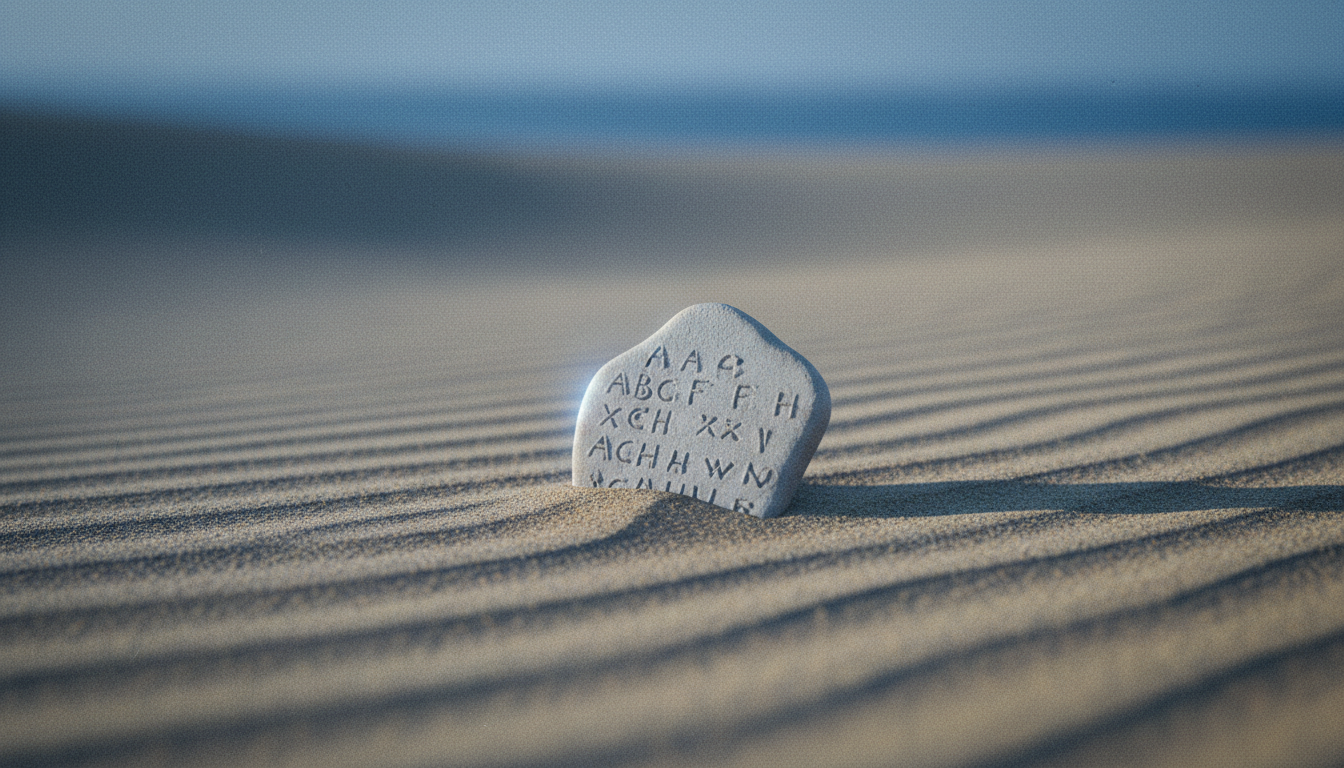
On 14 May 1929, excavators at Ras Shamra on the Syrian coast—directed by Claude Schaeffer for a mission backed by the Académie des Inscriptions et Belles-Lettres and the Louvre—cleared clay tablets from what proved to be the Bronze Age city of Ugarit. The signs looked like cuneiform but came in far too few shapes for a logosyllabic Akkadian inventory: on the order of thirty characters. Within about a year, Hans Bauer, Édouard Dhorme, and Charles Virolleaud, working in overlapping rivalry, showed that the system was alphabetic and that the language was Northwest Semitic. Abecedaries—tablets that list the signary in order—sit inside that corpus as school and scribe artifacts. Louvre inventory numbers still carry Schaeffer find numbers from the partage after excavation. This file is the discovery, decipherment, and museum paper trail. It is not a Bible-code sermon, and it is not a mystification that pretends Ugaritic remains unread.
Discovery on the Acropolis
Minet el-Beida, the harbour, and Ras Shamra’s tell yielded tombs, houses, and archives. The first alphabetic tablets came from building floors later understood as library or scribal contexts. Schaeffer’s multi-decade campaigns produced thousands of texts: mythological cycles, ritual lists, letters, and economic records alongside Akkadian and other scripts used at the same cosmopolitan port. CREWS Project’s ninetieth-anniversary essay retells the 1929 moment—including the labourer Mohamed Moursal in the find narrative—and the speed of decipherment once the alphabetic hypothesis and Semitic lexicon were in play. Cambridge’s Faculty of Classics hosts the broader CREWS hub on early writing systems, placing Ugaritic among comparative alphabet histories rather than in isolation.
CREWS ninety years: https://crewsproject.wordpress.com/2019/05/14/ninety-years-of-ugaritic-studies/.
Cambridge CREWS hub: https://www.classics.cam.ac.uk/research/projects/contexts-of-and-relations-between-early-writing-systems-crews.
Center for Online Judaic Studies summarizes the same arc for teaching readers: Schaeffer as field director, Virolleaud recognizing that fewer than thirty signs implied an alphabet, and a provisional fourteenth-to-thirteenth-century BCE date from associated finds. Provisional dating is ordinary archaeology. It is not a license to slide the tablets into prophetic timelines alien to the dig notebooks.
COJS alphabet tablet dossier: https://cojs.org/ugaritic_alphabet_tablet-_14th-13th_century_bce/.
Louvre Abecedaries and Inscribed Objects
The Musée du Louvre’s Département des Antiquités orientales holds partage objects from the Mission de Ras Shamra. Collection records make the paper trail concrete. Fragment AO 19998 A (RS 5.274), from the 1933 campaign on the acropolis, is a clay piece bearing traces of an abecedary in alphabetic cuneiform—school-order evidence, not a mystical diagram. Bronze adze AO 11610 (RS 1.[051]), found in 1929 in the House of the High Priest, carries a Ugaritic dedication naming a chief of priests; it has been shown in Sully’s Levant galleries among alphabetic inscriptions. A further Louvre alphabet tablet record (collections ark cl010144705) documents another abecedarium from Ras Shamra on the same institutional path. Find numbers, acquisition by partage or gift after excavation, and department inventory are how a Syrian dig becomes a Paris public record without erasing Ugarit’s place on the Levantine coast.
Louvre abecedary AO 19998 A: https://collections.louvre.fr/en/ark:/53355/cl010459153.
Louvre adze AO 11610: https://collections.louvre.fr/en/ark:/53355/cl010136328.
Louvre alphabet tablet: https://collections.louvre.fr/en/ark:/53355/cl010144705.
Catalogues such as CTA and KTU organize the wider alphabetic corpus for specialists. Abecedaries matter because they freeze sign order and training practice: scribes learned a sequenced inventory, which is why modern decipherers could treat the system as an alphabet rather than as open-ended syllabary soup. Administrative and literary tablets then become readable once values lock. That is ordinary philology. Folklore that treats every Ugaritic line as a secret key to later scripture overclaims what comparative Semitic linguistics actually does—illuminate shared Levantine religious vocabulary and narrative motifs without collapsing genres across a thousand years.
Mythological tablets—Baal Cycle passages among them—made Ugarit famous beyond epigraphy, but fame is not a substitute for sign values. Economic texts and letters show the same alphabet serving harbour administration. Holding literary and administrative uses together is how a corpus page stays honest: one script, many genres, zero need for secret-society captions.
Decipherment Without Mystique
Bauer, Dhorme, and Virolleaud’s near-simultaneous results in 1929–1930 are the documentary triumph. Credit disputes among them are historiographic texture, not a conspiracy. The language is Ugaritic; the script is alphabetic cuneiform; the city traded and corresponded in a multilingual Late Bronze world that also used Mesopotamian cuneiform traditions. None of that requires Atlantis, Nephilim logistics, or “suppressed Bible proofs.” Comparative work with Hebrew and Phoenician helps because the languages are related—not because Ras Shamra was excavated to win a modern culture war. Living-institution care means citing Louvre records and dig anniversary scholarship, updating when catalogs revise, and keeping Syrian heritage sovereignty visible even when partage objects sit in Paris.
What Documented Settles
Settled for documentary purposes: alphabetic cuneiform tablets were found at Ras Shamra beginning in 1929; the script was deciphered rapidly as a Northwest Semitic alphabet; abecedaries and inscribed objects enter Louvre AO inventory through excavation partage; CREWS and related academic doors narrate the find’s significance for early alphabet history. Still open as normal scholarship: exact labour credit in colonial dig hierarchies; ongoing conservation and publication of the full corpus; how Ugaritic religion informs, without overriding, biblical studies. Those open questions do not reopen undeciphered mystique or prophetic-code baptism, and they do not authorize treating partage objects as loot folklore when the acquisition path is excavation paperwork. Ugaritic is documented Bronze Age alphabetic writing from a Syrian port city—read with Louvre, CREWS, COJS, and Cambridge doors open, and with Bible-code folklore left outside the tablet room.