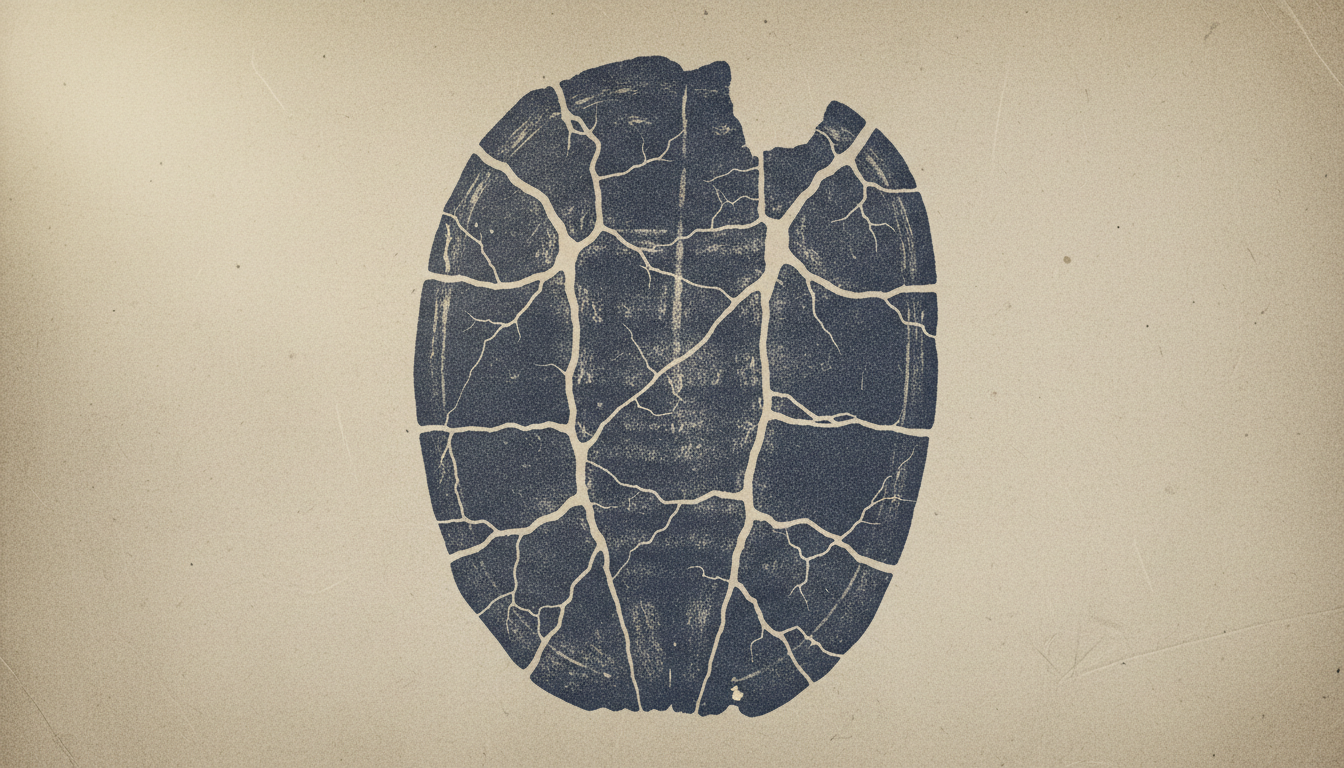
Northwest of Anyang on the Huanhe River, the archaeological landscape known as Yin Xu preserves the last capital of the Shang dynasty. Between roughly 1300 and 1046 BCE, twelve kings ruled from palace and ancestral-shrine compounds while a royal cemetery rose on higher ground. In pits associated with those compounds, excavators recovered cattle scapulae and turtle plastrons that had been prepared, burned, cracked, and carved with the earliest known mature Chinese writing. UNESCO inscribed Yin Xu in 2006 as List 1114. The Memory of the World Programme later registered Chinese oracle-bone inscriptions as documentary heritage. This file holds that capital and that script. It refuses prophetic mysticism that treats the bones as occult relics rather than administrative and ritual records, and it refuses lost-continent captions that invent a prior alien alphabet to explain Shang characters.
Capital, Pits, and Charges
UNESCO’s brief synthesis places Yin Xu among the formative capitals of early Chinese history: rammed-earth house foundations, ancestral shrines, a defensive ditch that also managed floodwater, chariot burials, and bronze, jade, and ceramic grave goods. Criterion language explicitly ties the property to bronze culture, early palace and tomb prototypes, and the earliest systematic written Chinese language on oracle bones. The Palace and Royal Ancestral Shrines Area and the Royal Tombs Area together cover hundreds of hectares inside a larger buffer that includes unexcavated Huanbei Shang City remains. Fu Hao’s intact royal tomb is the museum-face companion to the inscription pits; both belong to the same late Shang political world.
UNESCO List 1114: https://whc.unesco.org/en/list/1114/.
Nomination dossier PDF: https://whc.unesco.org/uploads/nominations/1114.pdf.
ICOMOS Advisory Body Evaluation: https://whc.unesco.org/en/documents/151785.
Committee Decision 30 COM 8B.39: https://whc.unesco.org/en/decisions/1005/.
Oracle practice was technical. Diviners prepared bone or shell, applied heat to produce cracks, read the cracks as omens, and often carved the charge and outcome into the surface. Subjects published in the Memory of the World dossier run across sacrifice, weather, harvest, military movement, and the king’s affairs—state concerns, not private fortune-cookie folklore. Periodization by form and content has allowed reconstructions of royal genealogy that push continuous Chinese historical documentation earlier by centuries. That is epigraphy and historiography, not mysticism.
Memory of the World — Chinese Oracle-Bone Inscriptions: https://www.unesco.org/en/memory-world/chinese-oracle-bone-inscriptions.
Museums, Rubbings, Overseas Fragments
Inscribed pieces are conserved in Chinese institutes and site museums at Anyang and in overseas collections formed in the early twentieth century, when “dragon bones” sold in pharmacies first drew antiquarian attention to the script. Cambridge’s Museum of Archaeology and Anthropology holds a turtle-plastron fragment (1927.835 B) attributed to the Anyang area, with modern catalogue notes on divination pits, cracks, and a translated royal charge concerning cattle use. Rubbings and the published Oracle Bone Collections in Great Britain series show how diaspora holdings enter the same epigraphic conversation as pits still opened under Chinese archaeological authority. Living-institution care means citing accession numbers and find traditions together, not treating every overseas fragment as loot theater or every local display as nationalist sermon alone.
Cambridge MAA 1927.835 B: https://collections.maa.cam.ac.uk/objects/557115/.
The MoW registration credits related custody through the Institute of History of the Chinese Academy of Social Sciences and illustrates pieces held in Shanghai, Anyang-linked CASS archaeology stores, and other museums. WH management texts stress State Priority protection, controlled excavation approval, and pressure from tourism and urban growth. Those are conservation politics on the Centre page. They are not proof that the script is undeciphered or invented.
Pit YH127 and later Xiaotun South and Huayuanzhuang East discoveries show how find context—stacked shells in a single pit versus scattered fragments—changes what timelines epigraphers can rebuild. Complete or near-complete plastrons with linked charge sets yield week-scale royal calendars; broken pharmacy pieces yield graphs without that administrative clock. Criterion (vi) on the WH listing treats the bones as tangible evidence of writing, belief, and major events of outstanding universal significance. That wording is heritage law language, not a sermon that every cracked bone is a finished chronicle of the dynasty.
Epigraphy Without Mysticism
Jiaguwen is early Chinese writing. Graphs relate, through long palaeographic sequences, to later seal, clerical, and modern forms; grammar and lexicon studies continue as ordinary philology. Nineteenth- and early twentieth-century pharmacy lore that sold inscribed fragments as medicinal “dragon bone” is reception history—the path by which some pieces entered antiquarian view—not a method for reading Shang kingship. Atlantis, Lemuria, and ancient-astronaut alphabets add mythology where the nomination and MoW dossiers already supply excavated pits, royal names, and calendrical science. Wonder at a three-thousand-year-old charge about cattle and weather is allowed. Wonder that needs a prior spacefaring scribe to invent the graph for “king” is not.
Failed popular claims that Chinese writing somehow arrived fully formed from elsewhere, or that oracle bones remain a sealed mystical code, confuse decipherment status with tourist captioning. The script is studied; open questions about particular graphs, exact ritual sequences, and unpublished joins are normal science. They do not reopen a denial that Shang had writing, and they do not authorize fake bilingual “Rosetta” announcements every time a new pit is reported.
What Documented Settles
Settled for documentary purposes: Yin Xu is a UNESCO-listed late Shang capital; oracle-bone inscriptions from the site constitute the earliest known mature Chinese writing; ICOMOS and Committee doors frame the 2006 inscription; Memory of the World registers the inscription corpus; museum catalogues such as Cambridge’s publish autopsy-level fragments. Still open as normal epigraphy and heritage management: fine-grained period seriations, repatriation and loan politics for overseas bones, and buffer-zone development risk. Those open questions do not authorize mystical prophecy cults or lost-continent alphabets as explanations of Shang script. Anyang oracle bones are documented early Chinese writing on a World Heritage capital—read with UNESCO, ICOMOS, MoW, and museum doors open, and with dragon-bone folklore left outside the pits.