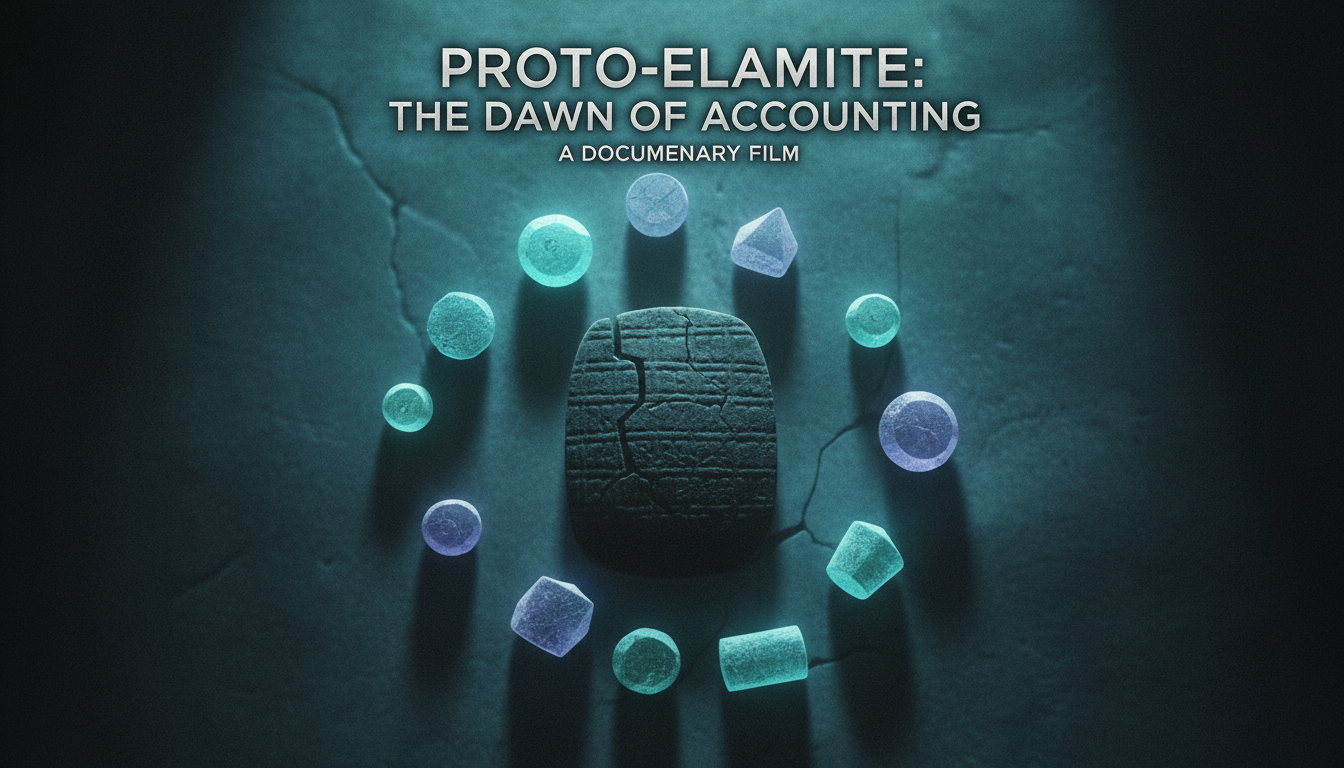
Proto-Elamite is the earliest complex writing system of the Iranian plateau, used for a brief horizon around 3100–2900 BCE on clay tablets from Susa and related highland sites. The script mixes numerical notations with non-numerical signs that appear to name commodities, institutions, or agents. Numerical systems are partly understood through comparison with contemporary proto-cuneiform bookkeeping in Mesopotamia; most of the remaining signary is still undeciphered as language. The Cuneiform Digital Library Initiative publishes images, line art, and working transliterations; major holdings sit in the Louvre and the National Museum of Iran. Encyclopaedia Iranica and Cambridge Elements frame the research history. This file is that accounting corpus and its honest opacity. It is not Linear Elamite, and it refuses viral claims that Proto-Elamite has been fully cracked.
Horizon, Tablets, What Numbers Can Say
Iranica’s Proto-Elamite article places the system in Susa Acropole levels and at sites such as Tepe Yahya, Malyan/Anshan, and Sialk during a span broadly parallel to Jemdet Nasr / Uruk III through Early Dynastic I in Mesopotamia. Tablets are administrative: entries, quantities, and summations rather than royal narrative or literature. Scribes shared or borrowed numerical conventions with lowland neighbours—sexagesimal and related counting systems appear—while also using decimal notations in some contexts. Object signs for animals and cereals can sometimes be proposed by analogy and by tablet structure. Headers that may name an owning institution or official recur at the start of accounts. None of that yields a readable spoken language. Eighty to ninety percent of non-numerical signs remain opaque in specialist estimates cited in public research communication around the Louvre imaging campaigns.
Encyclopaedia Iranica Proto-Elamite: https://www.iranicaonline.org/articles/elam-iii/.
Cambridge Elements Proto-Elamite: https://www.cambridge.org/core/elements/abs/protoelamite/3684B7262E21A8B6AF8657D948A5B1A6.
Jacob Dahl and collaborators have spent decades cleaning readings, joining fragments, and pushing digital documentation. Louvre Sb tablets form the historic core from early French Susa excavations; Tehran’s National Museum holds hundreds more. CDLI’s period search for proto-elamite returns well over a thousand catalogued entries—an order of magnitude that makes “unread mystery tablet” folklore look under-informed about how much ink and clay actually survive. A CDLJ 2015 article exemplifies the slow genre of edition: one text improved, sign readings argued, no press-conference language ID.
CDLI proto-elamite search: https://cdli.earth/search?simple-value%5B%5D=proto-elamite&simple-field%5B%5D=period.
CDLI CDLJ 2015:1: https://cdli.earth/articles/cdlj/2015-1.
CDLI National Museum Tehran collection: https://cdli.earth/collections/1106.
National Museum of Iran: https://irannationalmuseum.ir/en/.
Administrative honesty available now includes tablet layouts, numerical transparencies, and commodity hypotheses grounded in account structure. Linguistic closure—phonetic values tied to a named language—does not. Holding that distinction is the entire point of an undeciphered accounting-script page, the same honesty Linear A and Indus readers already practice.
Corpus Doors Without Fake Closure
Digital access matters because so many tablets live in storage drawers. CDLI’s open images and transliterations let scholars outside Paris or Tehran test a sign reading against a photograph. Reflectance Transformation Imaging campaigns on Louvre holdings, reported in research coverage tied to Oxford and Southampton work, were designed to surface toolmarks and faint wedges that flat photos miss—method improvements, not decipherment certificates. Joins of fragments identified even in the twenty-first century show how incomplete older print editions were. Cambridge Elements surveys how neglect, then renewed attention since the 1970s, moved the field from Scheil’s early pessimism toward usable corpora with working Meriggi-based signlists. Iranica remains the concise institutional reference for chronology and partial decipherment status. Museum doors in Tehran remind readers that Proto-Elamite is Iranian plateau archaeology first, not a Mesopotamian footnote that borrowed a few numerals. Highland findspots far from Susa also show the script traveling as an administrative tool across ecological zones, not as a single-city curiosity.
Amateur or media announcements that “solve” Proto-Elamite often confuse three different things: (1) better numerical and header structure readings, (2) computational clustering of signs, and (3) a full language identification. The first is real progress. The second is ongoing experiment. The third has not achieved consensus. Treating any of them as a Rosetta moment misreports the corpus. Progress on headers and numerals is real; a finished lexicon is not.
Not Linear Elamite
Linear Elamite is a later, still-debated Iranian script attested in a much smaller monumental and object corpus. Occasional twenty-first-century claims of Linear Elamite decipherment—whatever their peer reception—must not be pasted backward onto Proto-Elamite tablets as if the names were interchangeable. Different periods, different signaries, different media profiles. Conflation is a common viral error: a headline about one “Elamite” breakthrough gets captioned onto Louvre Proto-Elamite photos. This file keeps the early accounting system separate. Susa’s Proto-Elamite offices are not rescued by a Silver Cup inscription from another age.
Wonder at a three-thousand-year-old spreadsheet in clay is allowed. Wonder that needs Atlantis, or a weekend crack that skips CDLI signlists, is not. The plateau’s early urban administrations already look complex enough in the tablet formats we can parse without inventing a finished lexicon.
What Documented Settles
Settled for documentary purposes: Proto-Elamite is an early Bronze Age Iranian administrative script; numerical parts are partly readable by Mesopotamian analogy; most non-numerical signs remain undeciphered; CDLI publishes the working corpus; Iranica and Cambridge Elements frame the scholarship; National Museum of Iran and Louvre holdings dominate physical custody. Still open as normal science: language family; full phonetic confirmation; whether new joins or methods could shift the stalemate. Those open questions do not authorize fake full decipherment baptism, Linear Elamite false merger, or lost-continent linguistics. Proto-Elamite tablets are documented accounting before a readable language—Iranica, CDLI, Cambridge, and National Museum doors open, cracked-script folklore left off the Susa ledgers.