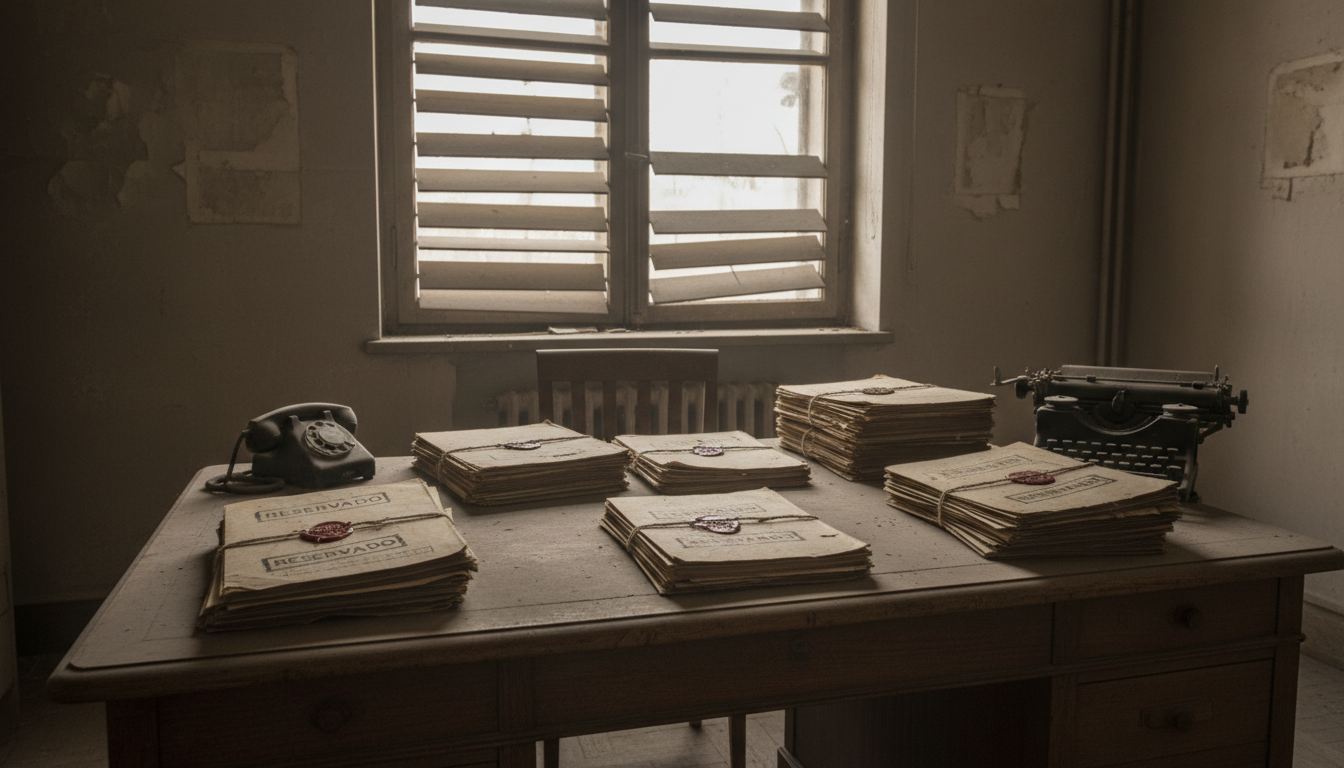
In the last years of Franco's Spain, the Air Force was collecting reports of strange lights over its bases and radar screens, and the public was not allowed to know. That is the core of the Materia Reservada story. What was hidden was a growing archive of military UFO files, with pilots' accounts, radar logs and investigators' conclusions. What was denied was any public access to them, and for years any official admission that the Air Force took the subject seriously at all. How it was done was by law: the 1968 Official Secrets Act and its 1969 regulations gave the military the power to stamp a subject secret or reserved and punish anyone who leaked it. Why is where the accounts split. Officers spoke of national security. Spain's best-known UFO writer, J. J. Benítez, says a general told him the reason was simpler: the people were not ready.
The legal machine is in the Boletín Oficial del Estado. Ley 9/1968, of 5 April, on Official Secrets (https://www.boe.es/buscar/act.php?id=BOE-A-1968-444), starts from the principle that state bodies act in public, "salvo los casos en que por la naturaleza de la materia sea ésta declarada expresamente 'clasificada'," except where a subject is expressly declared classified. Article 3 sets two grades, "secreto" and "reservado." The preamble is candid about why: Spain, it says, lacked the protective rules found even in states known for freedom of information, so the law creates measures to keep from spreading "lo que debe permanecer secreto." Anyone who comes across classified material must keep the secret and hand it to the nearest civil or military authority, and when classified matter looks likely to reach the press, the media are to be notified of its classification. It was signed under Franco and was still the governing law when the UFO files were opened a quarter of a century later.
The regulations came a year later. Decreto 242/1969, of 20 February (https://www.boe.es/diario_boe/txt.php?id=BOE-A-1969-263), approved by the Council of Ministers on 5 February 1969, defines "reservado" as matters of lesser importance than secrets "pero cuyo conocimiento o divulgación pudiera afectar" the fundamental interests of the nation, state security, national defence, external peace or constitutional order. It spells out the paperwork of secrecy: reserved documents stored in steel cabinets with combination padlocks, carried in double envelopes with no marking on the outside, sent by officer couriers or registered post and encrypted where possible. Any leak by staff counted, for disciplinary purposes, as a "falta muy grave," a very serious offence. These are the rules that would govern a file once someone decided a UFO report belonged in that category.
The files themselves show 1968 as the year the military's interest sharpened. When the Defence Ministry finally put its archive online, El Mundo's 2016 report, "'Expedientes OVNI': Defensa saca a la luz los avistamientos de 'fenómenos extraños'" (https://www.elmundo.es/ciencia/2016/10/22/580b4e30268e3ed5278b4604.html), described some of the earliest. Expediente 681209 records a telephoned report on 9 December 1968 of a luminous phenomenon east and southwest of Almería. Two days later, on 11 December 1968, two witnesses reported a very bright object with changing intensity southwest of Madrid to the duty officer of the Air Staff. One file concludes that it seemed "mucho más probable que se deba a la psicosis generalizada durante 1968 en torno a la aparición de OVNIS," far more likely the product of the general UFO psychosis of 1968. The Air Force, in other words, was writing up sightings, and its own officers recognised a national wave.
Benítez, who was then a reporter for La Gaceta del Norte in Bilbao, puts the classification in that same month. A profile on his website, "Echo de menos las redacciones, pero con el ambiente de antes" (https://planetabenitez.com/echo-de-menos-las-redacciones-pero-con-el-ambiente-de-antes/), says that the twelve files he obtained in 1976 were the first UFO release in Spain "después de que en diciembre de 1968 este tema fuera declarado como materia reservada," after the subject was declared reserved matter in December 1968. In the same interview he describes how he came to the subject in 1972, when his editor sent him to a village in Burgos where people said they had seen strange objects in the sky. "En esos años estábamos en una oleada," he says: those were wave years.
Vicente-Juan Ballester Olmos, the civilian researcher who later worked with the Air Force to open the files, gives the dates differently in "Declassification! Military UFO Records Released: The Spanish Experience" (https://web.archive.org/web/20060929191708/http://www.anomalia.org/declass.htm). He writes that before 1979 UFO information had been treated as Confidential, and that the "classified matter policy" he persuaded the Air Force to review in 1990 and 1991 dated from 1979. The archive handed over for review included "procedures and memos shaping official Air Force policy on UFOs, 1968 to 1991." Both men agree that a secrecy regime over UFO files began in 1968 under Franco's law and hardened later; they disagree on when the label "materia reservada" was first applied and on who was to blame for it.
Benítez's book Materia reservada, published by Planeta in 1993 (https://planetabenitez.com/libros/materia-reservada/), is the adherent history in full. Its synopsis opens with October 1992, when "se levantaba el secreto para los archivos OVNI de la Fuerza Aérea Española." The military admitted at last that they had investigated the unidentified, but what looked like a democratic step had become, he writes, "el mayor fraude de la historia de la Ufología europea," the greatest fraud in the history of European ufology. The book claims to expose "las maquinaciones de la cúpula militar desde la década de los sesenta hasta nuestros días," the manoeuvres of the military high command from the 1960s to the present.
Spain's UFO secrecy rested on a real legal structure: the Franco-era Official Secrets Act of 1968 and its 1969 regulations, under which the Air Force held its sighting files out of public reach. Benítez says the subject was made reserved matter in December 1968 and that the eventual release was rigged; Ballester Olmos dates the strict classification to 1979. Both agree the files were kept from the public for more than twenty years.
What Stays Contested
No published order from December 1968 naming UFOs as reserved matter has been produced; the date rests on Benítez's account and the start of the Air Force's policy memos that year. Whether secrecy protected radar and defence methods or something more is the question that divides the two sides.