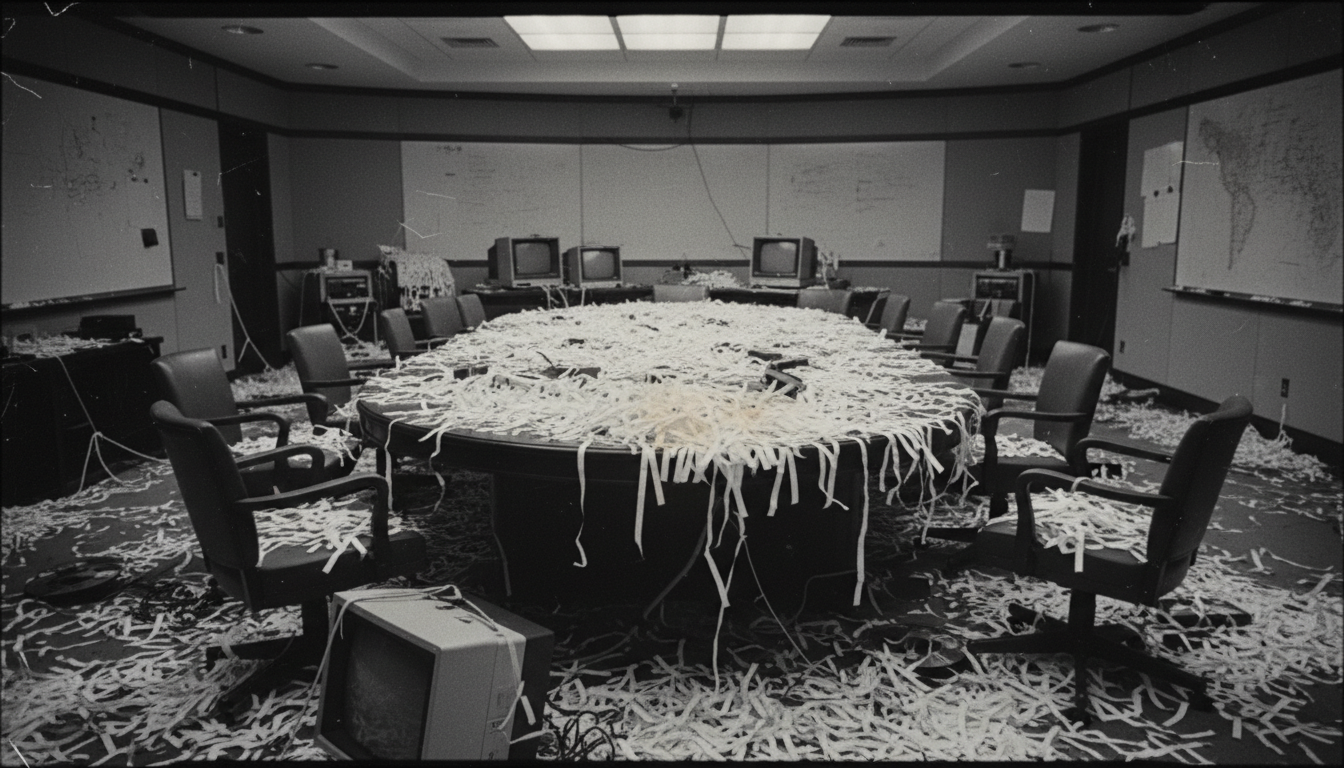
Iran-Contra
In the mid-1980s, pieces of American foreign policy went off the books and into a network of private planes, Swiss accounts, and National Security Council improvisation. When the story broke, it acquired a hyphenated name: Iran-Contra.
Two Policies Tied With One String
One strand sold arms to Iran—officially an embargoed adversary—partly to seek leverage on hostage releases. Another strand kept Nicaraguan Contra fighters supplied after Congress restricted funding. The knot was diversion: profits and parallel financing that linked the Iran channel to the Contra cause. Tower Commission investigators and later joint congressional committees reconstructed the knot from memos, notebooks, and sworn testimony.
Oliver North's role made for television. The deeper story was institutional: an NSC staff culture that treated statutes as obstacles to be routed around in the name of presidential policy.
Investigations, Indictments, Aftermath
Independent Counsel Lawrence Walsh spent years translating the scandal into criminal cases. Some convictions stuck long enough to matter; others died on appeal or under pardon. That legal ending frustrates people who wanted a single cage for every principal. It does not erase the factual spine the Tower report already nailed down.
Ajax and the Long Iran File
Operation Ajax in 1953 is not Iran-Contra's prequel script. Different decade, different toolset. Still, Archive readers tracing U.S. covert entanglement with Iranian politics will keep meeting the same country under different cryptonyms and crises. Stuxnet, much later, is another technical chapter in confrontation with Iran—again not the same conspiracy, same strategic neighborhood.
PRISM is a different species entirely (signals collection). The cross-link is about secret-state capacity and public-trust burns, not shared servers.
What the Record Settles
Arms went to Iran. Money and materiel reached Contras through irregular channels. Senior officials knew pieces; how the knowledge was siloed became part of the defense. The settled history is already a master class in covert policy colliding with law. The unsettled arguments are about presidential knowledge gradients and whether "rogue staff" is explanation or alibi.
Hostages, Hostility, and Hypocrisy
Iran-Contra's arms-to-Iran strand still startles because the same decade branded Iran an enemy in public rhetoric. Covert policy ate the rhetoric. Contra funding strand startles because Congress had used the power of the purse. The scandal is partly constitutional: who decides war-adjacent policy when statutes say no?