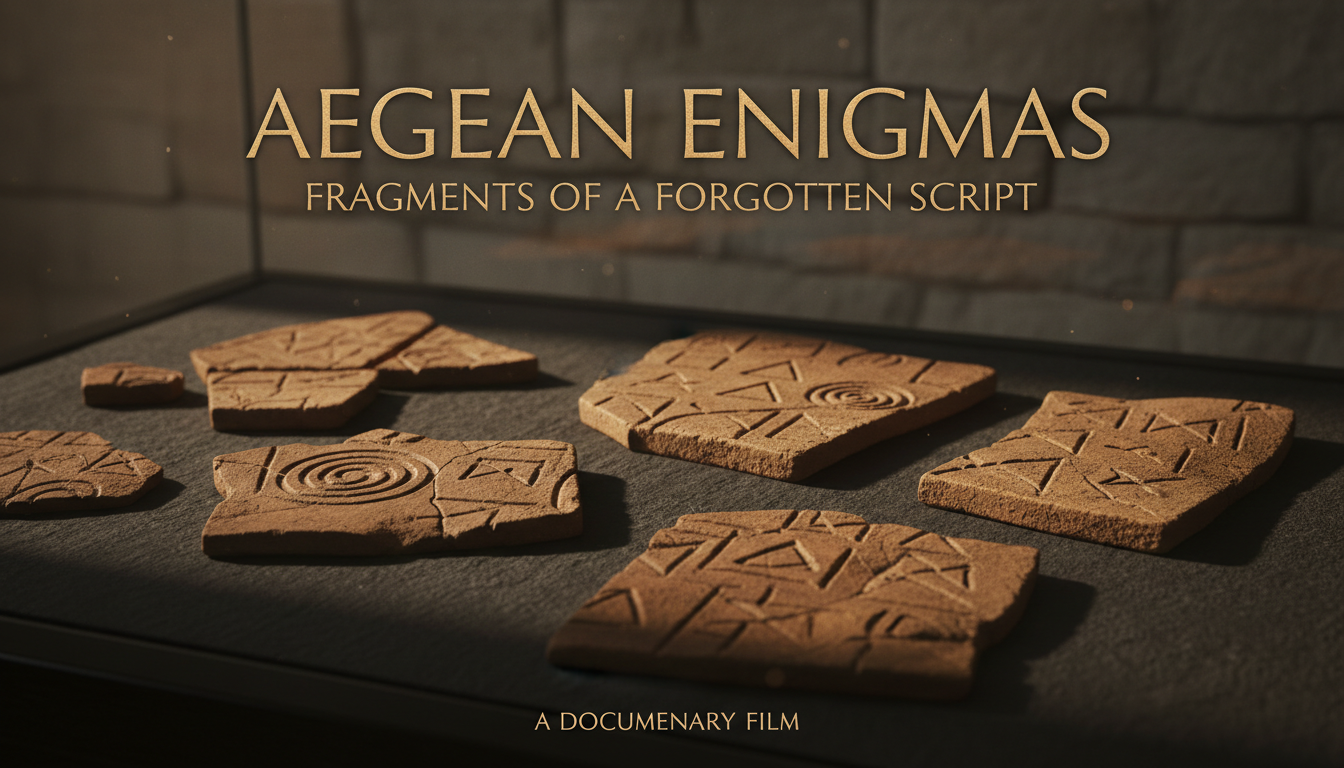
Linear A is the still-undeciphered administrative script of Minoan Crete, used in the second millennium BCE on clay tablets, roundels, and inscribed stone and metal objects across palace and secondary sites. Sign shapes overlap enough with later Linear B that scholars can propose phonetic values by analogy, yet the underlying language is not established as Greek—or as any securely identified tongue—so full decipherment remains unfinished. UNESCO’s 2025 inscription of the Minoan Palatial Centres (List 1733) names Cretan Hieroglyphic and Linear A as the earliest writing systems in Europe, alongside Linear B. Digital and print corpora (GORILA; SigLA) publish the documents without pretending the language problem is solved. This file holds that corpus honesty and palatial context. It refuses fake “Linear A cracked” headlines and Atlantis language claims.
Palaces, Tablets, Counts
Knossos, Phaistos, Malia, Zakros, Zominthos, and Kydonia form the serial World Heritage property whose brief synthesis highlights administrative, economic, and religious hubs with advanced architecture and early writing. Criterion (iii) language explicitly ties the centres to Hieroglyphic, Linear A, and Linear B. That is heritage wording grounded in excavated archives—not a tourist myth that every labyrinth story is a decipherment key. Clay documents often look like inventories: commodities, quantities, place or personnel signs. Even without a lexicon, format comparison with Linear B bookkeeping shows administrative intent. Libation formulas on stone vessels add a ritual register that may not share every assumption of the tablet offices.
UNESCO List 1733: https://whc.unesco.org/en/list/1733/.
UNESCO Decision 47 COM 8B.25: https://whc.unesco.org/en/decisions/8959/.
Hagia Triada alone supplied a dense tablet cluster; other sites contribute smaller dossiers. Find contexts—magazine rooms, deposits, discarded fill—matter for whether a text is a living office file or a discarded draft. Palaeography tracks hand variation across Crete and a few Aegean findspots. None of that finishes grammar.
Roundels—clay disks with seal impressions and short Linear A groups—add a sealing economy beside longer tablet grids. Inscribed double axes, pottery, and building blocks show the script leaving the pure office and entering other media, still without handing us a bilingual Rosetta. Site-by-site palaeography in SigLA lets researchers ask whether Knossos hands differ from Hagia Triada hands without inventing a finished lexicon to do so.
GORILA, SigLA, and Reference Doors
Louis Godart and Jean-Pierre Olivier’s Recueil des inscriptions en linéaire A (GORILA) remains the print standard for document numbering and drawings. SigLA (Signs of Linear A), an open interactive database by Ester Salgarella and Simon Castellan, aims at exhaustive coverage of that corpus with searchable signs, words, and documents. The project’s about page states plainly that the script is still undeciphered and that statistical and palaeographic work needs a usable digital tool beyond print plates. The SigLA home interface is the working door; a 2015 ACL workshop paper, “Minoan linguistic resources: The Linear A Digital Corpus,” records earlier digital-corpus design thinking now complemented by SigLA’s fuller build. Scuola Normale Superiore’s Mnamon portal hosts a Linear A writing-system dossier for reference readers navigating Aegean scripts.
SigLA about: https://sigla.phis.me/about.html.
SigLA home: https://sigla.phis.me/.
Mnamon Linear A: https://mnamon.sns.it/index.php?id=19&lang=en&page=Scrittura.
ACL Anthology PDF: https://aclanthology.org/W15-3715.pdf.
Museum galleries on Crete—above all Heraklion’s collections historically tied to Knossos and Hagia Triada finds—are where many tablets physically live; digital corpora extend access when travel or display rotation limits autopsy. Living-institution care means citing inventory numbers and GORILA labels together when publishing claims.
Cambridge and other Aegean epigraphy programs keep Linear A beside Cypriot and Levantine early scripts in comparative seminars; that adjacency is method, not proof of mutual decipherment. When UNESCO criterion language praises early writing at the palatial centres, it praises attested systems and their social embedding—administration, ritual, exchange—not a solved Minoan dictionary. Readers who want Linear B’s Greek payoff must accept that Linear A has not yet delivered an equivalent linguistic key, however many sign charts look familiar.
Linear B Contrast Without Fake Closure
Michael Ventris’s mid-1950s decipherment of Linear B as an early form of Greek is the contrast case everyone reaches for. Shared sign shapes tempt a simple transfer of values into Linear A. Partial transfers help catalogue signaries and sometimes yield plausible commodity readings; they do not automatically yield a grammatical language identification. If the Minoan language is not Greek, Greek glosses will mislead. If it is a related or unrelated Aegean language, proof still demands bilingual leverage or internal combinatorial breakthroughs the corpus has not yet locked. Computational papers continue to test statistical approaches; continuing effort is not the same as a finished decipherment press release. Amateur announcements that “solve” Linear A every few years rarely survive peer signary checks. Atlantis or Lemuria language baptisms add mythology where epigraphy needs more tablets and better methods.
Administrative honesty is available now: tally structures, recurring logograms, site distributions. Linguistic closure is not. Holding that distinction is the point of an undeciphered-script page.
What Documented Settles
Settled for documentary purposes: Linear A is a Bronze Age Cretan script attested across palatial and related sites; it remains undeciphered as language; GORILA/SigLA and Mnamon doors publish the corpus; UNESCO List 1733 frames the palatial centres and names Linear A among Europe’s earliest writing systems; Linear B’s Greek decipherment is a contrast, not a completed clone. Still open as normal science: language family; full phonetic confirmation; whether new finds or methods could change the stalemate. Those open questions do not authorize fake decipherment baptism or lost-continent linguistics, and they do not demote careful commodity readings that stop short of grammar. Linear A is documented undeciphered Minoan administration—read with UNESCO, SigLA, Mnamon, and ACL doors open, and with cracked-script folklore left outside the magazine rooms.