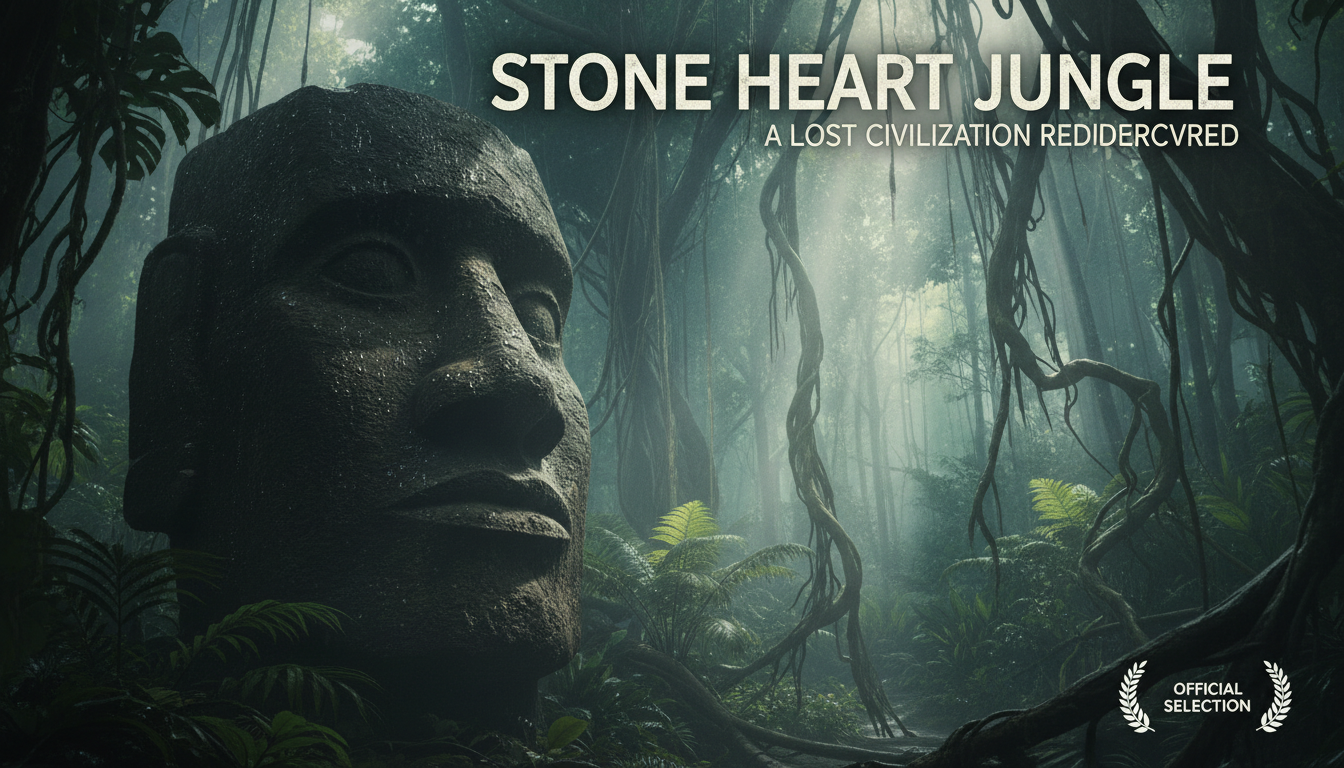
Seventeen known basalt colossal heads—ten from San Lorenzo, four from La Venta, two from Tres Zapotes, and one from La Cobata—anchor public memory of the Gulf Coast Formative societies archaeologists call Olmec. Faces differ; helmet-like headdresses recur; tonnage implies quarrying and transport systems capable of moving multi-ton blocks across the lowlands. Site museums under Mexico’s Instituto Nacional de Antropología e Historia, the open-air Parque-Museo La Venta in Villahermosa, and peer journals keep the monuments and the arguments about them in view. This file holds that corpus and the documented “mother culture” debate. It refuses to baptize nineteenth-century racialized facial readings, African-diffusion scripts, or Atlantis as archaeological fact.
Tres Zapotes, San Lorenzo, La Venta
The first head brought to scholarly notice came from Tres Zapotes, Veracruz. José María Melgar y Serrano’s 1869 notice in the Boletín de la Sociedad Mexicana de Geografía y Estadística described the sculpture and floated “Negroid” comparisons that later popular writers inflated into transoceanic contact myths. Matthew Stirling’s mid-twentieth-century excavations pulled Olmec monuments into international archaeology. INAH’s Museo de sitio de Tres Zapotes today exhibits the local colossal head alongside Stelae C and D and other monuments from the ancient city—community custody for the early findspot. San Lorenzo Tenochtitlán, on the Coatzacoalcos drainage, produced the largest head count; INAH’s site museum there highlights Colossal Head 10 and related sculpture while other San Lorenzo heads stand in Xalapa and Mexico City galleries. La Venta’s monumental program—heads, altars/thrones, offerings—was relocated in part to Villahermosa’s Parque-Museo La Venta, inventoried in Mexico’s Sistema de Información Cultural and in Tabasco state museum pages as an open-air sculpture landscape.
INAH Tres Zapotes museum: https://www.inah.gob.mx/museos/226-museo-de-sitio-de-tres-zapotes.
INAH San Lorenzo site museum: https://lugares.inah.gob.mx/en/node/4513.
SIC Parque Museo La Venta: https://sic.gob.mx/ficha.php?table=museo&table_id=127.
Museos de Tabasco La Venta: https://museos.tabasco.gob.mx/?page_id=2314.
Individualized facial features support elite portraiture hypotheses in standard syntheses: rulers or ranked persons rendered in basalt, not interchangeable idols. Helmets and ear ornaments vary. Recarving and mutilation episodes at San Lorenzo show monuments had political afterlives—reuse and damage as historical process, not random vandalism. None of that requires Atlantic crossings.
Quarry geology matters as much as facial typology. Tuxtlas basalt sources and riverine rafting hypotheses appear in standard field literature as logistics problems solvable inside Mesoamerica. Monument weight estimates in the multi-ton range make labour organization itself evidence of political capacity—mobilizing haul teams is statecraft whether or not one prefers mother-culture vocabulary. Altar-thrones with niche figures and jade-rich offerings at La Venta thicken the ritual economy around the heads without requiring overseas priests.
Mother Culture Versus Interaction
Whether Olmec Gulf centers were a “mother culture” seeding later Mesoamerican complexity, or participants in a web of sister societies exchanging goods and styles, remains a live peer argument. Petrographic studies of Formative pottery—open on PMC as “Implications of new petrographic analysis for the Olmec mother culture model”—test whether “Olmec-style” vessels at highland sites were Gulf exports or local products in shared style. Results complicate one-way export cartoons without erasing Gulf Coast monumentality. Smithsonian Libraries catalogues John Clark and Mary Pye’s edited volume Olmec art and archaeology in Mesoamerica, a standard symposium door for art, excavation, and interaction models. Cambridge’s Ancient Mesoamerica literature likewise tracks evolving mother-culture language toward more reciprocal Early Formative maps. Documenting the fight means citing those papers and catalogues. It does not mean declaring the debate finished from a caption.
PMC petrography: https://pmc.ncbi.nlm.nih.gov/articles/PMC1183595/.
Smithsonian Clark & Pye catalogue: https://www.si.edu/object/siris_sil_675220.
Mother-culture maximalism can flatten highland and Pacific-coast contemporaries into passive receivers. Interaction models can, if sloppy, underplay San Lorenzo and La Venta’s unprecedented sculpture scale. Holding both risks in view is ordinary Mesoamerican archaeology. Wonder at basalt portrait heads is allowed. Wonder that needs Egypt, West Africa, or drowned continents to explain them is not.
Xalapa’s Anthropology Museum and Mexico City’s National Museum of Anthropology hold additional San Lorenzo heads that most international visitors meet first; community museums keep later finds nearer the Coatzacoalcos and Tuxtlas landscapes. Split custody is ordinary Mexican heritage practice, not a conspiracy to hide African origins. Photographers chase the same helmet profiles across three states; archaeologists chase ceramic phases and magnetometer maps. Both can be true without a diffusion baptism.
Reception Foils, Not Stratigraphy
Melgar’s racialized adjectives are reception history: a nineteenth-century observer mapping unfamiliar features onto Atlantic slave-trade typologies. Later Africentric diffusion books and Atlantis pages recycle the same facial folklore against INAH chronologies that place Olmec florescence in the Formative centuries BCE inside Mesoamerica. Ancient-astronaut variants add nothing a quarry flake would recognize. The corrective is museum labels, radiocarbon, and ceramic seriation—not a counter-sermon that Olmecs must be “purely local” in every trade good. Obsidian, jade, and iron-ore mirrors already show long-distance Formative exchange within the Americas. Exchange is not the same claim as transoceanic founders carving seventeen heads before leaving.
What Documented Settles
Settled for documentary purposes: colossal heads are documented Formative monuments concentrated at San Lorenzo, La Venta, Tres Zapotes, and La Cobata; INAH and Tabasco institutions display them; peer literature debates mother-culture versus interaction models with petrographic and art-historical evidence. Still open as normal science: exact portrait identities; full transport logistics from Tuxtlas basalt sources; how much “Olmec style” elsewhere was emulation versus import. Those open questions do not reopen African-diffusion or Atlantis baptism as fact, and they do not freeze the mother-culture fight as settled dogma either way. Olmec heads are documented Gulf Coast monuments inside a contested early-complexity debate—read with INAH, SIC, PMC, and Smithsonian doors open, and with diffusion folklore left outside the park paths.