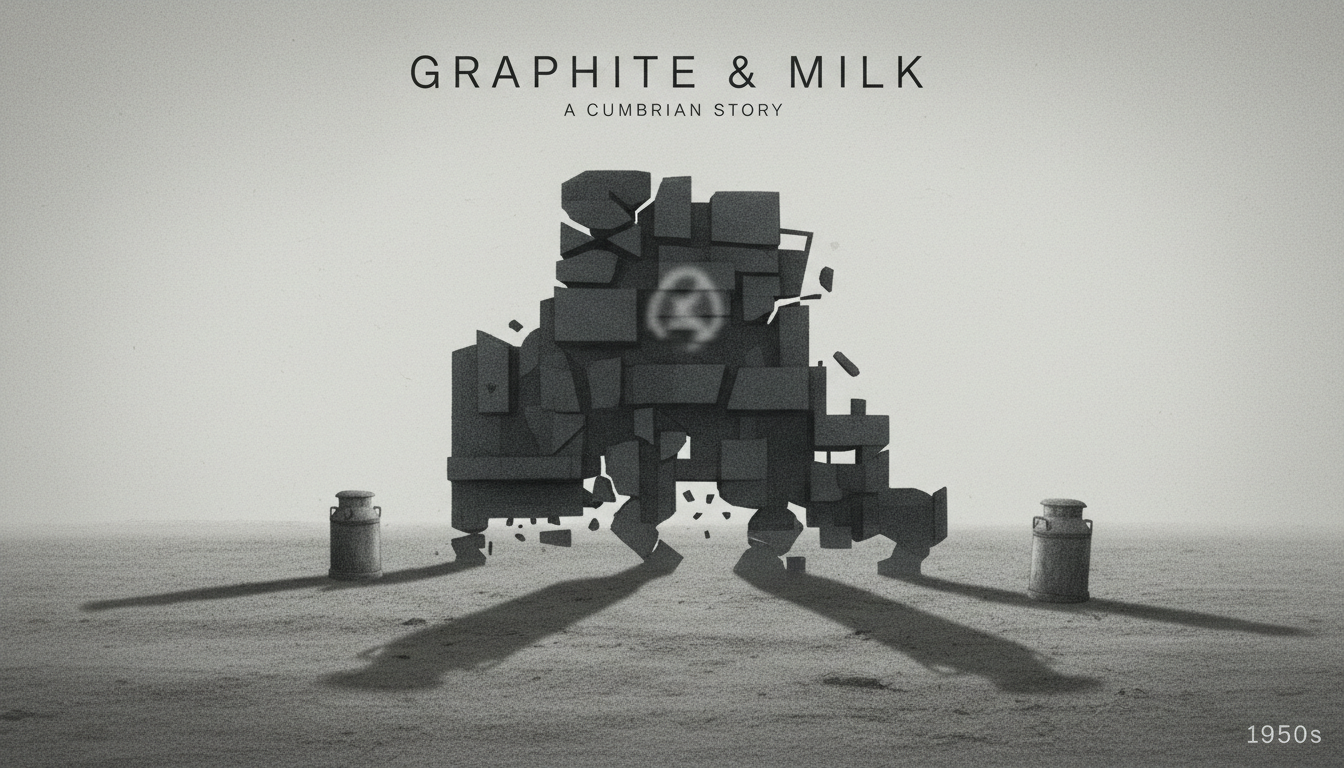
Windscale Fire (10 October 1957)
On 10–11 October 1957, Windscale Works Pile No. 1—on the Cumbrian coast now called Sellafield—caught fire in its graphite-moderated, air-cooled core. Official Britain moved fast: a UKAEA Committee of Inquiry under Sir William Penney, milk distribution controls, and White Paper Cmnd. 302 laid before Parliament on 8 November 1957 as the public technical summary. The full Penney Report had already been submitted to the UKAEA Chairman on 26 October 1957. It stayed unpublished for three decades. The National Archives opened AB 86/25 in January 1988. Iodine-131 crossed the milk map of northwest England from a weapons-plutonium pile whose military purpose shaped what the country was allowed to hear.
The Fire in Pile No. 1
Windscale’s piles were graphite-moderated and air-cooled, built to produce plutonium for weapons. A Wigner-energy release and annealing operation went wrong. The core caught fire. Iodine-131 and other fission products left the stack. Caption-ready geography: Pile chimneys on the Cumbrian coast, milk churns under distribution controls, the works that later became Sellafield.
This page is the 1957 pile fire and the secrecy of its full inquiry. Later civil reprocessing controversies at Sellafield are chronological neighbors, not the same event. Do not collapse them.
Official Posture: White Paper Openness
Penney’s committee sat 17–25 October 1957, interviewed thirty-seven people, examined seventy-three exhibits, and reported on the 26th. Three weeks after the fire, ministers presented Cmnd. 302 to the Commons. Hansard for 8 November 1957 records the political posture of that day: accident acknowledged, milk controls defended, public reassured through parliamentary theater.
Hansard: https://api.parliament.uk/historic-hansard/commons/1957/nov/08/atomic-energy-establishment-windscale.
That White Paper was the sanitized public face. It was not the full technical blame narrative the committee had already delivered upstairs.
What the Paperwork Shows
The National Archives catalogue for UKAEA Committee of Inquiry records and exhibits—AB 86 series—is the archival door: https://discovery.nationalarchives.gov.uk/details/r/C1701.
The best widely citable full-text path to the sealed report is the 2017 Journal of Radiological Protection reproduction of the Penney Report supplied from TNA file AB 86/25, with the editorial note that the report became public only in January 1988: https://iopscience.iop.org/article/10.1088/1361-6498/aa7788 (PDF: https://iopscience.iop.org/article/10.1088/1361-6498/aa7788/pdf). Credit TNA AB 86/25; the journal is the scholarly host, not a blog mirror.
A revised transcript of the October 1957 enquiry proceedings circulated historically through UKAEA channels and is commonly mirrored for researchers. Treat it as secondary texture beside the TNA report itself: http://news.bbc.co.uk/2/shared/bsp/hi/pdfs/05_10_07_ukaea.pdf.
The FOIA/Archives tension is the secrecy lag—1957 submission, 1988 public release—not the existence of a graphite fire. Britain had a White Paper in weeks and a sealed technical inquiry for a generation.
Why the Story Stayed Managed
Weapons-reactor context, Anglo-American nuclear relationship sensitivities, and UKAEA/government information control shaped 1957 messaging. Milk bans acknowledged contamination without opening the full technical narrative. Cmnd. 302 performed openness while AB 86/25 waited in the vault.
Reject fringe reframes that Windscale was a planned population-dosing experiment. The Penney packet does not support that cartoon. Reject treating every later Sellafield leak as the same 1957 event. Stick to Penney, Cmnd. 302, Hansard, and TNA release dates.
Milk Map, Sealed Report
Distribution controls on local milk were the visible public-health instrument. They told Cumbria something had left the pile. They did not hand farmers the Ad Hoc technical narrative Penney had already signed. For a generation, secondary accounts ran on White Paper summaries, partial press, and institutional memory while AB 86/25 stayed closed. When the file finally opened in 1988, the FOIA-era lesson was chronological: openness theater in November 1957, full technical record three decades later.
1957 Twin and Unfinished Legacy
Kyshtym in September 1957 is the Soviet opacity twin—another 1957 nuclear disaster under information control, different system, same year. Modern ONR and Sellafield Ltd work on Pile 1 decommissioning—chimney, trapped fuel, complex retrieval—shows 1957 is not a closed museum file. GOV.UK’s Windscale Pile 1 case study is the living legacy door under a UK government host: https://www.gov.uk/government/case-studies/windscale-pile-1.
Weapons purpose is not a conspiracy garnish. It is why information control around Pile No. 1 was never only a civilian reactor-safety story. Anglo-American sensitivities and UKAEA hierarchy shaped what could be said while the piles still mattered for the deterrent. That context explains the sealed report without requiring a cartoon experiment on the milk map.
Date discipline keeps the FOIA punch sharp: fire 10–11 October; Penney report upstairs 26 October; White Paper and Hansard 8 November; full report public January 1988. Prefer primary UK hosts—discovery.nationalarchives.gov.uk, parliament.uk, gov.uk—over Wikipedia lead framing. The JRP reproduction is acceptable as scholarly full text of the TNA file, not as a substitute for naming AB 86/25.
What the Paper Trail Settles
Settled on the documents: fire 10–11 October 1957 in Windscale Pile No. 1; Penney Committee 17–25 October; report to UKAEA 26 October 1957; Cmnd. 302 / Hansard 8 November 1957; full Penney Report public via TNA AB 86/25 in January 1988; milk distribution controls; modern Pile 1 decommissioning legacy. Overclaim to refuse: intentional civilian-dosing experiment claims; unsourced megacurie meme numbers detached from Penney/White Paper language; collapsing later Sellafield controversies into the pile fire without chronology.
The tension that remains is classified inquiry secrecy beside White Paper theater. Officials said manageable accident and parliamentary openness. The full technical report stayed sealed for thirty-one years while iodine crossed the milk map from a weapons pile. Windscale is that gap—read with The National Archives door open.