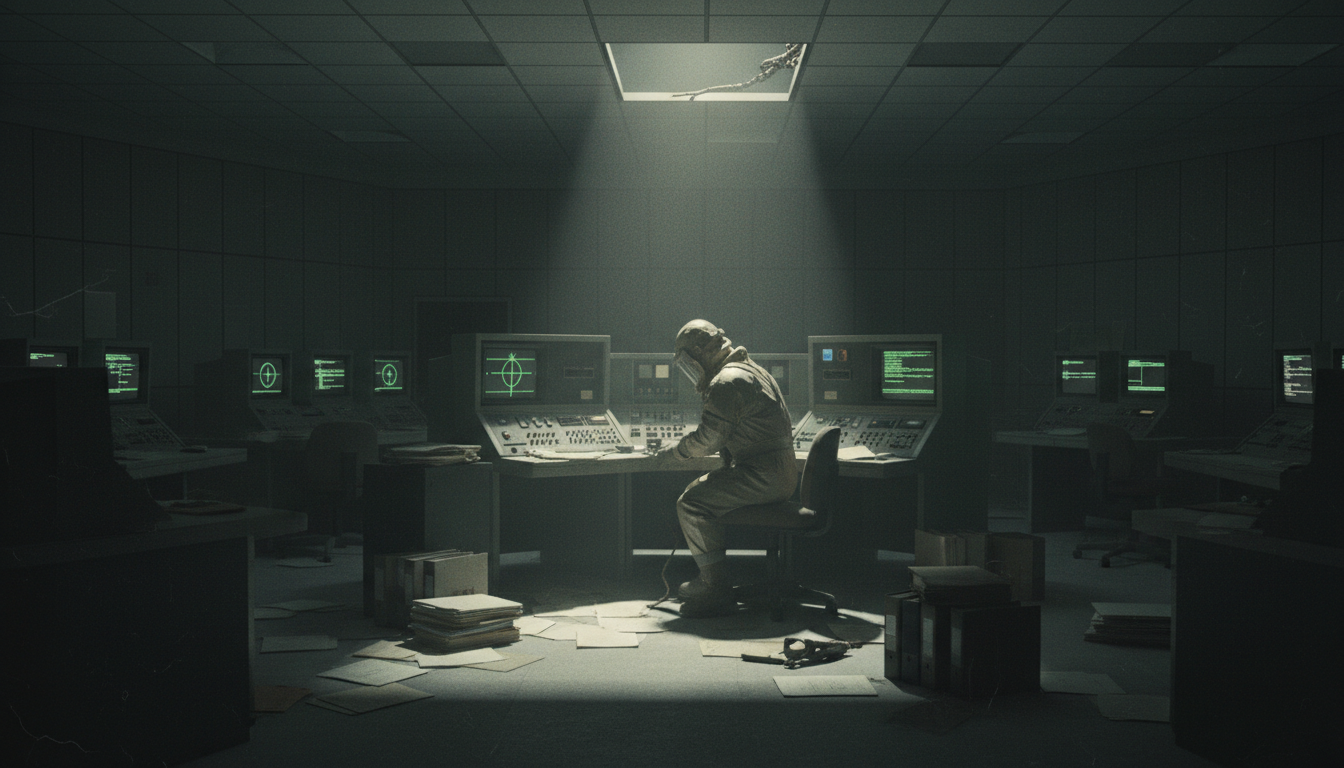
At 4:00 a.m. on 28 March 1979, Three Mile Island Unit 2 near Middletown, Pennsylvania, entered the worst commercial nuclear accident the United States had then seen. Mechanical failures and human misreads damaged the core. For the next days the gravity of the event was unclear to plant managers, to federal and state officials, and to the public. The President’s Commission chaired by John G. Kemeny later said fundamental changes were required in NRC and industry organization, procedures, practices—and attitudes. The Archive tension on this page is not another stuck-valve walkthrough. It is how information moved, stalled, and collided while people outside the fence tried to decide what the plant was doing to them.
The Product: Crisis Without a Public-Info Plan
Nuclear utilities and the NRC had spent years reassuring the public that severe accidents were vanishingly unlikely. When TMI-2 ran for days under national cameras, that reassurance became an institutional trap. Neither Metropolitan Edison nor the NRC had a disaster public-information plan. Neither had trained disaster spokespeople. Coordination in the first hours was so weak that responsibility for informing the public was undefined. Reporters arrived by the hundreds; Reading headquarters, the site, Region I, and Bethesda’s Incident Response Center did not share one picture of the plant.
Kemeny Commission report (NRC ADAMS): https://www.nrc.gov/docs/ML1927/ML19275A948.pdf
Official Posture: Optimism, Distance, Then Fundamental Change
Met Ed’s early public line leaned optimistic—core status minimized, operator-error talk delayed, radiation language careful to the point of deficiency. The NRC tried to distance itself from the utility as regulator rather than booster, refusing joint press conferences. Neither posture produced a coherent public picture. After the accident, Kemeny’s institutional verdict—“fundamental changes”—became the official so-what. That language is real. It is incomplete if it stops before the Public’s Right to Information Task Force’s map of who knew what, when, and who said what into microphones.
What the Paperwork Actually Shows
The Task Force summary to the President’s Commission is blunt. The most common captions—utility lied, NRC covered up to protect the industry, media ran a sensationalism orgy—do not hit the mark as primary explanations. Planning failure does. Met Ed’s public-information shop had low status and no policy input. The NRC’s phone chain from site investigators through King of Prussia to Bethesda to Joseph Fouchard’s public-affairs desk jammed under load. Internal gaps were mistaken for cover-up: one morning the company president told some reporters of small off-site releases while public-information staff in the same building said there had been none.
Summary — Public’s Right to Information Task Force: https://www.nrc.gov/docs/ML1927/ML19275A951.pdf
OSTI bibliographic door (full staff report): https://www.osti.gov/biblio/1465980
Friday morning’s roughly 1,200 millirem-per-hour release crystallized the failure. Bethesda did not know whether the release was controlled or uncontrolled, planned or unplanned, on-site or off. Harold Denton’s IRC recommended evacuation advice to Pennsylvania emergency managers; Governor Richard Thornburgh, hearing conflicting counsel inside his own government, settled on sheltering plus advice that pregnant women and young children leave the area. The White House then centralized lanes: Denton on reactor status at the site, Thornburgh on evacuation, the White House on federal relief. Bethesda’s press center—source of some of the week’s most alarming meltdown and hydrogen-bubble quotations—was ordered closed so comment would come from the site. Centralization reduced chaos. Journalists later told the Task Force it also narrowed structured contact with DOE radiation meetings and other monitors.
OSTI — Investigation into information flow during TMI: https://www.osti.gov/biblio/5762446
Mitchell Rogovin’s Special Inquiry Group report to the Commissioners and to the public extends the NRC’s own after-action shelf beyond the presidential commission—another official door on management, regulation, and public accountability.
Rogovin report package (NRC ADAMS): https://www.nrc.gov/docs/ML1932/ML19323A723.html
NRC Kemeny package door: https://www.nrc.gov/docs/ML1925/ML19254E707.html
Why the Story Stayed Managed
“Cover-up” and “media hysteria” are easier headlines than “undefined first-hours responsibility plus no technical briefers.” The Task Force found more reassuring than alarming statements overall in sampled coverage, and rejected the claim that national media invented catastrophe for sport. Utility self-deception and jargon-as-fog are documented; so is NRC staff candor that sometimes outran commissioners’ comfort. Living officials belong in documentary voice by role and commission citation, not character trials. Folklore that nothing serious happened, or that a China Syndrome erased central Pennsylvania, both sit outside the Kemeny/Rogovin packets.
From Bethesda Alarm to Site Reassurance
The hydrogen-bubble episode is the clearest exhibit of dual official voices. Bethesda experts, reading incomplete plant data through a strained information chain, voiced meltdown and explosion possibilities that reached wire services. Site and state officials, managing evacuation politics and a stabilizing plant after Denton’s arrival, sounded more reassuring. Both sets of statements were “official.” The Task Force’s point is not that journalists invented the clash. It is that an unplanned public-information system forced the public to adjudicate competing federal voices in real time. Rogovin’s inquiry shelf and the Kemeny volumes together refuse the neat morality play. They document an industry and a regulator that had not rehearsed telling the truth under uncertainty—and a White House that improvised centralization when improvisation was already too late for the first seventy-two hours.
Siblings and Myth Discipline
Earlier U.S. accidents such as Browns Ferry and Fort St. Vrain were largely covered retrospectively; TMI forced live technological uncertainty under deadline. Chernobyl’s later dual narratives show how official cause stories can shift when new design data arrive. Post-TMI emergency-planning reforms moved off-site readiness into a FEMA-centered frame—the institutional echo of the information failure. Prefer commission language over cable-news binaries.
Date discipline: accident 28 March 1979; Kemeny report to the President 30 October 1979; Task Force advance summary embargoed to the morning of 31 October 1979.
What the Paper Trail Settles
Settled on the documents: severe public-information planning gaps; broken utility–NRC–state–press chains; contradictory early radiation and core messages; Friday release confusion; White House centralization; Kemeny’s call for fundamental institutional change; Rogovin’s parallel NRC inquiry shelf. Overclaim to refuse: a single industry conspiracy as the whole story; media invention of the hydrogen bubble; “no information problem, only anti-nuclear spin.” Officials said attitudes must change. The paper trail says the public’s right to know failed because the information machine was never built for the accident the industry said would not happen.