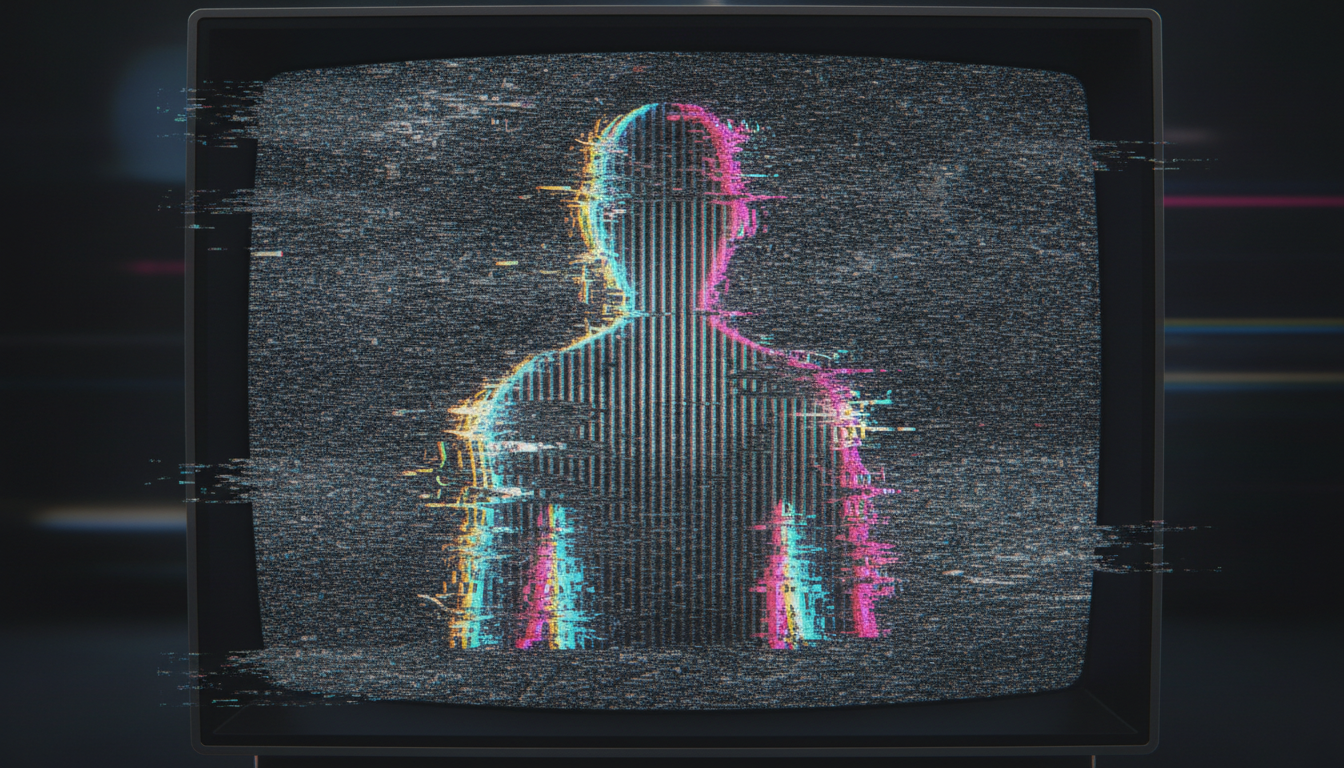
On the night of 22 November 1987, two Chicago television stations lost their own pictures to a figure in a Max Headroom mask. The first hit struck WGN-TV during the sports block of the Nine O'Clock News; the second, about two hours later, rode WTTW in the middle of a Doctor Who serial. Engineers described a microwave overpower of studio-to-transmitter links. The Federal Communications Commission opened a willful-interference investigation. Off-air recordings survive. What does not survive, nearly four decades later, is a charged defendant. The Archive tension is not whether the airwaves were seized. It is how a documented dual-station intrusion hardened into folklore while the docket stayed blank.
The Night on Two Transmitters
At about 9:14 p.m. Central Time, WGN's sports segment cut to roughly twenty-five seconds of a masked figure jerking in front of corrugated metal. Audio on that hit was a buzz, not speech. WGN engineers at Bradley Place changed the frequency of the studio-to-transmitter link feeding the John Hancock Center and recovered the newscast. Sportscaster Dan Roan returned on air saying he did not know what that was.
Around 11:15 p.m., WTTW's Doctor Who episode Horror of Fang Rock gave way to the same mask—this time with distorted speech for on the order of ninety seconds. A Pepsi can, a swipe at a WGN sportscaster, and a flyswatter gag closed the pirate segment. WTTW's transmitter path to the Sears Tower did not have an engineer on hand to switch frequency mid-hit. The episode resumed when the pirate stopped. Same-day and next-day wire copy treated both interruptions as one Chicago night, not two unrelated myths.
UPI Archives — 23 Nov 1987 same-day wire: https://www.upi.com/Archives/1987/11/23/A-video-pirate-struck-two-Chicago-television-stations-briefly/5688564642000/
UPI Archives — 24 Nov 1987 FCC hunt: https://www.upi.com/Archives/1987/11/24/Video-pirate-breaks-into-regular-programing/4083564728400/
Official Posture: Willful Interference
FCC Chicago spokespeople told wire reporters that witnesses were handing over tapes and that illegal interference with a licensed broadcast was a federal matter carrying civil and criminal penalties. Station engineers pointed at a stronger microwave signal aimed at the studio-to-transmitter receivers on downtown towers—the capture-effect path that lets a hotter transmitter seize a dish. That engineering reading explains two different licensees on one night and WGN's ability to kick the first hit by changing frequency. It names a method, not a person.
Willful broadcast interference was not an abstract statute that night. The Commission had just finished the 1986 HBO "Captain Midnight" satellite-uplink case, in which an identified Florida dealer was traced, charged, and sentenced. Chicago produced the opposite outcome: investigation without indictment.
UPI — Captain Midnight unmasked (23 Jul 1986): https://www.upi.com/Archives/1986/07/23/Feds-unmask-cables-Captain-Midnight/9690522475200/
UPI — Captain Midnight sentenced (27 Aug 1986): https://www.upi.com/Archives/1986/08/27/Captain-Midnight-sentenced-for-interrupting-HBO/2121525499200/
What the Wire and Later Investigators Put on Paper
Contemporaneous UPI copy records the dual-station sequence, FCC involvement, and engineer language about microwave transmitters aimed at Hancock and Sears links. Later interviews with Michael Marcus, who led Field Operations Bureau technical work on the Chicago case, describe an STL overpower assessment—high-power gear positioned with line of sight to the receive dishes—and the absence of a closed arrest file. Secondary long-form pieces and press-clipping hosts assemble that timeline; they do not convert folklore names into convictions.
VICE interview path (Marcus / technical reading): https://www.vice.com/en/article/headroom-hacker/
Doctor Who Cuttings Archive — contemporaneous clipping host: https://cuttingsarchive.org/index.php/2_channels_interrupted_to_the_Max
Captain Midnight Sibling Without Merge
John R. MacDougall's April 1986 HBO intrusion used a commercial satellite uplink to paint a protest message over premium cable. The FCC traced him; he pleaded and took a fine and probation. That identified path is the useful sibling for penalty and investigative capacity. It is not the same radio geometry as Chicago's terrestrial STL microwave hits. Preferring the HBO story as proof that "they always catch them" erases the Chicago blank docket. Preferring Chicago conspiracy captions that invent an inside-job verdict erases the HBO contrast: when the Commission had a name, it used it.
Unsolved Discipline
No federal charge, no plea, no sentenced defendant attaches to the 22 November 1987 Chicago intrusions in the open record. Internet dossiers that name civilians as "the Max Headroom pirate" remain unverified claims, not L1 identity findings. Statute-of-limitations commentary in later secondary writing is secondary to the simpler fact: the event is on tape; the perpetrator is not on a judgment. Hold named-ID folklore outside settled captions.
Why Dual Stations Matter
Hitting WGN and WTTW the same night undercuts single-insider cartoons that require employment at one licensee. Both paths used downtown tower receivers fed by microwave STLs—geometry available to anyone who could place a hot transmitter with line of sight. That does not identify a crew. It does discipline motive folklore that needs a disgruntled employee badge to work. Contemporaneous clipping hosts and wire copy keep the dual-station fact in the foreground; later identity threads often quietly drop it.
Penalty Frame Without a Defendant
Wire quotes in late November 1987 put six-figure fine and jail exposure on the table for willful interference. Those numbers describe statutory risk, not a sentence served. The HBO case shows what a completed FCC path looked like when investigators had a name and an uplink facility. Chicago shows what an incomplete path looks like when they did not. Collapsing the two into "the FCC never tries" or "they always know who" both fail the paper.
Myth Care
Frame as a documented dual-station signal intrusion investigated as willful interference. Refuse overclaims that any specific living civilian has been "proven" as the hijacker without charging paper. Refuse collapsing HBO satellite uplink geometry into WGN/WTTW STL microwave geometry. Refuse treating comedy-mask folklore as a substitute for the FCC and station engineering record.
What the Paper Trail Settles
Settled on the wires and station accounts: two Chicago licensees lost air on 22 November 1987 to a Max Headroom-masked pirate; engineers and the FCC described studio-to-transmitter microwave overpower; off-air recordings exist; no charged perpetrator appears in the open docket. Overclaim to refuse: solved-identity captions built from anonymous internet naming.
Officials called it illegal interference. The tapes show the mask. The file never produced a name the courts would own. Max Headroom in Chicago is that unfinished federal case—read with the UPI wires and the Captain Midnight contrast open.