
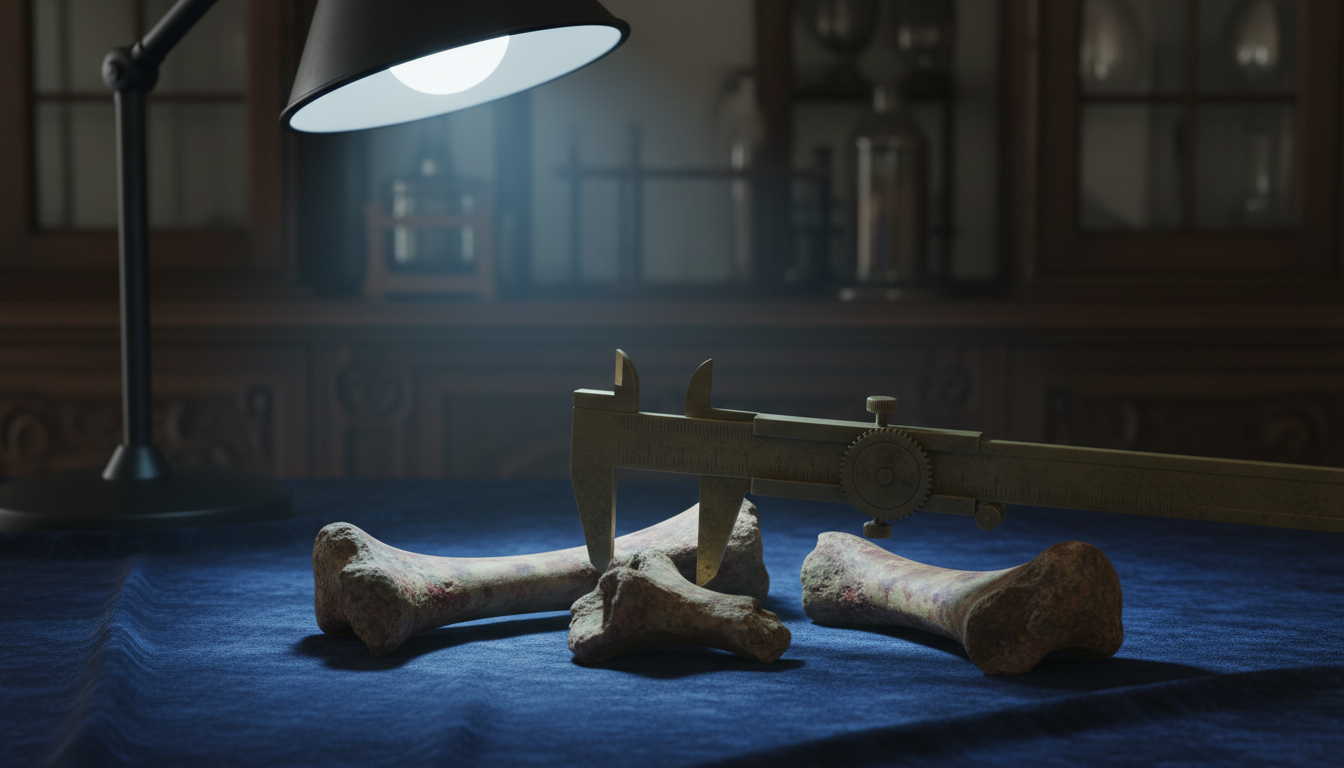
In December 1912, at an Ordinary General Meeting of the Geological Society of London, solicitor and amateur antiquarian Charles Dawson and Arthur Smith Woodward, Keeper of Geology at the British Museum (Natural History), announced a fossil they said bridged ape and human. The pieces came from Pleistocene gravel at Barkham Manor, near Piltdown in East Sussex. They named the creature Eoanthropus dawsoni—Dawson’s dawn-man. A thick human-like cranial vault sat beside an ape-like jaw with teeth worn, they argued, in a human pattern. For decades the composite held textbook space as an early British ancestor. In 1953 the same museum tradition that had curated the story dismantled it. In 2016 a Natural History Museum–linked restudy in Royal Society Open Science pointed again at Dawson as the likely primary forger. This file is documented scientific fraud with a museum paper trail—not paleocontact folklore, and not a secret-society novel.
1912: The Geological Society Announcement
Dawson had written Woodward claiming skull fragments from the Piltdown gravel. Joint digging produced more cranial pieces, a mandible with molars, animal fossils, and flints stained the same dark brown as the local deposit. Woodward reconstructed a mosaic skull. Nature’s 19 December 1912 notice treated the Geological Society presentation as the most important paleolithic human find yet made in England, citing the Ouse terrace gravel near Piltdown Common and the characters of extreme antiquity. The Geological Society’s later exhibition framing of John Cooke’s 1915 painting Discussion on the Piltdown Skull still marks 18 December 1912 as the night the claim entered institutional memory.
NHM library overview: https://www.nhm.ac.uk/our-science/services/library/collections/piltdown-man.html.
Nature 1912 notice: https://www.nature.com/articles/090438a0.
Geological Society exhibition: https://www.geolsoc.org.uk/the-library/online-exhibitions/the-societys-portrait-and-bust-collection/discussion-on-the-piltdown-skull-1915/.
Why the Mosaic Stuck
Britain wanted an ancestral fossil of its own while continental Europe produced Neanderthals and other deep finds. Museum prestige amplified the wish. Access to the original specimens was tightly controlled; few outsiders handled the bones. The package looked like what many expected a “missing link” to look like: big braincase first, ape jaw retained. That incentive stack—national hunger plus institutional authority—explains decades of textbook endurance better than any cabal memo. Dawson later reported a second locality, Piltdown II, with further fragments and a molar. After his death in 1916, no comparable haul appeared.
Doubts Before the Break
Anatomists had worried from early on that one individual could not own both vault and jaw. Comparative work elsewhere—Africa and Asia yielding clearer early-human lineages—made Piltdown’s mosaic look stranger with each decade. As Java, Zhoukoudian, and later African specimens entered the frame, a Sussex “dawn-man” with a modern-looking vault and an orangutan-grade mandible looked less like a missing link and more like a category error waiting for a chemical test. Dating skepticism grew among specialists denied free access to the originals. Still, prestige inertia kept the name in print until fluorine methods matured inside the museum itself.
Piltdown II complicated the story without resolving it. A second scatter of fragments and a molar, tied to Dawson’s later claims, seemed to confirm the type was not a one-gravel accident. After 1916 the second site produced nothing further. That silence mattered later, when forensic consistency across both localities argued for a single working method rather than many independent discoverers.
1953: Weiner, Oakley, Le Gros Clark
Museum geologist Kenneth Oakley’s fluorine tests showed the remains were far younger than the half-million-year story required. Joseph Weiner and Wilfrid Le Gros Clark joined him. Their 1953 Bulletin of the British Museum (Natural History) geology paper, The Solution of the Piltdown Problem—still catalogued in the NHM Archives CalmView—laid out the fraud: artificial abrasion on teeth, chemical staining to match gravel, nitrogen and fluorine results incompatible with a single ancient individual, and a mandible that belonged with an ape, almost certainly an orangutan, while the cranial vault was human. Microscopic file marks on the teeth finished the case. The museum that had hosted the announcement published the exposure.
NHM CalmView — 1953 Solution record: https://www.nhm.ac.uk/CalmView/Record.aspx?id=DF%2FPUB%2F512%2F7%2F1&src=CalmView.Catalog.
2016: DNA, CT, and a Single Working Method
A century after Dawson’s death, Isabelle De Groote and colleagues, including NHM human-origins researcher Chris Stringer, re-examined the assemblage with DNA, high-resolution CT, spectroscopy, and virtual anthropology. Royal Society Open Science published the open-access paper in August 2016. The team concluded that a single orangutan specimen and at least two human specimens—possibly medieval—had been assembled into the fake. Gravel plugs, the same putty, consistent staining, and matching DNA across Piltdown I and II teeth pointed to one forger’s hand. NHM’s Discover news summarized the finding: Charles Dawson is the likely fraudster; whether he acted entirely alone remains uncertain, but he is the only person documented at both pretended sites, and no further finds followed his death. Do not treat co-conspirator lists as settled fact on this page.
RSOS De Groote et al. 2016: https://royalsocietypublishing.org/doi/10.1098/rsos.160328.
NHM Discover 2016: https://www.nhm.ac.uk/discover/news/2016/august/piltdown-man-charles-dawson-likely-fraudster.html.
Fraud Anatomy, Not Alien Bleed
Piltdown is planted composite anatomy under prestige pressure. Shinichi Fujimura’s later Japanese Paleolithic planting scandal is a sibling in documented archaeological fraud—cameras and association reviews instead of fluorine and CT—not a clone and not a warrant for sneering at every dig. What this file refuses is bleed into ancient-astronaut captions or “science always lies” slogans. Settled for documentary purposes: 1912 Geological Society announcement of Eoanthropus; decades of textbook status under NHM curation; 1953 museum-bulletin exposure of staining, filing, and composite forgery; 2016 RSOS/NHM multi-method attribution leaning on Dawson as primary hoaxer. Still open as cultural history: exact motive, and whether any other hand ever helped. Those open questions do not reopen the fossils as genuine ancestors.
The tension that remains is institutional. Officials and keepers wanted an English dawn-man. Chemical tests and then genomics closed the wish. Piltdown is that closure—read with the NHM, Nature, Geological Society, and RSOS doors open, and with the fraud kept on the museum timeline where it belongs.