

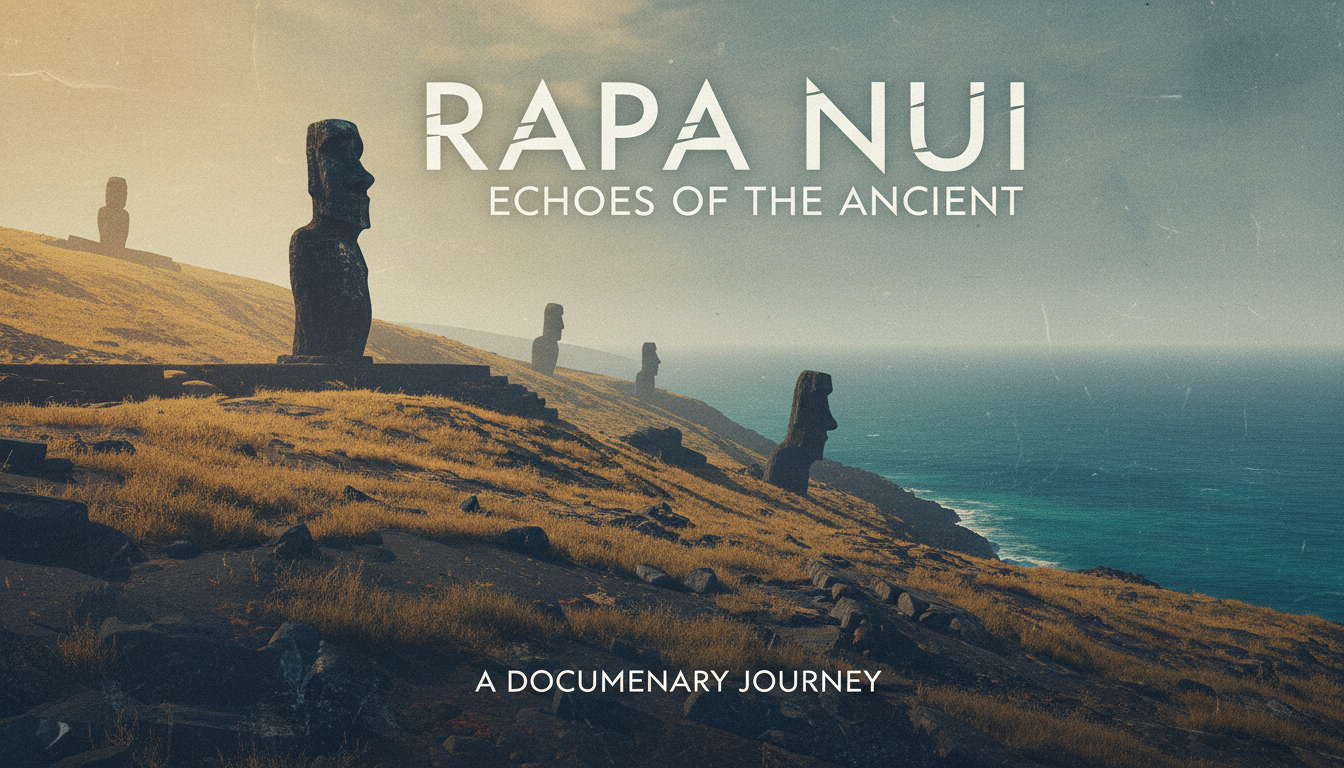
Rapa Nui—Easter Island—enters global folklore as a parable: a people who cut every palm to move stone giants, wrecked their ecology, and collapsed into war and cannibalism before Europeans arrived. Jared Diamond’s Collapse gave that story its widest audience. Archaeologists Terry Hunt, Carl Lipo, and collaborators have spent two decades arguing that the parable misorders cause and timing: deforestation involved introduced Polynesian rats as well as people; statue transport did not require total forest suicide; populations show resilience and rock-garden agriculture; the demographic catastrophe tracks European contact, disease, and slave raiding more than a pre-1722 self-destruction. UNESCO lists Rapa Nui National Park as World Heritage List 715 for the ceremonial landscape of moai and ahu. This file holds that contested peer fight on a documented island. It refuses alien or Lemurian builders for the statues.
Landscape, Moai, Park
The World Heritage property covers the volcanic island’s ceremonial centers, quarry zones such as Rano Raraku, and the wider cultural landscape of platforms and roads. ICOMOS evaluation and Centre listing language treat the monumental sculpture tradition as Polynesian achievement inside a fragile isolated ecology. That heritage frame does not settle the ecocide debate; it keeps the stones and the landscape under international and Chilean/Rapanui custody while scholars argue about pollen cores, rat gnaw marks, and radiocarbon chronologies.
UNESCO List 715: https://whc.unesco.org/en/list/715/.
ICOMOS Advisory Body Evaluation: https://whc.unesco.org/en/documents/154090.
Settlement chronology itself is contested. Older models placed first landfall near 800 CE and left centuries for population boom and forest wipeout. Short chronology arguments, including work associated with Hunt and colleagues, push substantial colonization closer to 1200 CE, compressing the timeline available for a drawn-out ecocide drama. Palm pollen collapse still happened; what it means for social “collapse” is the fight.
Ecocide Parable Versus Revision
Diamond’s popular synthesis gathered earlier academic collapse themes—deforestation for canoe and roller timber, soil exhaustion, bird loss, warfare, and a sudden demographic crash before Dutch landfall in 1722—into a moral for global environmental politics. The narrative is powerful because the island is small enough to feel like a laboratory and the moai are photogenic enough to stand in for hubris. Power is not the same as settled stratigraphy.
Hunt’s American Scientist essay and the Hunt & Lipo “Revisiting Rapa Nui Ecocide” paper reverse key causal arrows. Rattus exulans, arriving with Polynesian settlers, preyed on palm nuts and seedlings at scales that could halt forest regeneration even without every tree felled for statue sledges. Experimental and ethnohistoric work on “walking” moai with ropes reduces the assumed timber budget for transport. Lithic mulch gardens and coastal resource use read as adaptation, not a people too foolish to farm. Demographic collapse, in this framing, clusters after contact: Old World disease, Peruvian slave raids, and mission-era disruption, not a cannibal free-for-all in 1680 invented to moralize the twentieth century.
American Scientist Hunt PDF: https://www.americanscientist.org/sites/americanscientist.org/files/20068795334_646.pdf.
UH ScholarSpace Hunt & Lipo: https://scholarspace.manoa.hawaii.edu/server/api/core/bitstreams/b2ea5fcd-9601-4468-8c58-f816dc60961f/content.
Binghamton “Triumph of the Commons”: https://orb.binghamton.edu/cgi/viewcontent.cgi?article=1053&context=anthropology_fac.
Frontiers’ 2016 integrative overview by Rull and colleagues maps pollen, climate, and cultural phases without forcing readers to pick a slogan on page one. It records both the ecocide tradition (Flenley, Bahn, Diamond popularization) and the contact-catastrophe / rat-deforestation counter-tradition. That survey posture matches a contested clearance: both research programs publish; neither owns the island’s entire paleoecological archive alone.
Frontiers overview: https://www.frontiersin.org/journals/ecology-and-evolution/articles/10.3389/fevo.2016.00029/full.
Pre-contact social stress is not erased by rejecting cartoon ecocide. Deforestation, bird extinctions, and resource limits remain on the table as real ecological history. The contested claim is whether those stresses produced a societal collapse that left only a ruined remnant for Roggeveen to pity, or whether Rapanui communities were still coherent monumental and agricultural actors until external violence and disease broke them. Living scholars on both sides deserve citation without internet caricature: Diamond as popular synthesizer of a collapse school; Hunt and Lipo as field archaeologists pressing rats, chronology, and contact.
Field programs associated with Hunt and Lipo have also tested statue transport experimentally and mapped road segments that fit upright “walking” better than horizontal log-roller fantasies that consume imaginary forests. Rock gardens—lithic mulch concentrating moisture and nutrients—appear as engineered responses to poor soils rather than as proof of a people who forgot how to farm. None of that erases palm loss; it reframes agency. A society that redesigned agriculture while carving and moving moai is harder to cast as a single-note suicide parable, which is precisely why the contested clearance stays contested rather than flipping to a smug reverse sermon.
Refuse Alien Moai
Ancient-astronaut and lost-white-civilization captions treat moai as too heavy or too refined for Polynesian makers. Quarry tool marks, unfinished statues in Rano Raraku, road segments, and oral traditions of walking statues already answer that folklore inside Pacific archaeology. Contested ecological history is not an invitation to reassign authorship to extraterrestrials. Wonder at multi-ton tuff figures on a tiny island is allowed. Wonder that needs starfarers to raise them is not.
What Contested Holds
Held as contested: whether Rapa Nui’s signature lesson is pre-contact ecocide or resilience undone mainly after European arrival; how heavily rats versus humans drove palm loss; how large pre-contact populations grew. Settled enough for documentary purposes: the island’s monumental landscape is UNESCO-listed Polynesian heritage; peer literature actively disputes Diamond’s parable; Hunt/Lipo and survey papers are primary doors for the revisionist and integrative sides. Alien builders remain folklore. Rapa Nui beyond ecocide is a live archaeological argument—read with UNESCO, American Scientist, ScholarSpace, Frontiers, and Binghamton doors open, and with starfarer captions left off the ahu.